The data and analysis in this post are drawn from Dakota's GP Stakes: From a Niche to Mainstream report, powered entirely by Dakota Marketplace, the global private markets intelligence platform used by thousands of investment professionals to research LPs, GPs, and private companies. Built by fundraisers for fundraisers, Dakota Marketplace delivers complete, accurate, and daily-updated intelligence across every allocator channel, from family offices and RIAs to sovereign wealth funds and public pensions. Learn More | Book a Demo
GP stakes has spent the better part of two decades as an institutional-only strategy. The structural barriers were real: illiquid fund formats, long investment horizons, and the need to underwrite management company economics rather than fund portfolios.
Those barriers are coming down.
The semi-liquid evergreen universe is projected to surpass $1 trillion within five years, and GP stakes are among the strategies best positioned to benefit.
In this article, we'll discuss why GP stakes are a natural fit for the wealth channel, what vehicles now exist to access it, and what RIAs need to understand before adding it to client portfolios.
The Strategy Was Built for This Moment
Most alternative strategies that enter the wealth channel do so awkwardly. They're designed for institutional investors with long lockups and irregular distributions, and the semi-liquid wrapper is an afterthought. GP stakes is different. The underlying economics map almost perfectly to what wealth channel clients need.
It generates current income. Unlike most private equity strategies, GP stakes produces quarterly income through management fee distributions from day one. There is little to no J-curve. For clients with yield requirements — retirees, endowments, insurance companies — that's a meaningful structural advantage over a traditional PE fund that may return no cash for three to five years.
It holds up in down markets. Management fees are contractual, not mark-to-market. A PE firm with $20 billion in committed capital earns its fee base whether the S&P is up or down. That low correlation to public markets is a genuine portfolio construction advantage for RIAs managing through volatility.
The positions don't need to be force-sold. GP stakes investments are long-duration and not self-liquidating, which means there is no inherent pressure to sell and new investors can be onboarded continuously. That makes the strategy structurally compatible with evergreen and semi-liquid vehicles in a way that most PE strategies are not.
It captures a secular tailwind. Alternatives AUM is forecasted to grow significantly over the next decade. Owning management company economics is a leveraged long on that growth: as a portfolio manager raises successive, larger funds, the management fee base grows with it. A firm that manages $5 billion today and grows to $15 billion over a decade has tripled its fee revenue without any change in fee rates.
Where RIAs Can Actually Get Access Right Now
Access to GP stakes through the wealth channel is still early, but the infrastructure is being built. The table below shows the current access points.
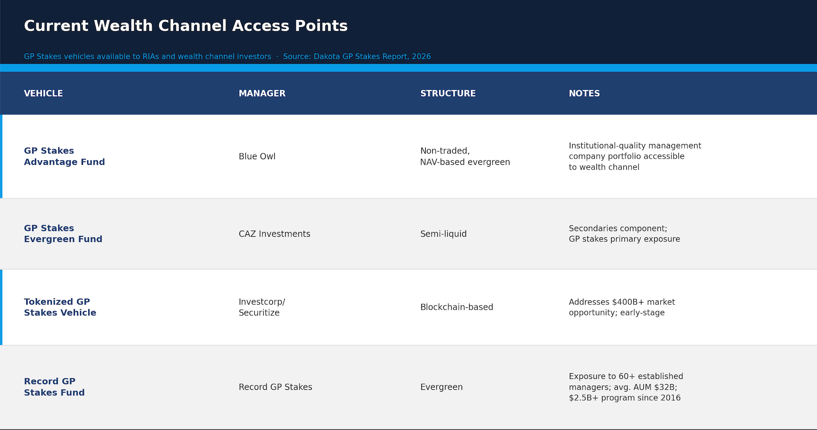
The platforms building wealth channel products today will have a meaningful head start. Expect product development to accelerate in 2026 and 2027 as more managers build distribution infrastructure for advisors and their clients.
The Conversation You'll Have With Clients
The educational challenge for RIAs is real. GP stakes requires clients to think about owning the management company rather than the fund, which is a different mental model than most private markets exposure they've encountered. The framing that tends to work: "owning the toll booth, not the road."
A few positioning principles that hold up in practice:
- Lead with the income story. Quarterly management fee distributions are tangible and easy to explain. Most clients understand the concept of owning a recurring revenue stream better than they understand carried interest mechanics. Start there.
- Use the low-correlation argument for portfolio construction conversations. For RIAs managing risk across a full portfolio, the contractual, non-mark-to-market nature of management fees is a genuine differentiator from equities and most other alternative strategies. It belongs in the portfolio construction conversation, not just the alternatives allocation conversation.
- Address the illiquidity question directly. Semi-liquid evergreen vehicles have redemption mechanisms, but clients should understand these are long-duration positions. The "no forced selling" characteristic that makes GP stakes structurally attractive is also why liquidity windows are measured in quarters, not days.
- Distinguish GP stakes from PE fund investing. Clients who have had negative experiences with PE fund lockups and J-curves may conflate the two. The differences are material: current income from day one, no J-curve, lower public market correlation, and diversification across dozens of managers and strategies through a single vehicle.
Want to research which GP stakes platforms are active in your segment? Dakota Marketplace tracks the platforms, their portfolio managers, and the allocators behind them. Book a demo to see what's available.
Before You Put It in a Portfolio
GP stakes is a proven strategy at the institutional level. According to McKinsey's LP survey, 43% of LPs currently invest in GP stakes funds. Blue Owl has a decade-long track record: GP Stakes Fund III delivered a 3.00x net return and 21.6% net IRR, built steadily over a decade without a single binary exit event driving the outcome. Sovereign wealth funds are co-investing directly alongside dedicated platforms.
The wealth channel is earlier in that curve, but the strategy itself is not experimental. A few things RIAs should assess before allocating:
- Manager selection matters. The difference between a top-performing and median GP stakes fund is significant. Evaluate the platform's track record, the quality of its existing portfolio companies, and whether it has genuine strategic value-add to offer GPs beyond a check.
- Understand the fee structure. GP stakes vehicles carry fees at two levels: the management fee and carry charged by the GP stakes fund itself, and the underlying management fees earned by portfolio managers. Understand how those stack before recommending to clients.
- Know what you're buying in an evergreen wrapper. NAV-based evergreen vehicles smooth returns and provide liquidity windows, but they also introduce pricing lag. The underlying management company valuations move more slowly than public markets, which is part of the low-correlation story but also means NAV may not reflect sharp moves in either direction immediately.
- The market is still maturing. Put rights from 2016-2020 vintage deals are beginning to vest, and the next few years will test exit mechanisms that haven't been stress-tested at scale. That's not a reason to avoid the strategy, but it's context worth having.
Start Calling on the Allocators Behind These Vehicles
GP stakes is moving into the wealth channel, and the RIAs and family offices that get there early will have the most to gain. Dakota Marketplace tracks the institutional investors, family offices, and RIA platforms allocating to private markets strategies, including GP stakes vehicles. If you're mapping the wealth channel opportunity for your fund, book a demo to see what's available.