In This Report
-
Mechanics & Structure — how GP stakes deals work, the economics an investor owns, and what a typical transaction looks like.
-
Market Evolution — how the strategy grew from a 2007 niche into a mainstream private-markets allocation.
-
Market Landscape — the dominant platforms, mid-market specialists, and new entrants, mapped by scale and strategy.
-
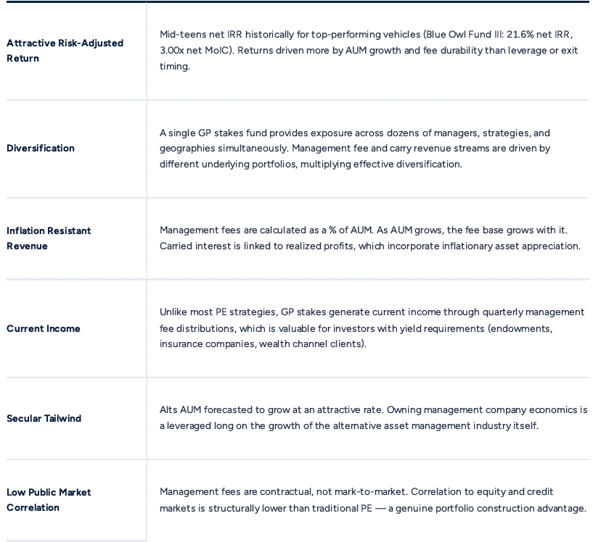
Investment Rationale — why GPs sell stakes and the case for LPs investing in them.
-
Performance — how returns are generated, and how they compare to traditional private equity.
-
Distribution & Outlook — the wealth-channel opportunity, GP seeding, and where the market is heading.
Executive Summary
GP stakes — acquiring minority equity interests in alternative asset management firms — has quickly evolved from a niche institutional curiosity into a central strategy within private markets. According to Campbell Lutyens, M&A transaction volume jumped 40% in 2025, signaling growth in appetite for investing in GP stakes.
Via buying into a management company rather than a fund, a GP stakes investor captures contractual management fee income, carried interest upside, and in some cases co-investment economics. This is all tied to the long-duration growth of the alternatives industry itself. Owning the fee-generating infrastructure of that growth is a fundamentally different risk proposition than betting on any single fund's performance.
Several themes define the market as it matures. Target GP profiles have broadened significantly, with middle-market managers now the most active cohort. Sovereigns from the Gulf are co-investing directly. European platforms are emerging. The wealth channel is beginning to access the strategy through evergreen and semi-liquid vehicles.
Key Takeaways
01 — This is a proven strategy, not an emerging one.
According to McKinsey's LP survey, 43% of LPs currently invest in GP Stakes funds. Blue Owl has a decade-long track record. Sovereign wealth funds are investing directly alongside dedicated platforms. The question for wealth channel clients is not whether this works, but how to get access.
02 — You own the fee stream, not the fund.
When a GP stakes investor buys into a management company, they receive a share of management fees every quarter, regardless of what markets are doing. As the manager grows and raises larger funds over time, those fees grow with it. That is why Blue Owl Fund III delivered a 3.00x net return with no J-curve dip, while the typical 2016 vintage PE fund returned 1.84x and made investors wait years before seeing any cash back.
03 — The best opportunities are in the middle market.
The early deals in this space were with household names like Silver Lake and Vista Equity. Today the most activity is with middle market managers running $2–10 billion, who face a tougher fundraising environment and have the most to gain from a GP stakes partner.
04 — The wealth channel is just getting started.
Semi-liquid funds are finally making this strategy accessible to advisors and their clients. It fits naturally, as the positions generate income, hold up well in down markets, and do not need to be force-sold. The platforms building wealth channel products today will have a head start on everyone who waits.
GP Stakes Mechanics:
How It Works
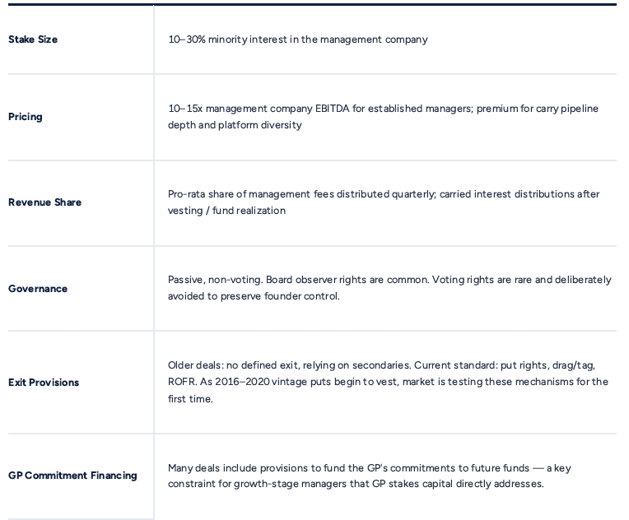
A GP stakes transaction involves an investor acquiring a minority equity interest (typically 10–30%) in an alternative asset management firm's management company. The management company is the entity that earns economics from running the funds: it collects management fees annually and receives a share of carried interest when funds are realized. Buying into the management company means becoming a co-owner of that earnings stream.
Transactions can be primary (new equity issued, proceeds go to the firm's balance sheet) or secondary (existing partners selling down). The most common structure is a combination of both, providing the GP both growth capital and founder liquidity simultaneously.
LP vs. GP Economics
An LP invests capital into a fund and earns returns on that capital. A GP stakes investor is exposed to the management company's earnings, which sit one level above:
-
Management fees — typically 1.5–2.0% of committed or invested capital, earned continuously for the life of the fund. Contractual, not performance-contingent, and paid by LPs regardless of public market conditions.
-
Carried interest — the GP's profit share (typically 20% above a hurdle rate). Performance-contingent but represents significant upside for well-run franchises compounding over decades.
-
Balance sheet / co-investment return — some structures also provide pro-rata exposure to the GP's own fund co-investments, adding direct performance linkage.
The critical insight: management fees are not correlated with public market cycles. A PE firm with $20 billion in committed capital earns its fee base whether the S&P is up or down. This is the foundation of the low-correlation, inflation-resistant argument for GP stakes.
Typical Deal Structure
History: Market Evolution
2007 - 2010
GP stakes as an institutional strategy traces back to 2007, when Goldman Sachs Asset Management launched Petershill with an initial focus on hedge fund managers. Dyal Capital Partners followed in 2010, spinning out of Neuberger Berman with a sharper focus on private equity managers and the thesis that large, durable PE platforms were essentially perpetual fee machines worth owning directly. These two firms spent the better part of a decade building the category largely in the dark — most institutional investors had never heard of the strategy, and the universe of willing GPs was still limited to those with genuine succession or liquidity needs.
2016 - 2022
The 2016–2022 period was when the market broke open. Dyal's Fund III vintage established the category's benchmark portfolio — Silver Lake, Vista Equity, Sixth Street, Cerberus, Starwood, KPS — and demonstrated that GP stakes could work across PE, credit, real estate, and European managers simultaneously. Blackstone launched its Strategic Partners effort. Bonaccord was founded. Hunter Point was formed by ex-Goldman professionals in 2021, the same year Dyal merged with Owl Rock to form Blue Owl and go public on the NYSE, and Petershill listed on the London Stock Exchange. By the end of this period the strategy had gone from niche to mainstream, and every major alternative manager knew what a GP stakes conversation looked like.
Since 2022
Since 2022 the market has matured and broadened. Blue Owl raised GP Stakes V at $12.8 billion, the largest fund ever in the category, while the center of gravity shifted toward the middle market — managers under $10 billion in AUM who face a harder fundraising environment and have more to gain from a strategic partner. A new wave of platforms launched in 2024 and 2025, most founded by veterans of the established firms. Sovereign wealth funds moved from passive LPs to direct co-investors. And the wealth channel began accessing the strategy for the first time through evergreen and semi-liquid vehicles. According to Campbell Lutyens, M&A volume jumped 40% in 2025, signaling growth in appetite for investing in GP stakes.
Market Landscape
The Dominant Platforms
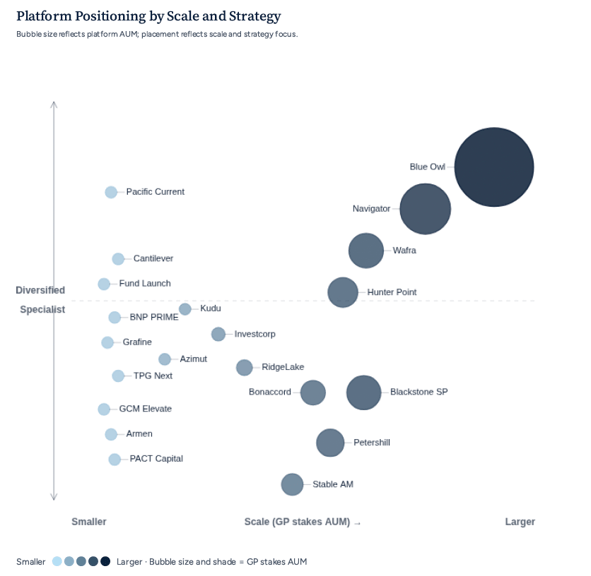
The GP stakes market has a clear structure. A handful of large, established platforms dominate deal flow and have built portfolios that define the category. Below them sits a growing tier of mid-market specialists with distinct mandates and target profiles. And a new wave of entrants — most founded in the last two years by veterans of the established firms — is filling out the bottom of the market.
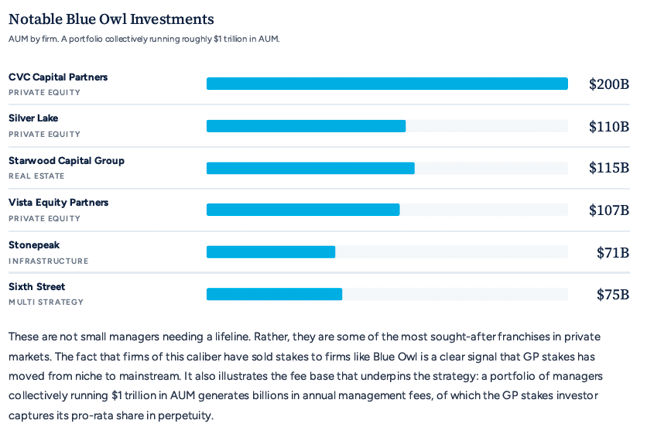
Blue Owl, Petershill, and Blackstone Strategic Partners built the category and still account for the majority of capital deployed. With roughly $75 billion in platform AUM and 35+ active investments, Blue Owl is the largest dedicated GP stakes platform in the world. What started as Dyal Capital Partners in 2010 — a Neuberger Berman spin-out — merged with Owl Rock in 2021 and went public on the NYSE. The portfolio reflects fifteen years of compounding: early Vintage 2016 anchors like Silver Lake, Vista Equity, Sixth Street, and Starwood Capital are now among the largest alternative managers in the world, having grown 3–5x in AUM since Blue Owl first invested. Later vintages added HPS, Golub Capital, Stonepeak, CVC, and Ardian. The table below illustrates some of the top managers Blue Owl has backed.
Notable Blue Owl Investments
Notable Platform AUM Footprint
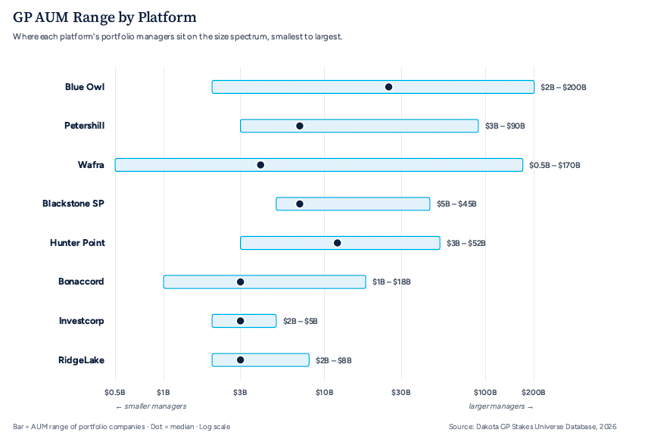 Petershill has been at this longer than anyone, deploying capital since 2007. Its four funds have backed names across PE, credit, hedge funds, and venture — Permira, Clearlake, Francisco Partners, Accel-KKR, and most recently Millennium Management in a roughly $2 billion deal, the largest single GP stakes transaction on record. Blackstone's Strategic Partners operates more selectively, functioning as a co-investor and opportunistic participant rather than a standalone platform at the scale of the top two.
Mid-Market & New Entrants
Established Mid-Market Platforms
Below the top tier sits a group of well-capitalized platforms that have each carved out a distinct lane. Hunter Point Capital, founded in 2021 by former Goldman Sachs professionals, closed its inaugural fund at $2 billion in March 2024 and is now deploying its second. The portfolio spans PE, credit, infrastructure, and secondaries — L Catterton, Inflexion, Coller Capital, Pretium Partners, and Equitix. Hunter Point has brought in Abu Dhabi sovereign wealth as a co-investor on select deals, adding a distribution and relationship dimension that pure-play financial buyers cannot offer.
Bonaccord Capital Partners, part of publicly listed P10, has raised two funds totaling roughly $3 billion with a deliberate focus on managers under $10 billion in AUM, which is the cohort most underserved by the top-tier platforms. Its portfolio includes Revelstoke Capital Partners, Kayne Anderson Private Credit, Park Square Capital, and Synova. Wafra, backed by Kuwait's sovereign wealth fund, is the most connected player in the market: it shows up as a lead investor and coinvestor across more deals than almost any other platform, and its Capital Constellation joint venture has been seeding and backing emerging managers for over a decade. Investcorp's Strategic Capital Group has quietly built a 12- investment portfolio across two dedicated funds, focused on the mid-market PE and credit universe.
New Entrants and Specialists
Since 2024, a cohort of new platforms has launched, most founded by veterans of the established firms. PACT Capital Partners was founded in 2025 by Christian von Schimmelmann, formerly of Petershill, and has made early investments in Graham Partners and Accel-KKR. Grafine Partners is building a European-focused portfolio. Cantilever Group, backed by BTG Pactual, is targeting the US mid-market. GCM Grosvenor's Elevate Fund, which closed at $800 million in January 2025, is one of the few platforms explicitly focused on seeding diverse and emerging managers. TPG's Next platform also is involved in GP seeding.
The Competitive Map
Investment Rationale
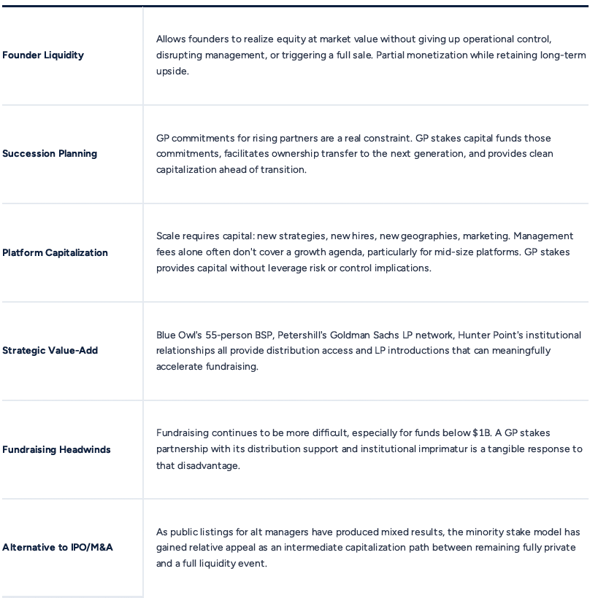
Why GPs Sell Stakes
Investment Thesis for LPs
Performance
Return Mechanics
GP stakes and traditional private equity are both private markets strategies, but they generate returns through fundamentally different mechanisms. Understanding that difference matters more than comparing headline IRR numbers. A GP stakes fund acquires minority interests in management companies. Returns come from three sources that are structurally different from PE:
-
Management fees begin flowing almost immediately after investment. A GP with $10 billion in AUM charging a 1.5% management fee generates $150 million annually, of which the GP stakes investor receives its pro-rata share. These fees are contractual, not performance-contingent, and continue regardless of whether the underlying fund is marked up or down. There is little to no J-curve, as the investment is generating yield from day 1.
-
Carried interest is where the upside lives. As the underlying funds mature and portfolio companies are realized, the GP earns carry (typically 20% of profits above a hurdle rate) and the GP stakes investor participates pro-rata. This is the lumpy, long-duration component that can be significant but takes years to materialize.
-
AUM growth is the compounding engine. As a portfolio manager raises successive, larger funds, the management fee base grows with it. A firm that manages $5 billion today and grows to $15 billion over a decade has tripled its fee revenue without any change in fee rates. The GP stakes investor participates in that growth in perpetuity, not just for a fixed fund life.
GP Stakes vs. Private Equity
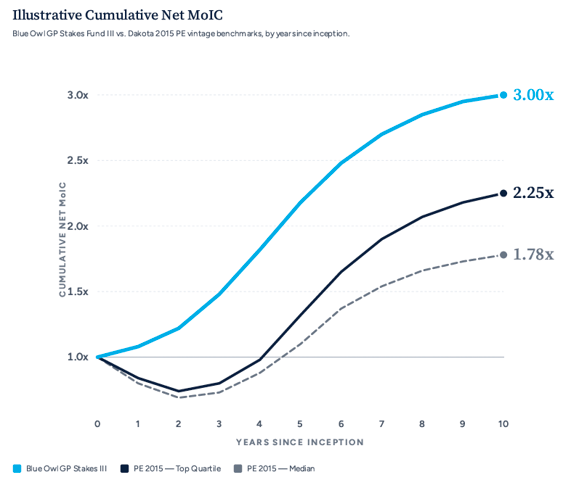 Blue Owl GP Stakes III illustrates this cleanly. Against $3.3 billion invested, the fund has returned $4.6 billion in realized proceeds with $5.3 billion still sitting unrealized in the portfolio. The 3.00x net MoIC and 21.6% net IRR were built over a decade, steadily, without a single binary exit event driving the outcome. That is a meaningfully different experience for an LP than waiting for a PE fund's realization window to open.
Benchmark data: Dakota 2015 vintage PE benchmark (top quartile: 2.25x TVPI; median: 1.78x TVPI). Blue Owl GP Stakes Fund III terminal values sourced from Blue Owl Capital investor materials (3.00x net MoIC, 21.6% net IRR). J-curve shape and return timing are illustrative only and do not represent the actual return path of any specific fund. Past performance is not indicative of future results.
Distribution
GP Stakes in the Wealth Channel
The wealth channel represents the largest pool of largely untapped capital in private markets — and GP stakes may be among the strategies best suited to accessing it. The historical barriers were structural: illiquid funds, long investment horizons, and the need to underwrite management company economics rather than fund portfolios. These fit institutions well but made wealth channel access difficult.
The semi-liquid evergreen universe is projected to surpass $1 trillion within five years. GP stakes fits naturally: positions are long-duration, cash-generative, and not self-liquidating, which means there is no inherent pressure to sell and new investors can be onboarded continuously.
RIA Positioning
For RIA and family office clients, GP stakes offers attributes that map directly to wealth channel investment priorities: current income from management fee distributions, low correlation to public equities, inflation-resistant economics, and private markets exposure through a fundamentally different lens than fund investing. The educational challenge is real, but the "owning the toll booth, not the road" framing resonates with sophisticated clients.
Adjacent Strategy
GP Seeding
GP seeding is a distinct but adjacent strategy: providing launch capital to first-time or emerging managers in exchange for a revenue share or equity stake. The risk-return profile is fundamentally different from GP stakes in established platforms. A seed investment in a $200M first-time fund carries performance uncertainty, LP base development risk, and operational risk that a GP stakes investment in a $20B manager does not.
The line between the two strategies has blurred. Capital Constellation has backed managers from launch through institutional growth. Blue Owl/Lunate's mid-market JV targets GPs under $10B in AUM, some of which are earlier stage. TPG Next blends seed capital and GP stakes. What unifies both ends of the spectrum is the same principle: the management company, not the fund, is the asset.
Key Seeding Platforms
-
Capital Constellation (Wafra JV) — Most active seeding program in alternatives; Gen I–IV deployments including Ara Partners, Motive Partners, Broad Sky Partners, Thompson Street, Citation Capital, Niobrara Capital, and Gallatin Point Capital.
-
GCM Grosvenor Elevate — $800M fund; blend of seeding and GP stakes; focus on diverse/emerging managers (Excolere Equity, Invidia Capital, Matter Real Estate).
-
TPG Next — Seed capital + GP stakes + operational support; Cohere Capital and Ardabell Capital among investments.
-
Fund Launch Partners — Stage-agnostic platform providing seed capital and launch infrastructure; Optimist Ventures, Ollin Ventures, Enclosure Energy.
-
Capricorn Investment Group (Sustainable Investors Fund) — Impact-oriented; backs emerging managers in sustainability and energy transition.
Looking Ahead
Market Outlook
The pipeline for GP stakes transactions is deep and shows no sign of slowing. Middle-market managers are facing a fundraising environment where most LP capital flows to a handful of large established funds, leaving smaller managers structurally disadvantaged. First-generation founders are approaching succession decisions. Growth-stage platforms need capital to hire, expand into new strategies, and fund their own GP commitments. These are durable, structural pressures, and the universe of managers who have never done a GP stakes transaction is still vast. Volume should remain elevated.
The more interesting near-term question is what happens on the exit side. Put rights from deals done between 2016 and 2020 are beginning to vest, and the next two to three years will test whether the liquidity mechanisms built into those transactions actually work as intended. Resolution will happen through a mix of buy-backs, secondary market sales, and negotiated extensions — and however it plays out, it will shape how both investors and GPs think about deal terms going forward. As Akin Gump noted in its 2026 GP stakes outlook, the market should expect further innovation in balancing investors' need for liquidity against GPs' preference for stable ownership structures.
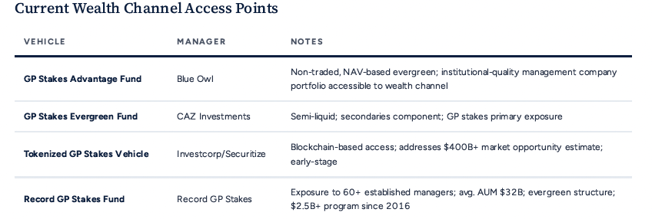
The wealth channel is the longer-term growth story. Semi-liquid and evergreen vehicles are expanding rapidly, and GP stakes is a natural fit for that format, since the underlying positions are cash-generative, long-duration, and don't require forced selling. Blue Owl's Advantage Fund, CAZ Investments' evergreen vehicle, and Investcorp's tokenized structure through Securitize are early entrants. Expect meaningful product development in 2026 and 2027 as more platforms build distribution infrastructure for wealth advisors and their clients.
Geographically, the next wave of activity will come from Europe and Asia-Pacific. European GPs (particularly in private credit and mid-market buyout) are becoming more receptive to GP stakes conversations, and dedicated platforms including Armen, Grafine Partners, and BNP Paribas AM Prime Capital Partners are actively building European portfolios. APAC GP interest is even higher, with 90% of surveyed managers in the region indicating they would consider a stake sale in the next 24 months.
One meaningful risk to watch: as more capital chases a finite pool of attractive managers, entry multiples are rising and the best GPs are negotiating harder on terms. Platforms that bring genuine value beyond a check will continue to win the best deals. Those that compete on price alone will find forward returns compressing.
About This Report
This report was built entirely on data from Dakota Marketplace — the most comprehensive private markets database designed for the institutional investment community. Every allocation figure, consultant relationship, CIO transition, and performance data point was researched and verified by Dakota's 60-plus person data team. For further insights, visit dakota.com.
Dakota Marketplace
Dakota Marketplace is a database of LPs, GPs, Private Companies and Public Companies used by fundraising teams and deal sourcing teams to both raise money as well source investment opportunities. Over 1,300 global investment firms use Dakota daily.