This post compares Dakota's MCP Server and API, two ways to access data from Dakota Marketplace, the global private markets intelligence platform used by thousands of investment professionals to research LPs, GPs, and private companies. Built by fundraisers for fundraisers, Dakota Marketplace delivers complete, accurate, and daily-updated intelligence across every allocator channel, from family offices and RIAs to sovereign wealth funds and public pensions. Learn More | Book a Demo
For investment sales teams, getting Dakota Marketplace data into the tools you actually work in, whether that's a CRM, a dashboard, or an AI assistant like Claude or ChatGPT, is what turns a database into a daily workflow.
There are two ways to do it: an API or an MCP. Both connect you to the same Dakota Marketplace data… they just do it for different kinds of users.
This post walks through what an API is, what an MCP is, how they differ, and how to decide which one is right for your team.
What’s the Difference Between an API and MCP?
An API, or application programming interface, is the structured way two software systems talk to each other through code, giving technical teams full programmatic control over how data flows between platforms.
An MCP, or Model Context Protocol, is an open standard created by Anthropic that sits on top of an existing API and lets anyone connect an AI assistant to live data and get answers in plain English, with no code required.
Both are good at their respective jobs. APIs give technical teams total control; MCPs give everyone else direct access. The two are complementary, not competing.
What an API Is
Behind every CRM integration, every real-time dashboard, and every automated data feed in a modern investment firm is an API. The mechanics are simple: your platform sends a request, and the receiving system sends back the exact data that was asked for, in a clean, structured format your software can read and act on.
When Dakota Marketplace data shows up inside Salesforce, HubSpot, Backstop, DealCloud, Microsoft Dynamics, Dynamo, or Snowflake, an API is what's moving the data between the two systems in real time.
What APIs are good for:
- Custom integrations. A technical team can connect Dakota data to any proprietary platform, internal tool, or CRM.
- Live dashboards. Marketplace updates flow into a CRM in real time, so the data the team sees is always current.
- Custom alerts. When a specific record, firm, or data point changes, the system fires a notification.
- Programmatic workflows. Any process that needs the data on a schedule, in bulk, or transformed in a particular way runs through the API.
What APIs require: a developer. APIs are built and maintained by engineers who know how to write code that handles authentication, query construction, response parsing, and error handling. For a team with engineering resources, that's a feature, not a bug. The API gives total flexibility and control over how Dakota Marketplace data flows into the systems the team already uses, which is one of the reasons APIs sit at the core of any modern investment firm's tech stack.
What an MCP Is
An MCP server sits on top of an existing API. It uses the same underlying data the API has access to, but it makes that data accessible to anyone through natural language instead of code.
The shift MCP introduces: no developer required. Anyone on a team can connect Claude, ChatGPT, Gemini, or any compatible AI assistant to an MCP server and start asking questions in plain English.
What MCPs are good for:
- Ad-hoc research. A fundraiser asks the AI assistant "show me all endowments in the Northeast that invest in private equity" and gets the answer in seconds.
- Working inside an AI tool. Once the data is returned, the user can draft outreach, create follow-up tasks, or feed the results into other prompts, all in the same chat window.
- Speed. Setup takes under two minutes, and queries return answers in seconds.
- Access for non-technical users. Sales teams, fundraisers, and operations people get direct access to the data without filing a request with engineering.
What MCPs require: an AI assistant and an MCP server. That's the entire stack. The AI assistant handles the natural-language interpretation; the MCP server handles the connection to the underlying data. This is what makes embedded data the future of investment research: the data sits where the work is happening, instead of in a separate tab the user has to switch into.
Side By Side
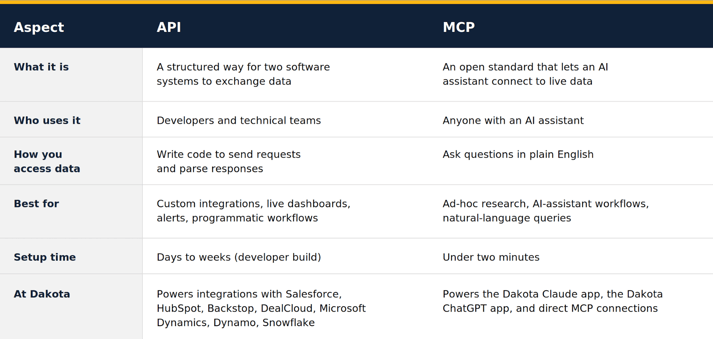
They’re Not Alternatives, They’re Layers
The most common misconception is that MCP is a replacement for an API. It isn't. An MCP server sits on top of an API; the API is doing the actual work of moving the data. What MCP changes is the interface, not the plumbing.
That distinction matters for two reasons. First, it explains why MCPs exist at all. Building an MCP server requires an API underneath; the API does the heavy lifting on data access, authentication, and permissions, and the MCP layer adds the natural-language interpretation on top.
Second, it explains why APIs aren't going anywhere. Every MCP query is, behind the scenes, an API call. The customer-facing experience changes, but the underlying technology stack is still built on APIs. For teams running custom integrations, real-time dashboards, or alert systems inside their CRM, the API remains the right tool. For teams that want a fundraiser to be able to ask a natural-language question and get an immediate answer, the MCP is the right tool. Most investment firms will end up using both.
Which One Should Your Team Use?
There are a few practical guidelines to look at.
You’ll want to use an API if your team has engineering resources and wants Dakota Marketplace data flowing into a proprietary system, a custom dashboard, or a CRM in a very specific way. APIs give total control over how the data is shaped, when it's pulled, and where it lands.
Use an MCP if your team wants fundraisers, sales reps, or operations people to query Dakota Marketplace data directly through Claude, ChatGPT, or another AI assistant, without involving engineering. MCPs are the path of least resistance for natural-language access, and they're where the AI sweet spot in investment intelligence lives right now: fast, ad-hoc, low-friction queries against verified data.
Use both if the team has a technical group running custom integrations and a fundraising or sales group that lives inside AI tools. The same Dakota Marketplace data is accessible through both paths, governed by the same package-based permissions, so there's no conflict between the two.
To see what each looks like in practice with your own queries, book a demo of Dakota Marketplace.