A Growing, Fragmented Market
Switzerland has served as a private-wealth hub for centuries. Private banks such as Pictet (1805) and Lombard Odier (1796) predate most of the industrial fortunes they now manage. Political neutrality and a culture of discretion established the country as the leading custodian of European family wealth, and many of the operating-company holding structures built generations ago are the family offices fundraisers work with today. That base is also broadening: families from Asia and other regions increasingly establish a presence in Switzerland to gain a stable, neutral platform for managing wealth across borders.
Dakota Marketplace tracks over 330 Swiss family offices, with balance sheets ranging from under $500M to institutional-scale platforms above $10B. Swiss single family office assets have grown roughly 30% since 2023, per University of St. Gallen FO report.
Zurich and Geneva are the two largest hubs, each with more than 90 family offices; Zug is the preferred domicile for holding structures; Basel is home to pharmaceutical and chemical wealth; and Lausanne and Lugano serve the Lake Geneva region and Ticino's Italian-speaking clientele. Swiss family offices are not a single, uniform allocator segment. The capital is substantial, but it is fragmented across cantons, languages, and structures, and the market operates on a private, relationship-driven basis.
Understanding The Landscape
Fundraisers typically encounter five recurring structures: single family offices, which serve one family; multi-family offices, which serve several unrelated families; entrepreneurial holding companies built around an operating business; foundation-linked organizations that route wealth through a charitable or industrial foundation; and bank- or adviser-connected offices, which operate independently but remain structurally tied to a bank or OCIO adviser.
Who influences the decision
-
The principal or family member(s) with ultimate decision-making authority, and the CIO or investment director who leads diligence
-
External advisers, OCIO providers, and the private bank(s) holding custody
-
A board or investment committee, for larger or foundation-linked structures
-
Investment teams are typically small, and many offices remain led by the first or second generation, so the principal is often the primary point of contact
What Allocators Look For
-
Alignment with the family's history, sector background, or values, and trust established over time rather than at a single meeting
-
Downside protection and capital preservation, prioritized over benchmark-beating returns
-
Co-investment rights and direct access alongside a fund commitment
-
Long-term relationships that extend across a generational transition
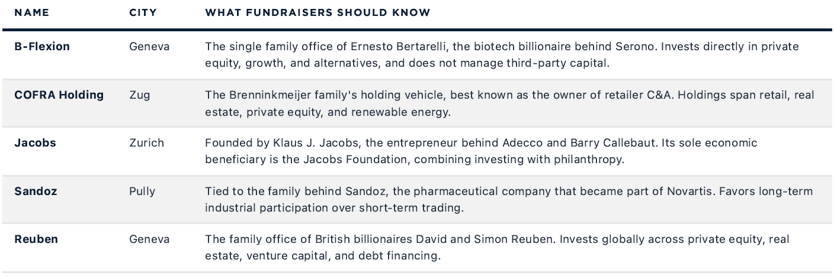
Notable Swiss Family Offices
Investment Style and Asset Allocation
-
Portfolios generally combine traditional holdings, public equities and fixed income, with a meaningful allocation to alternatives such as private equity, real estate, and hedge funds
-
Allocations vary significantly by family, from cash-heavy to concentrated in a single alternative asset class, depending on the family's operating business, time horizon, and risk tolerance
-
Capital preservation, rather than return maximization, drives most mandates
-
Some families have shifted from venture capital toward developed-market public equities following the private-market valuation reset, though private equity remains a core holding
-
Geographic exposure centers on Switzerland, North America, and Western Europe, reflecting existing relationships and familiar deal-sourcing networks
-
Cash is often held as strategic reserve capital, available to support the family business or act on an opportunity
Private banks play a central role in this market. Dakota Marketplace tracks 68 Swiss private banks, including Pictet, Julius Baer, Lombard Odier, Vontobel, and J. Safra Sarasin. A bank-advised family and a bank-linked family office are distinct arrangements, and identifying which applies to a given prospect informs both the pitch and the appropriate point of contact.
The Bottom Line
Switzerland's family office market is large, growing, and increasingly well documented, but it remains private, fragmented, and relationship-driven. The most effective fundraising approach treats it as a segmented set of structures and decision-makers rather than a single addressable list, and establishes the profile and the relationship before making the ask.
Key Takeaways For Fundraisers
-
Define the target profile first: structure type, mandate, strategy fit, check size, and source of wealth
-
Segment the market rather than treating it as one group; a single family office and a multi-family office require different outreach
-
Identify the actual decision maker, along with the advisers and banks around them
-
Prioritize active allocation signals over static, unverified lists
-
Use personalized, relationship-led outreach, and track follow-up over an extended cultivation cycle
How Dakota Can Help Fundraisers
-
Identifies family offices, across every structure type, that actively allocate to outside managers
-
Surfaces the relevant decision makers and their stated investment preferences
-
Tags each account across 75+ investment-preference fields, updated daily
-
Helps teams prioritize the strongest-fit prospects and build a repeatable, team-wide coverage process
Dakota Marketplace
Dakota is a financial, software, data and media company based in Philadelphia, PA. Dakota's flagship product, Dakota Marketplace, is a database of LPs, GPs, Private Companies and Public Companies used by thousands of fundraising, deal, and investment teams worldwide to raise capital, source deals, track peers, and access comprehensive data—all in one global platform.
For more information visit dakota.com