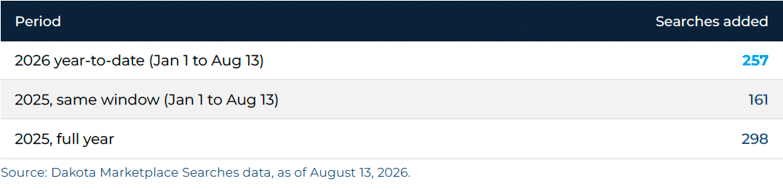
Allocators have posted 257 institutional manager searches so far in 2026 (January 1 through August 13), against 161 over the same window last year. That is a 60% jump, and it has already reached 86% of everything logged in all of 2025 with more than four months of the year still to run.

The rise is not evenly spread. Private markets now account for the majority of search activity, public pension funds dominate the pipeline, and the fastest-growing category is the least glamorous one: annual commitment pacing plans. Here is what the search data shows, why it is happening, and what it means for fund managers deciding where to spend their next quarter of raising.
Data: Dakota Marketplace Searches, as of August 13, 2026.
The Data
Two framings matter. On a like-for-like calendar basis, 2026 is running well ahead of 2025. On a full-year basis, 2026 is on pace to clear last year comfortably.
Breaking the pipeline down by source shows where the growth is concentrated. Public-Online covers live, RFP-style searches published by allocators and consultants; Pension Brief covers the commitment pacing plans that public plans set each year across their private markets sleeves.

Where the growth is concentrated
Both channels grew, but pacing-plan activity nearly doubled year-on-year and has already passed its entire 2025 total in eight months. Live searches rose 44% over the same window. The read for fund managers: more allocators are publishing formal intent to commit, and they are doing it earlier and more systematically than a year ago.
The asset-class mix has also shifted. Because a single search can span multiple asset classes, the figures below count searches touching each class and are shares of total searches, not mutually exclusive slices.
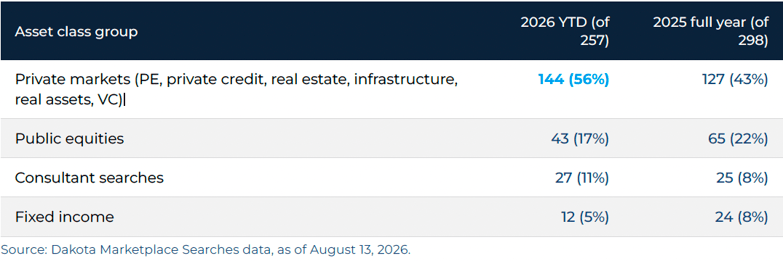
Private markets went from under half of search activity to well over half in twelve months. Public equities and fixed income shrank as a share of the pipeline. If you raise for a private strategy, the addressable search volume is growing faster than the market as a whole.
1. Private Markets Now Own the Pipeline (56% of Searches)
Private markets appear in 144 of 257 searches this year, up from 43% of activity in 2025 to 56%. Private equity, private credit, real estate, and infrastructure carry most of that weight.
The allocation data lines up with the search data. Dakota's Q2 2025 Institutional Allocations Report found public pensions committed $64.3 billion to private markets in the quarter, a 22% increase over Q1, with private equity leading at $26.3 billion and private credit at $14.8 billion.
Why the tilt is holding
For fund managers, the practical point is that the searches are there, and they are specific. Generic "alternatives" mandates are rare. Allocators are hiring against named sleeves.
2. The Pacing-Plan Surge (Up 83% Year-on-Year)
The single fastest-growing category is commitment pacing plans. Pension Brief searches climbed from 58 in the first eight months of 2025 to 106 in the same window of 2026, and have already exceeded the full-year 2025 count of 104.
This is a signal about behavior, not just volume. Roughly 62% of global pension funds were over their private equity allocation targets at the end of June 2025, according to S&P Global Market Intelligence, and plans are responding with disciplined pacing models that factor lower expected distributions into their commitment schedules.
Source: S&P Global Market Intelligence, cited March 2026.
Why it matters
-
Pacing plans are forward calendars. They tell you a plan's intended commitment size and asset-class split before the individual searches are written.
-
More plans publishing pacing plans means earlier visibility into demand, sometimes a full year ahead.
-
Pacing discipline favors managers already in the plan's pipeline, because re-ups are the default deployment tool.
If you can map a plan's to you fund's timing, you are reading demand a year before your competitors see the live search.
Get ahead of the live search: Pacing plans are published months before the mandates they fund. See which of your target plans have already posted theirs →
Credit, consultants, and the smaller signals
3. Private Credit Is the Liquidity Lever
Private credit runs through both the search data and the allocation reports as a core sleeve, not a satellite one. Dakota's 2025 review expects private credit to gain share in 2026 and beyond as plans lean on it to pace commitments and manage liquidity.
Source: Dakota Public Pension Private Markets Report, 2025 Review and Outlook (May 2026).
The August 2025 Public Pension Brief showed private credit leading allocations, with rising interest in real estate value-add, data infrastructure, and energy transition strategies.
Source: Dakota August 2025 Public Pension Brief (September 2025).
For credit managers, the takeaway is that direct lending, asset-based, and opportunistic credit searches are being written against a yield and liquidity mandate. Position the strategy around income durability and cash-flow predictability, because that is the job the allocator is hiring for.
4. Consultant and Emerging-Manager Searches Are Small but Rising
Consultant searches (general, private markets, and asset-class-specific advisory mandates) grew to 27 this year from 25 in all of 2025, and now make up 11% of the pipeline. Emerging-manager searches rose to 9 from 6, and impact or ESG-flagged searches to 5 from 3.
Source: Dakota Marketplace Searches data, as of August 13, 2026.
These are niche in absolute terms but each already exceeds its 2025 full-year count. Consultant searches in particular are worth tracking, because winning the consultant relationship shapes every downstream manager search that consultant touches.
Map the consultant layer: Consultant relationships shape every downstream mandate they touch. Book a demo to see consultant searches and the contacts behind them →
The Takeaway
What this means for fund managers
The search data points to a market that is more active, more private-markets-weighted, and more forward-signaled than a year ago. A few grounded implications:
-
Demand is concentrated in public pensions. The pipeline is overwhelmingly public pension funds, with a scattering of sovereign wealth funds, corporate pension investment offices, and endowments. Build your target list accordingly.
-
Re-ups are the default. With plans pacing commitments and managing liquidity, existing managers have the advantage. Getting into a pacing plan early is worth more than a strong one-off pitch.
-
Specificity wins. Searches are written against named sleeves with defined roles. Map your strategy to the exact function the allocator is filling.
How to Act on the Search Data
-
Filter searches to your strategy and geography first. Start from the 144 private-markets searches if you raise for a private fund, then narrow by sub-asset class.
-
Pull the pacing plans for your target plans. Treat them as a forward calendar and time your outreach to the commitment window, not the live search.
-
Prioritize plans where you already have a relationship. Re-ups are the deployment default, so warm pipelines convert faster than cold ones.
-
Track consultant searches in your asset class. The consultant relationship shapes multiple downstream mandates.
-
Watch the emerging-manager and impact flags if either fits your positioning, since both are growing off a small base.
-
Set alerts. The pipeline is moving faster than last year, and the edge is in seeing a search the day it posts, not the week after.
Find the allocators behind the searches
Dakota Marketplace tracks institutional manager searches, RFPs, and pacing plans as they post, alongside 1,493 US public pension accounts and daily-updated contacts (coverage as of January 2026).
Filter live searches by asset class, allocator type, and search status, then connect directly to the decision-makers running each mandate. If you are raising for a private strategy in 2026, this is where the demand is being published first.
See the live search pipeline. Every figure in this report is filterable in Dakota Marketplace, down to the contacts running each mandate.
Book a demo »