Executive Summary
The perpetual strategies market has grown from $46 billion to $505 billion over the past decade, a 27% annualized growth rate driven by structural demand, per Blackstone. Today, 252 registered vehicles hold $431 billion in AUM, and new filings are running at more than one per business day.
Three forces are compounding: a $150 trillion wealth channel with almost no private markets exposure, regulatory reforms in the U.S. and Europe making access easier, and distribution infrastructure that has finally scaled. A proposed DOL safe-harbor rule puts U.S. defined-contribution plans, $12.2 trillion with effectively zero allocation to private markets, on a 2 to 3 year path to opening.
This report covers what the perpetual strategies market looks like today, where the capital sits, how the math works, who is building these products, and what the data says about returns and risks.
What Is an Evergreen Fund?
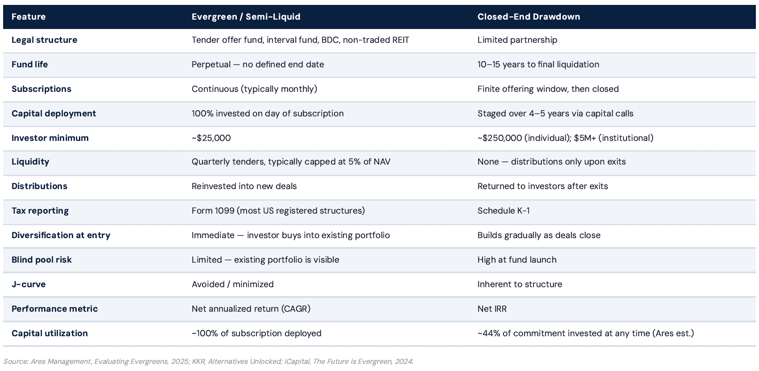
An evergreen fund is an open-ended investment vehicle with no fixed end date. Investors subscribe monthly at the fund's current net asset value. When the fund sells an asset, the money is reinvested rather than returned to investors. Each quarter, investors can request to exit, but the fund caps total redemptions at 5% of assets in any given quarter. The fund keeps running indefinitely.
In the U.S., most of these funds are registered under the Investment Company Act of 1940 as interval funds or tender offer funds. Non-traded BDCs and non-traded REITs follow the same open-ended logic but are specific to private credit and real estate respectively. The terms semi-liquid, perpetual-life, and evergreen are used interchangeably in practice. They all describe the same basic idea: private markets exposure in a wrapper investors can get into and out of without waiting ten years.
Structure Comparison: Evergreen vs. Drawdown
Three Forces Driving the Shift
Force 1: The Wealth Channel Is Enormous and Underallocated
Apollo puts the total addressable market for individual investors at roughly $150 trillion. Family offices already put about half their portfolios into private markets. High net worth investors put in around 5%. Mass affluent investors put in almost nothing. The gap is not lack of interest. It is lack of access.
Force 2: Regulation Is Opening the Door
Regulators in Europe and the U.S. have spent the past two years making it easier to put private market assets into retail and retirement wrappers. In January 2024, Europe's updated ELTIF rules dropped the minimum investment from €10,000 to zero, opened the product to retail investors, and expanded the eligible asset universe. The U.K. did the same for defined-contribution pensions through the Long-Term Asset Fund regime. In the U.S., an August 2025 executive order directed agencies to expand retirement plan access to alternatives, and the Department of Labor followed in March 2026 with a proposed safe-harbor rule for 401(k) plan sponsors.
Force 3: Distribution Infrastructure Has Finally Scaled
Five years ago, launching an evergreen was the easy part. Selling it was the problem. Most wirehouses had no process for alternatives on their platforms. RIA custodians required custom diligence for every new product. iCapital, CAIS, and similar platforms have changed this. They now serve thousands of RIAs and advisors, handle compliance and documentation centrally, and have built NAV calculation and subscription workflows that make the operational burden manageable at scale.
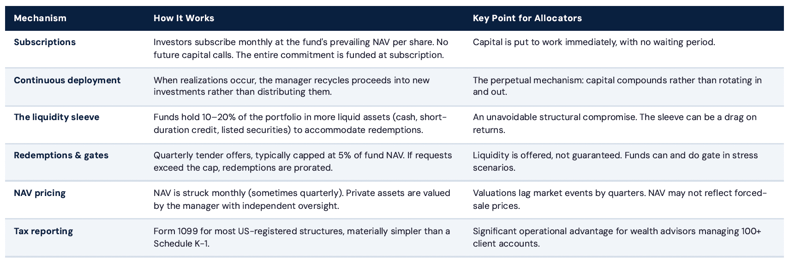
How Evergreens Actually Work: The Mechanics
The mechanics matter for anyone evaluating a fund and for anyone thinking about launching one.
The Math: Why IRR and CAGR Are Not Directly Comparable
Drawdown funds report returns as an IRR. Evergreen funds report returns as a CAGR. These are not the same thing, and comparing them directly leads to bad decisions. The difference comes down to one question: when was the money actually at work?
Same Headline Return, Different Dollar Outcome
A clean illustration: $100 invested at a 15% return over 10 years.

Both funds would advertise a 15% return. Neither is lying. But the drawdown investor ends up with $216 while the evergreen investor ends up with $405. The gap comes from two places: uncalled capital sitting in cash during the ramp-up period, and distributions returning to the investor rather than staying in the fund to compound.
The Capital Utilization Gap
In a drawdown fund, you commit $1 million but the manager calls it gradually, typically over four to five years. During that period, the money sitting in your account earns whatever your cash rate is, not the fund's return. Industry research estimates that across a typical drawdown fund's life, only about 44% of committed capital is actually invested at any given moment.
In an evergreen, your money goes to work on the day you subscribe. The fund holds a small cash buffer, typically 10 to 20 percent, to cover redemptions, but the rest is invested from the start.
Multiple on Committed Capital (MOCC)
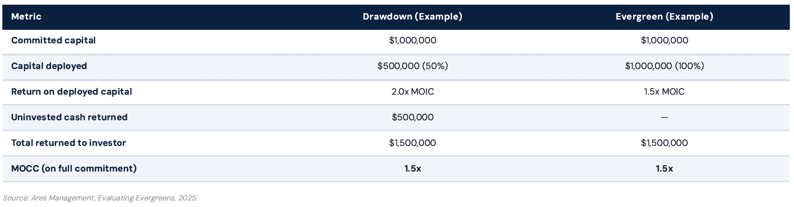
A more useful comparison is Multiple on Committed Capital (MOCC) rather than the standard Multiple on Invested Capital (MOIC). A fund that calls half your commitment and doubles it reports a 2.0x MOIC. But you only received 1.5x what you put in. That is the number that matters to a real investor.
Breakeven Analysis: What IRR Equals What CAGR?
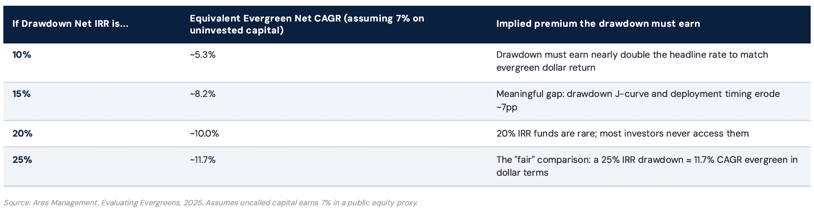
The breakeven analysis makes this concrete. If uninvested capital earns 7% in public equities while waiting to be called, a drawdown fund needs to generate a 25% IRR to produce the same dollars as an evergreen running at 14.8% CAGR. Most drawdown funds do not clear that bar.
Where Evergreens Fit in a Portfolio
One useful way to think about where evergreens fit: split a private markets allocation into a core and a satellite.
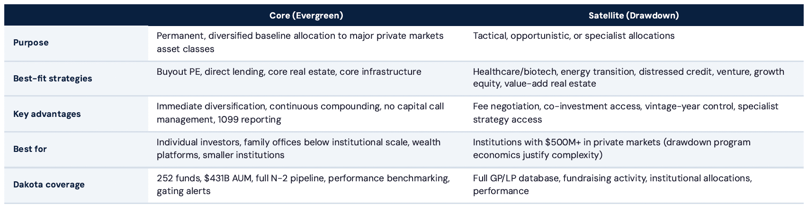
Most large allocators use both. Evergreens go in the core — a permanent position in buyout PE, direct lending, and core real estate. Drawdowns go in the satellite: specialist mandates where vintage control, co-investment access, or GP relationships matter more than liquidity.
The Market Landscape
Market Sizing and Growth
According to Blackstone, perpetual fund AUM for individual investors in the U.S. grew from $46 billion in Q4 2014 to $505 billion in Q4 2024, a 27 percent annualized growth rate over the decade. Global perpetual AUM across all investor types sits above $1 trillion. Dakota Marketplace tracks 252 active registered evergreen vehicles in the U.S. holding $431 billion in total net assets.
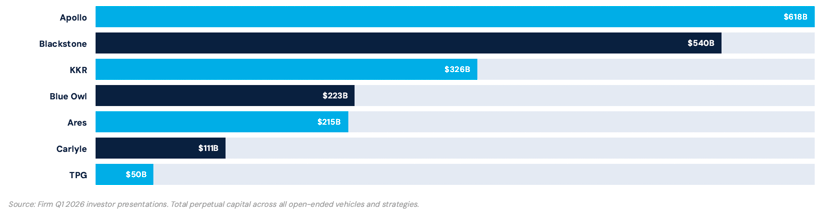
Perpetual Capital at the Largest Alternative Asset Managers
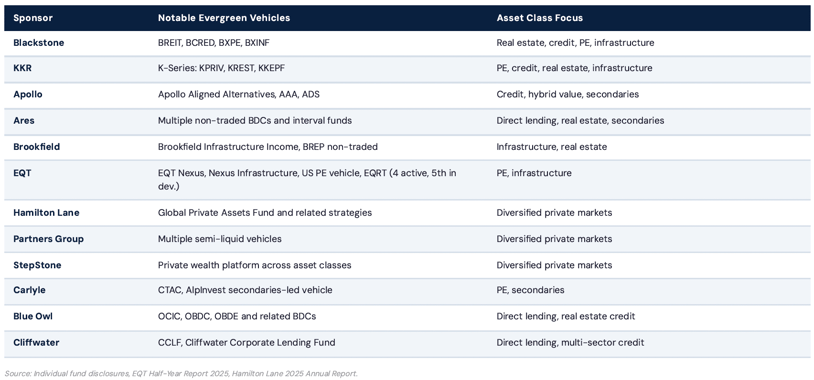
The Competitive Landscape: Major Evergreen Platforms
The largest managers dominate because scale matters for deal sourcing. A firm running $50 billion gets co-investment allocations, secondaries deal flow, and GP relationships that a $500 million fund simply cannot access. Smaller managers who want to reach wealth investors without building their own distribution platform typically work through iCapital or CAIS instead.
Where the Assets Sit
Most of the $431 billion sits in two strategies: private credit and real estate. Both produce regular income, interest payments and rent, which makes it easier to fund quarterly redemptions. Private equity returns come from selling companies, not from cash flows, which makes the math harder. Private equity evergreens exist and are growing, but they require more careful portfolio construction to manage liquidity. Private credit and real estate got there first because they suited the structure.
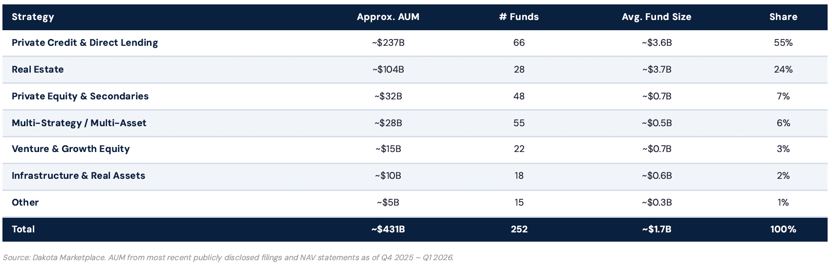
The average fund size column tells the real story. Private credit and real estate funds average around $3.6 billion each, pulled up by a small number of very large vehicles. Multi-strategy and PE funds, despite filing in volume, average under $1 billion. Most of the new launches are small. Capital is sitting with the established names.
The Largest Evergreen Funds
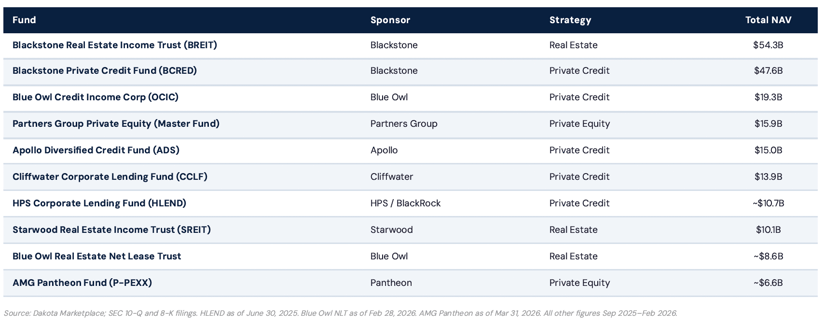
The ten largest funds hold roughly half of the $431 billion. The NAV figures below come from each fund's own filings: 10-Qs, NAV statements, and shareholder letters from September 2025 through February 2026. Where these numbers differ from figures published elsewhere, it is usually because other sources combine share classes, platform AUM, or total investments in ways that overstate the fund's actual net asset value.
Category Leaders: Who Owns Each Strategy
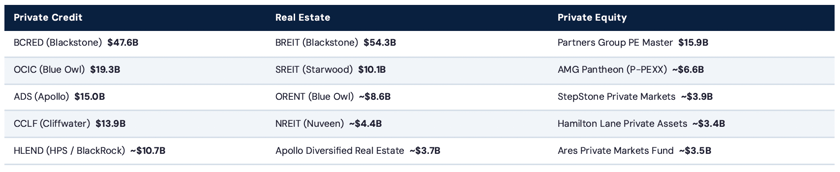
In private credit, BCRED alone holds more assets than the next four funds put together. HLEND, managed by HPS under BlackRock, has grown to roughly $10.7B. In real estate, Blue Owl's ORENT has reached $8.6B in NAV, the third largest behind BREIT and SREIT, and Apollo Diversified Real Estate sits at around $3.7B. In private equity, Partners Group leads at $15.9B, with AMG Pantheon (P-PEXX) second at $6.6B, up from under $3B three years ago.
The Launch Pace Keeps Accelerating
93 new evergreen funds were filed in 2024. 100 more in 2025. The first four months of 2026 produced 38 filings, which runs at roughly 114 per year, another 14 percent increase. At that pace, more than one new fund is being filed every business day.

Where the Growth Is Coming From
Bain estimates that institutions will account for about 75% of new private markets capital raised between 2023 and 2033, with private wealth making up the other 25%. Institutions are bigger in dollar terms. But private wealth is growing faster from a much smaller base. That is why every major alternative asset manager now runs a dedicated wealth team alongside its institutional business. Evergreens charge fees continuously, with no wind-down and no fundraising gap — steady fee revenue supports a higher stock price for publicly traded managers. EQT runs four active evergreen vehicles with a fifth in development and expects 15 to 20 percent of its current fundraising cycle to come from private wealth.
Return Dispersion
Comparing evergreen performance is messier than comparing mutual funds. NAVs are calculated on different schedules. Private asset valuations can lag market moves by a quarter or more. Funds start at different points in the cycle. To control for some of that noise, the analysis below uses a single group: 63 funds with performance data dated November 2025 in Dakota Marketplace, the largest single-date cohort available. Sample size drops at longer horizons because many funds are newer. All returns are net CAGR.
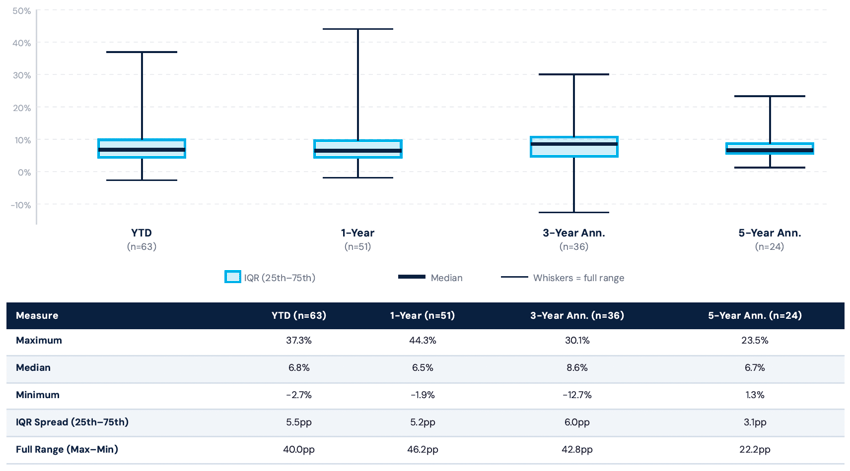
Median returns are steady: between 6.5% and 8.6% across all horizons. That is better than most investment-grade fixed income and roughly in line with what private credit and real estate fundamentals would suggest. The median is not the story, though. The spread is. Over five years, the bottom fund in this group returned 1.3% per year. The top returned 23.5%. That 22-point gap comes partly from strategy differences, but within strategies the dispersion is still wide. The negative tail in the three-year data. The worst fund in that group was down 12.7% annualized, almost entirely real estate funds whose NAVs were cut as rates rose in 2022 and 2023.
The spread means manager selection matters as much as strategy selection. A first-quartile manager beats a third-quartile manager by roughly two-to-one in the same asset class. That gap is structurally larger in evergreens than in drawdown funds: in a drawdown fund, the investor controls what happens to uncalled capital. In an evergreen, the manager controls everything, including how the cash buffer is invested. A manager who deploys slowly or lets the liquidity sleeve grow is a drag on every dollar in the fund.
The Retirement-Plan Unlock
The largest potential source of new capital for evergreen funds is not the wealth channel. It is U.S. retirement plans. In August 2025, an executive order directed federal agencies to make it easier to include private assets in defined-contribution plans. In March 2026, the Department of Labor published a proposed rule that would give plan sponsors a safe harbor from fiduciary liability if they follow a defined process when adding alternatives to a 401(k) lineup. U.S. defined-contribution plans hold $12.2 trillion with almost no private markets exposure today. A 2% shift in target-date fund allocations would bring in $244 billion, more than the entire current wealth-channel AUM base. A 5% shift would approach $610 billion. Managers have been preparing: daily NAV systems, ERISA-compliant share classes, and record-keeper integrations are already in place. The proposed rule still has to clear a comment period and final publication, and some opposition from plan trustees and consumer advocates is expected. But the direction is clear.
What Sponsors Are Bringing to Market
Before an evergreen fund can accept investor money in the U.S., it has to register with the SEC on a form called the N-2. Tracking those initial filings is the clearest way to see what sponsors are planning before they launch. Dakota captured 290 clean N-2 filings between May 2023 and April 2026, after removing amendments, duplicates, feeder funds, and re-registrations that would otherwise inflate the count.
Complete Private Market Offerings Are Gaining Traction
The key number: direct lending is only 10% of new filings even though private credit holds 55% of existing AUM. Most new launches are multi-strategy or multi-asset vehicles that bundle private equity, credit, and real assets together. The reason is simple. An advisor does not want to explain to a client why they need four different private market funds. One allocation that covers everything is an easier sell. That is what sponsors are building.
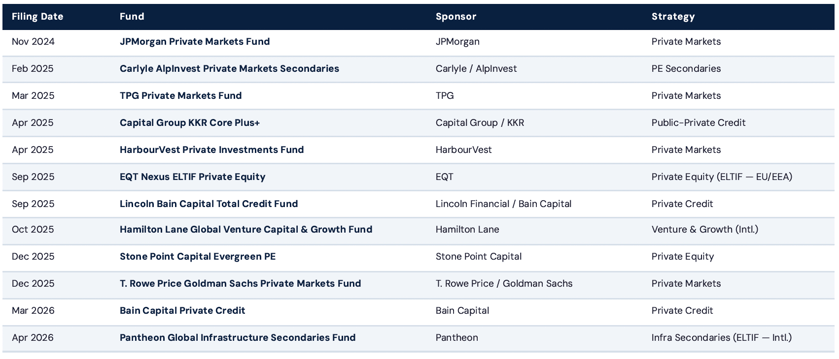
Notable Launches: 2024–2026 Vintage
Two things stand out in this vintage beyond the multi-asset trend. First, most traditional asset managers are entering through partnerships rather than building alternatives capabilities in-house. T. Rowe Price and Goldman Sachs registered a joint interval fund. Capital Group and KKR launched two public-private credit interval funds in April 2025 that drew more than $100 million within their first three months. Lincoln Financial partnered with Bain Capital. Carlyle launched CAPS with AlpInvest. Building a private markets origination network takes years, and the wealth channel is already open. A partnership gets a firm to market faster.
Inside the Portfolio: Construction and Deployment
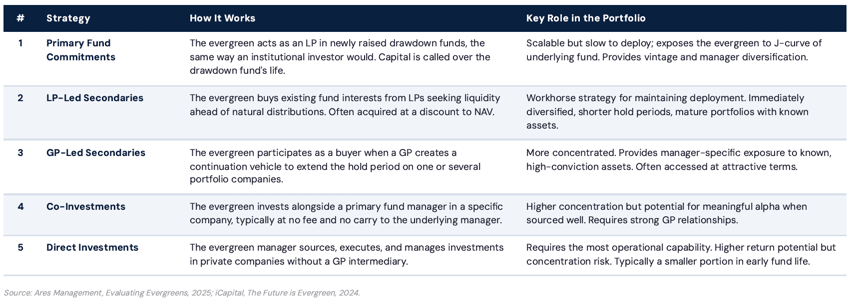
A fund sitting 20% in cash will underperform one that stays 90% deployed. Staying deployed is harder than it sounds. New subscriptions arrive monthly, redemptions need funding, and deal pipelines dry up. Managers use five approaches in combination to keep capital at work.
Inside the Portfolio: Partners Group Private Equity (Master Fund)
What does a top-performing evergreen private equity fund actually own? Partners Group launched the Master Fund in 2009, one of the first registered PE evergreen funds in the U.S. At the end of 2025 it held $15.9 billion in net assets with exposure to more than 3,000 companies. A newer fund at $500 million cannot replicate that diversification.
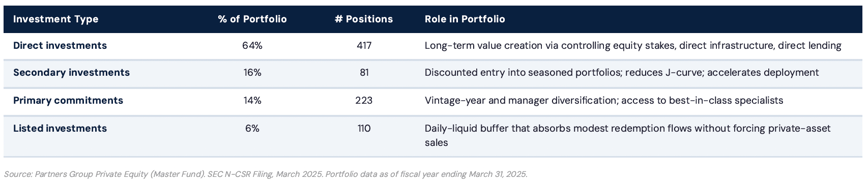
The 6% in listed equities is the most widely copied design decision in the category. Liquid positions absorb redemption requests. When investors want out, the manager sells listed stocks rather than private company stakes. The 16% in secondaries does something different: secondaries deploy capital quickly, come at a discount to NAV, and give the fund exposure to mature, known assets from day one rather than blind-pool commitments. Most new evergreen private equity funds launching today use some version of this construction: direct investments for return, secondaries for deployment speed, primaries for diversification, and a liquid sleeve for redemptions.
What the Structure Gives Up and Where It Can Break
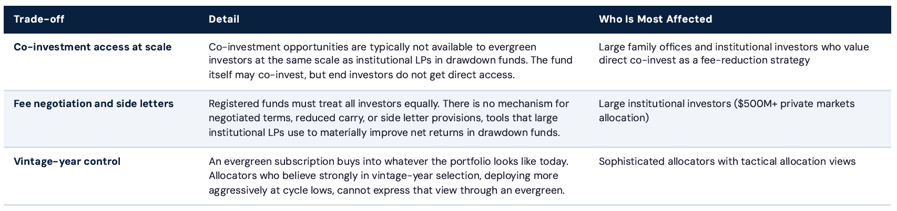
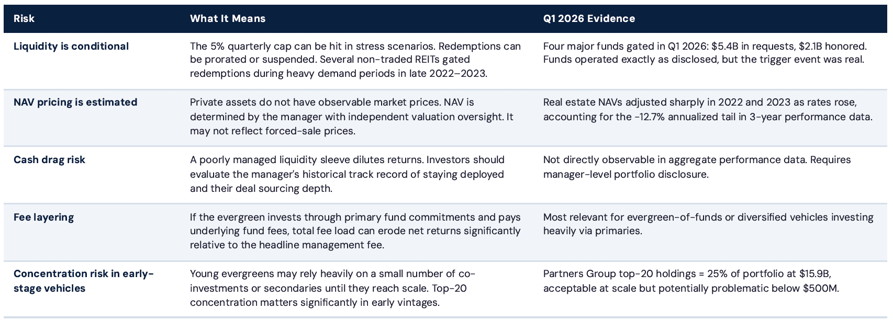
The evergreen structure genuinely helps investors who couldn't otherwise access private markets. It also introduces risks that a drawdown fund doesn't have. Both sides matter.
What Evergreens Give Up vs. Drawdowns
Structural Risks
Looking Ahead
- More managers entering, more complete solutions launching — The pace of new filings is accelerating. Large incumbents are expanding their evergreen lineups beyond single-strategy products into complete private markets solutions that bundle PE, credit, and real assets in a single vehicle. Traditional asset managers are entering through partnerships rather than building in-house, compressing the time to market significantly.
- Continued adoption across private wealth and institutional channels — Wealth channel adoption has been the growth story of the past decade, but institutional interest is accelerating too. Smaller institutions — pension funds, endowments, and insurance companies without dedicated alternatives teams — are using evergreens as an efficient entry point to private markets exposure without the operational burden of a drawdown program.
- Retirement plans are the defining catalyst to watch — The March 2026 DOL safe-harbor proposal, if finalized, opens $12.2 trillion in defined-contribution assets to private markets for the first time. The implementation timeline is 2–3 years, but managers who have built ERISA-compliant infrastructure — daily NAV systems, record-keeper integrations, compliant share classes — are already positioned.
- Distribution infrastructure evolving to meet retail demand — RIAs, broker-dealers, and wirehouse platforms are building dedicated alternatives workflows. Platforms like iCapital and CAIS have scaled the technology layer that connects fund managers to thousands of advisors. As demand from retail investors grows, distribution is becoming a core competitive differentiator — not just a sales function.
Dakota Marketplace
Dakota tracks every evergreen fund in detail — investment strategies, market sizing, manager activity, performance benchmarks, fund launches, and allocator intelligence. When a new vehicle launches, a manager shifts approach, or a category reaches scale, Dakota captures it and puts it in front of you.
Dakota is a financial, software, data and media company based in Philadelphia. Dakota Marketplace is a database of LPs, GPs, private companies, and public companies used by thousands of fundraising, deal, and investment teams worldwide to raise capital, source deals, track peers, and access comprehensive data, all in one global platform. For more information, visit dakota.com to book a demo.