For years, fund managers could treat the consultant channel as one of several distribution paths. A useful layer to cultivate, but not the whole game.
That framing no longer holds.
Today, investment consultants advise on approximately 87% of institutional private market allocations. They are not one channel among many. They are the channel through which institutional capital flows, and the firms still treating them as a complementary effort are watching their peers pull ahead.
Here's what's changed, and what fund managers need to do about it.
In this article we’ll review the data, the shifts, and how fund managers should engage.
The Numbers Tell the Story
In 2025, Dakota tracked more than 1,800 private market allocations totaling over $192 billion from U.S. pension funds alone. The vast majority routed through consultants. The concentration is even more striking: just 10 consultants advised on approximately 61% of U.S. pension fund commitments last year.
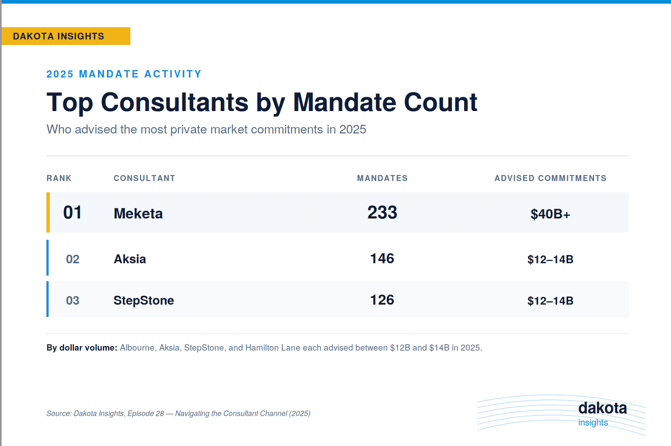
Private markets, not public equities, are now where consultants spend their time. Private equity led with 608 mandates in 2025, followed by private credit (314) and private real estate (256).
If your fundraising plan doesn't account for who covers your asset class at these firms, and where mandates are actually active, you're not running a fundraising plan. You're guessing.
Want to see who's allocating, where mandates are active, and which consultants cover your strategy? Book a demo of Dakota Marketplace.
The Channel Has Transformed
The consultant industry has changed more in the last five years than in the prior two decades. Three forces are driving the shift.
- OCIO is now the default trajectory. The U.S. OCIO market grew 16% in 2025 alone, reaching approximately $2.5 trillion in AUM. Cerulli projects it will hit $5.6 trillion by 2029 (Cerulli Associates, 2025). When a consultant moves from advisory to OCIO, the dynamic changes completely. They hold full discretionary authority over manager hiring, firing, allocation, and rebalancing. Decisions move faster. The bar gets higher.
- PE-backed consolidation is reshaping the channel. Hightower acquired a majority stake in NEPC ($1.7T+ AUA). Madison Dearborn acquired NFP Wealth including Fiducient ($382B combined). Cerity Partners acquired Verus Investments ($1.2T AUA). Mariner Institutional acquired Cardinal Investment Advisors. The mid-tier independents are thinning out. The scaled gatekeepers are getting bigger.
- Asset class specialization is deepening. Most large pension systems now retain at least two consultants: one generalist plus one or more asset class specialists. In private markets, specialists are increasingly outperforming generalists in mandate awards.
The implication is straightforward: fund managers who treat consultants as a monolithic group will struggle. The ones who segment by tier, asset class, and mandate type will win.
What Fund Managers Need to Do Differently
The firms succeeding in this channel share a few habits that the firms struggling don't.
- Start early. Consultant engagement should begin 12 to 24 months before you go to market. Database submissions, intro meetings, content touchpoints: all of it takes time, and none of it can be compressed once you're already on the road.
- Get specific about who covers what. Mercer, Aon, and Willis Towers Watson are global consulting leaders, but the person evaluating your private credit fund is not the person evaluating their public equity managers. Identify the asset class specialist. Understand their style box. Communicate your edge in one or two sentences.
- Work both directions. Reaching out to underlying institutional clients in parallel with the consultant creates independent interest that accelerates evaluation. A consultant who hears your name from their own client moves you up the queue.
- Build familiarity before the meeting. Quarterly webinars, LinkedIn insights, thought leadership: none of it replaces the meeting, but all of it shortens the path to one. The first time a consultant hears about your firm should not be in a database submission.
The Bar Is High, and Worth Clearing
Consultants assess managers across six dimensions: organization, investment team, philosophy, process, performance, and ESG integration. They run operational due diligence on back-office, compliance, cybersecurity, audit quality, and service providers. They monitor continuously after selection.
That bar isn't going down. If anything, it's rising as private markets complexity grows and regulatory scrutiny on conflicts and disclosure intensifies.
But the firms that clear the bar, and treat consultants as long-term partners rather than transactional gatekeepers, get access to the majority of institutional capital flowing into private markets. That's not a complementary channel. That's the game.
The consultant channel is becoming more concentrated, more specialized, and more discretionary. Fund managers who build their distribution strategy around that reality will continue to win mandates. The ones who don't will be left explaining why their fundraising stalled.
Map the Consultant Channel
Dakota Marketplace tracks consultants and verified contacts across global consulting leaders, large institutional consultants, private markets specialists, and OCIO providers. Filter by AUA, asset class coverage, OCIO versus advisory model, and specialist team contacts.
Engaging the consultant channel with precision starts with knowing exactly who covers what. Book a demo to see Dakota's consultant coverage.