POWERED BY DAKOTA MARKETPLACE
The research and analysis in this report are powered entirely by Dakota Marketplace, the most comprehensive private markets database built for the institutional investment community. Dakota's 60-plus person data team researched, verified, and maintained every data point referenced in these pages by hand, with real people who verify the information and update records with the rigor that institutional-grade intelligence demands. This report is the output. The database is the foundation.
Summary
Pension systems committed $84.8 billion to private markets and alternative strategies in Q1 2026, up 51% from Q4 2025's $56.1 billion. We tracked 739 commitments across 126 allocators and 574 investment strategies, with every major asset class posting higher commitment volumes than the prior quarter. The headline number requires one important footnote, however, as CalPERS committed $23.4 billion in Q1 alone, nearly 28% of all tracked capital. Excluding CalPERS, total Q1 volume was $61.5 billion — still a solid 9.5% increase over Q4, but the optics shift considerably.
That said, the backdrop was genuinely supportive. New fiscal-year budgets reset on January 1, giving investment teams fresh capacity after a cautious Q4. The denominator effect that constrained many systems through 2023 and into 2024 has materially eased as public equities recovered, restoring portfolio capacity for new alternatives commitments. Institutional conviction around private markets as the primary vehicle for achieving actuarial return targets in the 6.5%–7.5% range remains intact. With public fixed income still offering sub-par real returns and public equity valuations stretched, the pull toward private markets seems to be more structural, not cyclical.
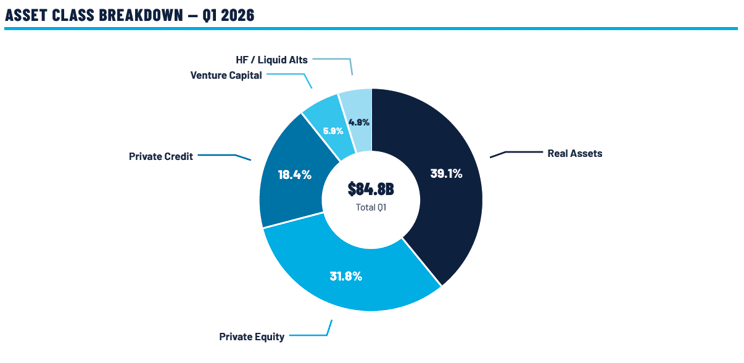
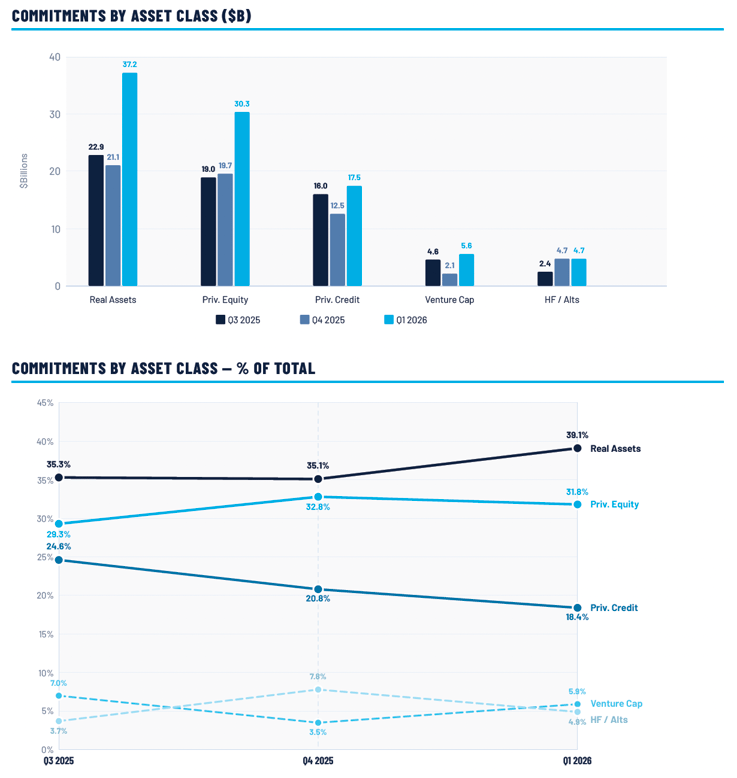
Real Assets and Private Equity have taken up an increasingly large portion of where institutions are putting their money, consistently capturing the lion's share of capital across all three quarters with no signs of that changing. Private Credit is the most interesting story, as it's still attracting dollars in absolute terms, but its slice of the pie has been shrinking quarter over quarter, which suggests allocators are now just maintaining their position rather than adding aggressively.
Private Equity
Q1 Allocations: $30.3B
Share of Total Q1 Allocations: 32%
Buyout is where the overwhelming majority of PE capital is going, and within buyout there is a clear barbell forming. Middle market strategies attracted the most commitments, reflecting a preference for managers operating in less competitive parts of the market where deal prices are lower and there is more room to improve businesses operationally rather than just riding leverage and multiple expansion. Simultaneously, the largest brand-name platforms are pulling in outsized capital from the biggest systems. Green Equity Investors X drew $1.35 billion across seven separate commitments and Francisco Partners VIII attracted nine tickets totaling $995 million, the kind of convergence around a single fund that signals broad institutional consensus. Growth equity rounded out the top strategies, with allocators wanting PE exposure that carries less debt risk in an environment where borrowing costs remain high. Secondaries and co-investments are also quietly becoming a bigger part of how institutions engage with PE, not as a replacement for fund commitments but as a way to manage their pacing, get liquidity out of portfolios that are not distributing much cash, and access deals on better economic terms than a traditional blind pool fund offers.
Key themes driving allocation behavior
- Capital is consolidating around a small number of proven platforms as allocators reduce manager rosters and deepen relationships with GPs they trust to navigate a more challenging deal environment.
- The secondary market is seeing growing institutional demand as systems look for ways to rebalance vintages and generate liquidity without waiting on distributions that have been slow to materialize.
- Co-investment activity is accelerating as allocators push for better economics and GPs use co-invest access as a tool to anchor large commitments from key limited partners.
Notable allocation: New York State Common Retirement Fund committed $640 million to TPG Partners X, a flagship large-market buyout vehicle and a clear example of a major public system doubling down on a scaled, multi-strategy PE platform.
Outlook
The distribution drought is the central issue hanging over PE heading into the rest of 2026. Until GPs start returning meaningful cash to limited partners, allocators will remain cautious about pacing new commitments, and the secondaries and co-invest trends are likely to accelerate as systems find creative ways to manage exposure. The platform consolidation dynamic is unlikely to reverse. If anything, a more selective fundraising environment tends to widen the gap between the managers who can close quickly and those who cannot.
Private Credit
Q1 Allocations: $17.5B
Share of Total Q1 Allocations: 18%
Corporate lending is where the bulk of private credit capital is going, and the largest tickets in the quarter show us that, similar to PE, the biggest allocators are building deep relationships with a small number of credit managers rather than spreading capital broadly. CalPERS put $2.5 billion into two OHA Senior Private Lending vehicles and $2.0 billion across two Blackstone Credit vehicles. Texas Municipal put $600 million into LibreMax. Asset-backed lending has grown into an area of focus, attracting allocators who want the floating-rate benefits of private credit but with the added protection of hard collateral behind the loans. The more notable shift is what is happening at the edges: special situations capital, which surged when interest rates rose and corporate stress picked up, has pulled back meaningfully as those opportunities become harder to find and credit spreads tighten.
Key themes driving allocation behavior
- Private credit has cemented its role as a fixed income replacement, with allocators treating direct lending and corporate lending funds as a higher-yielding substitute for public bonds rather than as an alternative investment.
- Asset-backed lending is gaining traction as allocators seek the floating-rate and collateral protection benefits of ABL in an environment where unsecured corporate credit quality is increasingly scrutinized.
- Manager consolidation is accelerating in credit just as it is in PE, with the largest systems concentrating capital into a small number of scaled platforms capable of deploying at the size and speed that large institutional mandates require.
Notable allocation: State of Michigan Investment Board committed $500 million to Apollo Asset-Backed Finance Fund, one of the cleaner expressions of the ABL theme in the quarter and a sign that large public systems are increasingly interested in flavors of private credit outside of direct lending.
Outlook
Private credit is entering a more mature and more scrutinized phase of its institutional adoption cycle. The easy growth story of rates rising, banks pulling back, and private credit filling the gap is largely played out, and the asset class now needs to prove it can perform through a credit cycle rather than just benefit from one. The compression in special situations activity and the flattening capital share are early signals that the growth rate is normalizing. The managers who built disciplined underwriting standards during the boom years will be separated from those who chased volume, and allocators are beginning to differentiate accordingly.
Real Assets
Q3 Allocations: $37.2B
Share of Total Q1 Allocations: 39%
The largest capital bucket in Q1 and the one with the most diverse set of underlying investment themes. In real estate, allocators tilted heavily toward value-add and opportunistic strategies, a deliberate bet that parts of the real estate market have corrected enough to offer attractive entry points, particularly in industrial logistics, healthcare facilities, and multifamily housing. Core real estate still attracted capital but played a secondary role. Infrastructure saw dollars flow into energy transition themes including renewables, power grid upgrades, and energy storage. Some of the larger commitments went to managers focused on these areas, including Energy Capital Partners, Stonepeak Global Renewables, and LS Power. The common thread is the massive infrastructure buildout required to power AI data centers and electrify the broader economy, which many allocators now view as a generational investment opportunity. The $1 billion CalPERS commitment to Golden Maple Infrastructure Partners and the $742 million NEST commitment to a U.S. timberland fund add to a picture of institutions using real assets to find inflation protection, steady long-term cash flows, and exposure to the physical infrastructure the digital economy runs on.
Key themes driving allocation behavior
- The energy transition and AI infrastructure buildout have given infrastructure investing a secular growth narrative that is attracting capital well beyond traditional utility and transportation mandates.
- Real estate allocators are rotating toward higher-returning strategies as they see the market correction as an entry opportunity, moving away from the core and core-plus strategies that dominated the post-GFC cycle.
- Institutions are using real assets broadly as an inflation hedge and a source of long-duration cash flows that match their liability profiles in a way that most other asset classes cannot.
Notable allocation: Florida State Board of Administration committed $250 million to Stonepeak Global Renewables Fund II, a signal of a major public pension leaning into the energy transition infrastructure theme as a core part of its real assets program.
Outlook
Real assets is the asset class with the most durable tailwinds heading into the rest of 2026. The infrastructure spending cycle tied to energy transition and digital infrastructure is in its early innings, and institutional capital is still in the process of building out dedicated allocations to these themes. Real estate faces more near-term uncertainty as the opportunistic tilt reflects genuine conviction but also genuine risk if rate cuts are slower than expected, but the long-term demand story for logistics, healthcare, and housing remains intact.
Venture Capital
Q1 Allocations: $5.6B
Share of Total Q1 Allocations: 6%
More than 60% of Q1 VC commitments went to early-stage funds, a deliberate bet by allocators who believe the current AI wave creates an early-stage opportunity comparable to the early internet era, and that the best time to get in is now before valuations at the seed and Series A level reflect the full optimism of the cycle. The largest tickets including North Carolina's $1 billion into AH 2026 Fund Multiplexer II, CalPERS's $850 million into Bear Coast Ventures, and $400 million into Khosla Ventures Excelsior are concentrated positions by large systems with the sophistication and time horizon to absorb early-stage risk. Late-stage activity stayed quiet, which makes sense given that late-stage private company valuations have not fully come down to match public market levels and the IPO market has not opened up enough to give investors a clear line of sight to liquidity. The allocators showing up in VC right now are largely the ones with long enough time horizons to wait it out, and the more cautious systems have stepped back and are watching from the sidelines.
Key themes driving allocation behavior
- The AI investment cycle is the primary driver pulling institutional capital back into VC, with allocators making deliberate vintage-year bets that early-stage AI-native companies today represent the same kind of generational entry point that the early internet did in the mid-1990s.
- Late-stage hesitation persists as private valuations at the growth stage have not corrected enough to make the risk-reward compelling relative to public market alternatives.
- The VC allocator base is narrowing, with activity increasingly concentrated among large sophisticated systems willing to absorb illiquidity and J-curve risk while smaller and more conservative institutions stay on the sidelines.
Notable allocation: North Carolina Retirement Systems committed $1 billion to AH 2026 Fund Multiplexer II, one of the largest single VC tickets we tracked from Q1, and a statement of conviction from a system making a concentrated vintage-year bet on the AI cycle.
Outlook
VC's trajectory from here depends heavily on two things largely outside allocators' control: whether the AI investment cycle produces real company formation and revenue at scale, and whether the IPO and M&A markets open up enough to start returning capital to limited partners from the 2019 to 2022 vintage backlog. If both happen, VC allocations will broaden and accelerate. If neither happens, the asset class risks another wave of pullback beyond the already cautious posture most institutions currently hold. The concentration of Q1 activity in a small number of large early-stage bets suggests the institutions still in the game are playing for the long cycle, not a quick recovery.
Hedge Funds/Liquid Alts
Q1 Allocations: $4.7B
Share of Total Q1 Allocations: 5%
The capital going into hedge funds is increasingly concentrated in large multi-strategy and systematic platforms, and that is a deliberate choice rather than a default. New York State Common's $600 million commitment to Great Mountain Partners Saranac Holdings is the clearest example, a large liquid alternatives mandate designed to sit alongside a heavily illiquid private markets portfolio and provide liquidity and downside protection rather than chase returns. The average ticket size of $206 million, the highest of any asset class, confirms that institutional hedge fund allocations are now almost exclusively large relationships with scaled platforms rather than diversified rosters of specialist managers. The asset class has found a stable but narrow role in institutional portfolios: valued for its liquidity and its ability to perform when private markets are struggling, but no longer expected to compete with private markets on returns.
Key themes driving allocation behavior
- As private market allocations have grown, hedge funds have been repurposed as the liquidity sleeve of institutional portfolios, a counterweight to illiquid exposure rather than a standalone return generator.
- Multi-strategy and systematic platforms are winning the majority of new mandates as allocators consolidate relationships and prioritize operational scale and strategy diversification over specialist single-strategy exposure.
- Fee pressure has restructured the hedge fund market, leaving a small number of large platforms with the leverage to maintain terms and a long tail of managers competing on price for shrinking allocator attention.
Notable allocation: Illinois State Universities Retirement System committed $400 million to AQR Capital Management's Helix strategy in March 2026, part of the fund's ongoing implementation of a new asset allocation framework. Helix is a systematic, trend-following hedge fund strategy focused on hard-to-access alternative markets spanning equity factors, interest rates, and commodities. This allocation reflects how mid-sized public systems are following the lead of larger peers in consolidating hedge fund exposure into fewer, larger, more diversified relationships.
Outlook
Hedge funds are unlikely to meaningfully grow their share of institutional portfolios from current levels. The asset class has found its floor as the liquidity and diversification arguments are real and well understood, but the ceiling is capped by private markets continuing to absorb a larger share of total allocation budgets. The managers positioned to thrive are the large multi-strategy platforms that can offer genuine portfolio construction value, not just returns. Single-strategy specialists will continue to face an uphill battle for new institutional mandates unless they can demonstrate performance that is genuinely uncorrelated to the broader private markets programs allocators are building around them.
LP Spotlight: Contra Costa County Employees' Retirement Association (CCCERA)
Contra Costa County Employees' Retirement Association committed $881 million across 14 alternative investment funds in Q1 2026, continuing an active deployment pace against a portfolio that already carries roughly $1.7 billion in outstanding unfunded commitments across private equity, real assets, and real estate. Private credit was the largest allocation this quarter at $350 million across four funds, consistent with the portfolio's existing posture — the StepStone private credit program alone already represents $1.16 billion in market value and $813 million in outstanding commitments, making credit the single largest alternative sleeve by a wide margin. Private equity followed at $300 million across six managers and real estate/infrastructure made up about $230 million.
The Q1 commitments largely reinforce existing manager relationships rather than introduce new ones. TPG is a clear example: CCCERA already holds TPG Healthcare Partners I and II alongside TPG Partners IX, and this quarter added TPG Partners X and Healthcare Partners III, bringing their total TPG commitment footprint to five funds. The real estate sleeve tells a similar story, with Covenant Apartment Fund XII and EQT Exeter Europe Logistics Value Fund V both representing re-ups into established relationships. The one outlier is Tallvine Middle Market Infrastructure Fund I, a debut manager that sits inside an infrastructure portfolio still carrying significant unfunded exposure from recent commitments like EQT Infrastructure and Cloud Capital Fund II. At $15 million it is clearly a relationship-building position, but it adds to an already stretched unfunded pipeline in that sleeve.
Notable Commitments
1. TPG — $150M across two funds. With five TPG funds now in the portfolio spanning large buyout and healthcare-focused PE, CCCERA has built a substantial platform relationship with the firm. The back-to-back commitment to Healthcare Partners III is particularly notable given that Healthcare Partners II, committed in mid-2022, is only at $38 million in market value against a $60 million commitment — meaning capital is still being drawn from the prior vintage while the next one is already being funded. That kind of sequential commitment before a predecessor is fully deployed is a strong signal of conviction in the GP's deployment pace and strategy.
2. ICG Metropolitan II — $60M. This is the only commitment this quarter that lands in the opportunistic real estate bucket without an obvious predecessor in the existing portfolio. Unlike the Covenant and EQT Exeter commitments, which are clear re-ups, ICG Metropolitan II appears to be a new manager relationship for CCCERA. At $60 million it is a meaningful initial ticket, and the opportunistic real estate sleeve already carries a heavy load of older funds from Oaktree, Angelo Gordon, and DLJ that are well into liquidation. ICG likely represents the team's attempt to refresh that sleeve with a more current vintage as the legacy positions wind down.
3. Dragoneer Opportunities Fund VII — $50M. Growth equity is a relatively light allocation within CCCERA's existing private equity portfolio, which skews heavily toward buyout across large, middle market, and sector-focused vehicles. Paired with Bregal Sagemount V, CCCERA added $100 million to growth equity in a single meeting, which stands out as a deliberate tilt toward earlier-stage, higher-growth exposure within an otherwise conservative PE sleeve
Strategic Takeaways
-
Private equity activity is being driven by a shrinking group of managers. The 322 PE commitments look healthy on the surface, but the reality is that LP capital is moving toward a smaller number of large, established managers while many systems quietly reduce their PE targets. Several major pensions cut allocations in 2025 citing slow distributions and returns that have trailed public markets for two straight years. The meaningful co-investment and secondaries activity this quarter tells you that the pensions still deploying are doing so more carefully, favoring structures that reduce fees and get capital back faster rather than simply writing checks to new funds.
-
Private credit is still an in-demand asset class, but the easy part of the cycle may be over. The $163M average ticket size reflects pensions treating this as a core allocation. Corporate lending and asset-backed strategies dominated, which are the more conservative parts of the credit market. But borrower stress is building, defaults picked up in late 2025, and banks are starting to win back market share in larger deals.
-
Real assets are attracting capital from two very different directions at once. On one end, pensions are buying timberland, natural resources, and core real estate because they want stable, inflation-linked income that does not move with public markets. On the other end, they are committing to infrastructure and data center vehicles because AI is generating a physical buildout of unprecedented scale that requires exactly the kind of long-duration institutional capital pensions can provide. CalPERS putting $1B into a traditional infrastructure fund and $1B into a digital infrastructure fund in the same quarter captures this dynamic well.
-
Hedge fund capital is flowing to a very short list of large platforms. With just 23 commitments averaging $206M, pensions are not building diversified hedge fund books. They are writing large checks to a handful of multi-strategy and systematic managers they already know and trust. The presence of Balyasny, Millennium, AQR, and Winton across multiple allocators in the same quarter points to a market where a handful of managers are capturing most of the available pension capital. Smaller and single-strategy funds are being left behind.
Final Thoughts
Q1 2026 was a big quarter on paper, but CalPERS drove nearly 28% of the total, so the underlying pace is more steady than spectacular. The real takeaway is that pensions are concentrating capital into fewer managers across every asset class, making bigger bets on themes like AI infrastructure and energy transition, and leaning harder into private credit even as cracks start to show. That's a portfolio built on conviction, but it's also one with less room for error — distributions are still slow, tickets are getting larger, and when everyone crowds into the same managers and the same themes, the downside if something breaks is sharper than it used to be. The systems that come out ahead will be the ones that picked the right GPs and sized their commitments carefully enough to absorb a bad vintage or two without derailing the whole program.
For further insights, visit dakota.com.
Dakota Marketplace, is a database of LPs, GPs, Private Companies and Public Companies used by fundraising teams and deal sourcing teams to both raise money as well source investment opportunities. Over 1,300 global investment firms use Dakota daily.