A Venture Fundraiser's Playbook: Who's Investing, at What Stage, and in What Themes — a data-driven look at family office venture activity for fundraising teams: where the capital is going, who is deploying it, and why.

EXECUTIVE SUMMARY
Single family offices are among the most important sources of capital in the venture ecosystem today, not a peripheral allocator class. Dakota Marketplace tracks 4,567 single family offices globally, and half of them already carry a stated investment preference for venture capital, a larger share than most other allocator channels Dakota covers.
That scale is being reinforced by real structural change. A wave of new family offices, many formed by successful founders and entrepreneurs, is building venture exposure from day one, run more like active investment platforms than passive capital pools. Established multi-generational families are building alongside them, expanding institutional-grade platforms of their own. Both groups matter to venture, for different reasons, and both allocate to the asset class in their own way, through funds, direct deals, SPVs, secondaries, and club deals.
This brief lays out why family offices matter to the venture ecosystem, how that market is being built and by whom, the many paths family offices actually use to reach the asset class, and why they are structurally inclined to back new ideas, new themes, and emerging managers ahead of the rest of the market. It closes with concrete takeaways for fundraising teams.
FAMILY OFFICES ARE AMONG VENTURE'S MOST IMPORTANT CAPITAL SOURCES
That scale changes how a fundraising conversation should start: a fund manager targeting family offices broadly can expect that one in every two prospects has already signaled interest in the asset class before a single conversation takes place.
A few implications follow directly from this concentration:
- Venture is not a niche preference among family offices. It sits alongside private equity and real estate as one of the default allocations for single family offices, particularly those seeded by a liquidity event from a technology or founder-led business.
- The rest of Dakota's tracked universe is real, untapped opportunity, not a dead end. Many simply haven't been coded with a venture preference yet, or allocate through funds-of-funds or multi-family platforms rather than directly, and reaching them just takes a different approach.
- Because family offices are private, Dakota's preference data is the most reliable signal of real interest available anywhere, and it should anchor targeting more than public statements or media coverage.
MANY PATHS INTO VENTURE
Family offices don't allocate to venture the same way, or through the same door. Some write checks directly into companies; others commit to funds, SPVs, secondaries, or club deals, often more than one of these at once. Dakota's transaction data captures the direct side of that best, particularly for recent activity.
In recent activity, hundreds of family offices have made a direct investment into a venture-backed company, about 1 in 8 of the 2,300 with a stated preference. That's a floor, not a ceiling: it only counts direct activity. That same pattern shows up in public fund-closing announcements too, where family offices turn up as fund LPs alongside institutional backers, sitting right next to the direct-deal activity Dakota tracks. The real opportunity is bigger than this window can show, and it grows every quarter as more of that activity gets captured.
A MARKET BUILT BY FOUNDERS, SUSTAINED BY MULTI-GENERATIONAL WEALTH
The family office channel isn't static, and it isn't one thing. Dakota's 2025 Global Family Office Report found wealth creation accelerating across the US and globally in 2025, and that growth is reshaping who is actually running these offices and how. Newer family offices, often formed by younger principals straight out of a technology exit, are being set up earlier and run like active investment platforms, with a real appetite for direct investing and fast decisions. Established multi-generational families are building right alongside them, expanding institutional-grade platforms of their own, with formal governance built for the long term.
- Founder-led offices tend to move first: Dakota's Global Family Office Report calls out archetypes like Technology-Founder family offices (Bezos Expeditions is a cited example) and Emerging family offices, both built to move quickly and invest with conviction in a small number of opportunities, often the same sectors that created the family's wealth in the first place.
- Multi-generational offices bring something different: capital preservation, longer time horizons, and increasingly formal governance. That's why they remain some of the most consistent, repeat participants in venture.
- The result is a channel with two speeds: newer, founder-led offices are often the first money into a pre-track-record manager or theme; multi-generational offices are more likely to show up once there's already a pattern worth following. A fundraising strategy that treats family offices as one audience misses that distinction.
Secondaries deserve a specific mention, because they behave differently from the other four paths. Buying an existing LP interest or a direct stake from another holder lets a family office step into a known portfolio rather than underwrite a blind pool, take on a shorter remaining hold, and often do it at a discount — which is exactly the profile that appeals to an office building venture exposure without a decade-long ramp. For a manager, that makes secondaries a practical entry point with a family office that likes the strategy but isn't ready to anchor a new fund.
THE SWEET SPOT: SEED THROUGH SERIES A
Family office appetite for venture concentrates where the opportunity is richest: early. That holds across direct deals, fund commitments, SPVs, and club deals alike. That's exactly where a founder relationship and a fast decision matter most, and where family offices have the biggest edge.
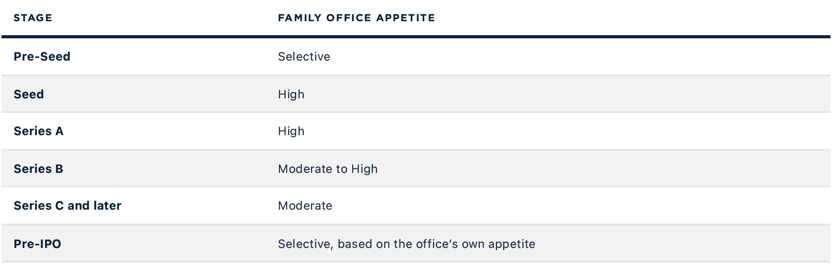
Dakota's own transaction data confirms this for the direct-deal side specifically: Seed and Series A rounds together account for roughly half of all family office-backed direct venture deals in recent activity, more than any other stage. That's the range where a direct relationship with a founder or a fast decision matters most, and where a family office's lack of a formal investment committee is an advantage instead of a constraint.
DIRECT DEALS: WHO IS ACTUALLY DEPLOYING
The table below is a representative snapshot of recent activity: it reflects direct venture deals Dakota has tracked, and the names and order will shift as more activity is captured.
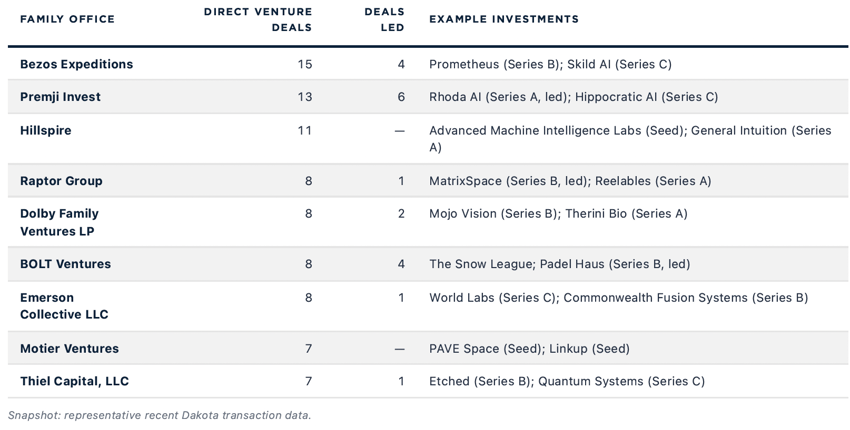
Deal count tells its own story: Bezos Expeditions leads the table with more direct venture investments than any other family office tracked. Hillspire, Emerson Collective, and Premji Invest are also broadly diversified, consistent participants, and Premji Invest stands out for leading, not merely participating in, nearly half of its deals.
Even among family offices active in direct deals, most have only scratched the surface: the large majority made just one direct deal in the window, and only a handful made five or more. That's real headroom for a manager looking to become a family office's second or third deal, not just its first, exactly the kind of pattern Dakota Marketplace is built to surface.
WILLING TO THINK OUTSIDE THE BOX
Family offices are also unusually willing to back an idea before it has a track record, and a fund before it has one either. That shows up clearly in where the money is actually going. The table below groups that same recent direct venture activity by investment theme rather than by company or investor, so it shows which categories of ideas are actually attracting family office capital right now, how many distinct deals fell into each one, and what share of all tracked activity each theme represents.
The data below reflects direct family office investments only. Fund-level, SPV, secondary, and club-deal exposure isn't captured here, so the actual thematic spread is likely broader than what this table shows.
WHERE THE CAPITAL IS GOING, BY THEME
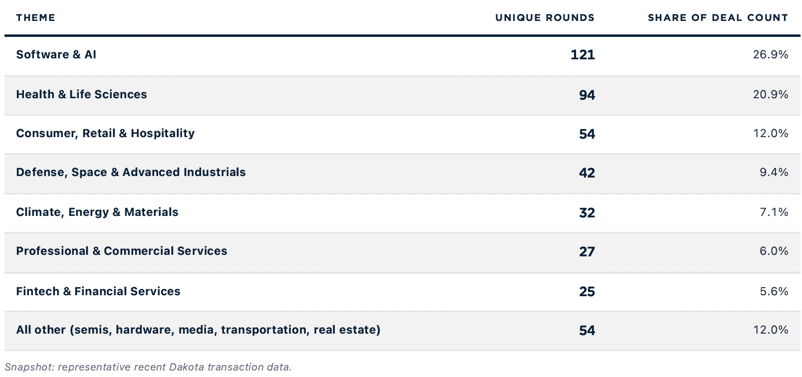
- Software & AI: AI is the theme accelerating fastest within this category. Family offices that started with generalist software bets are increasingly writing AI-specific checks instead, and that shift has picked up noticeably heading into 2026.
- Defense, Space & Advanced Industrials: This is the theme with the most momentum right now. Family offices are showing up earlier than usual here, often at the pre-seed or seed stage, well before these companies have an established track record.
- Health & Life Sciences: This has been the steadier, more consistent presence, more of a gradual build than a rush, without the bursts of activity seen in AI or defense.
- Consumer, Retail & Hospitality: Sports investing shows up here too, consistent with Dakota's 2025 Global Family Office Report naming it an emerging theme. BOLT Ventures' backing of The Snow League, Padel Haus, and Men In Blazers Media Network is a good example.
The fastest-growing themes, AI and defense/space, are also the ones with the least track record to point to. Most institutions wait for that record to build. Family offices are getting in anyway.
FUND COMMITMENTS: THE OTHER HALF OF THE PICTURE
Direct deals are the easiest family office activity to track, because they show up in company-level press releases and deal databases the moment they close. Fund commitments are just as real, and just as important for a manager raising a fund rather than sourcing a co-investor, but they get disclosed far less consistently, most funds simply don't publish an LP list. What is public still paints a clear picture: family offices are LPs in venture funds at every stage, from brand-new debut vehicles to firms managing tens of billions.
- Touring Capital's debut fund closed oversubscribed at $330M, with family offices among its LPs alongside institutional backers.
- Sunflower Capital's $150M sophomore fund counted Pathstone, a multi-family office, alongside institutional names like Dana-Farber Cancer Institute and CalSTRS.
- Peter Thiel personally anchored Thrive Capital's first institutional fund in 2011, a $40M vehicle from a first-time manager that now manages more than $25 billion.
A formal co-investment program is often the bridge between the two. Offering a family office the chance to co-invest directly in a specific deal is a lower-commitment way to start a relationship than asking for a fund commitment outright, and it gives the family office a firsthand look at how a manager sources, diligences, and prices a deal before committing capital to the blind pool. For a manager building a family office pipeline, a well-run co-investment program can function as a proving ground for exactly the kind of fund relationship described in the next section.
BACKING EMERGING MANAGERS AND SMALLER FUNDS
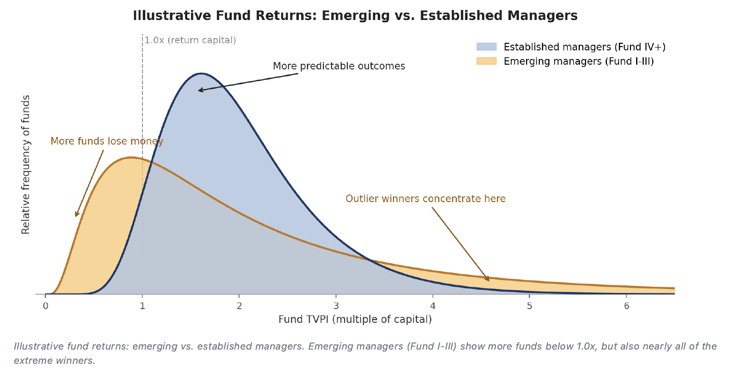
That same willingness shows up one level up the stack, in which fund managers family offices are willing to back. Performance data helps explain why: emerging managers don't just outperform on average, they produce a wider range of outcomes, more funds that lose money, but also nearly all of the extreme winners.
- One example of this is FirstMark Capital, whose debut fund (2005 vintage) returned 10.63x TVPI, one of the strongest results in the dataset regardless of fund sequence.
- Some of the strongest results overall came from very small funds: one debut fund under $20 million in size returned close to 5x TVPI and a triple-digit net IRR, a reminder that fund size, not just fund sequence, is part of the outlier story.
- The pattern also tends to repeat within firms: managers who post a strong debut fund often show similar strength in their Fund II and Fund III vehicles, suggesting that early access to a good manager is itself a signal for backing that manager's follow-on funds.
- The fund-commitment side of this isn't just a Dakota transaction pattern, it shows up in public fundraising history too. Peter Thiel personally backed Thrive Capital's first institutional fund in 2011, a $40 million vehicle from a 25-year-old first-time manager. Thrive went on to back Instagram, Stripe, and OpenAI, and now manages more than $25 billion. Thiel Capital, the same family office, also shows up directly in the leaderboard table above, evidence that a single family office backing both a fund and a direct deal isn't a hypothetical, it's the same behavior showing up twice.
- That pattern isn't limited to one family or one theme. Bill Conway, co-founder of the Carlyle Group, was Lux Capital's first outside investor when it was an unproven manager; Lux went on to seed Anduril Industries and remains one of the defining names in defense tech. Peter Thiel, Marc Andreessen, Chris Dixon, and Mark Cuban backed 1confirmation's $26 million debut fund in 2017, before it became an early backer of Coinbase and Ethereum.
The practical read for fundraising teams: family offices back both ends of this distribution, and that is not a contradiction. Established managers earn a place in the portfolio for capital preservation and a dependable, capped multiple. Emerging managers earn their place because family offices are structurally willing to underwrite the fatter downside in exchange for a shot at the fatter upside, whether that means a first-time fund manager, a specific deal in a new or under-covered theme, or a founding team perceived as an outlier before the track record exists to prove it.
Why family offices specifically: unlike institutions bound by governance layers, consultant gatekeeping, or headline-risk aversion, a family office's investment committee can commit to a first-time fund manager on the strength of a direct relationship or a founder's own instinct, precisely the kind of underwriting that captures Fund I and Fund II outliers before performance data exists to de-risk the decision. As the earlier section on founder-led versus multi-generational offices laid out, that willingness isn't evenly distributed: it's the founder-led and emerging family offices doing most of this underwriting, not the multi-generational ones.
KEY TAKEAWAYS FOR FUNDRAISERS
- Build a standing family office program, not an opportunistic one: family offices are already a core allocator group in venture, not a side channel worth chasing only when one happens to come up. That's enough reason to give them the same dedicated outreach cadence given to institutional allocators.
- Segment by generation before you segment by anything else: founder-led and emerging family offices are built to move on conviction alone; multi-generational offices are a better fit once there's a track record to point to. Leading with the wrong pitch to either group wastes the meeting.
- Weight outreach toward Seed and Series A: that's where family office appetite is highest and where a direct relationship or a fast decision matters most. Later-stage conversations are still worth having, but they compete more directly with institutional capital.
- Go after the family offices already writing checks first: most of the actual dealmaking in venture right now comes from a small, identifiable group. Time spent on family offices with recent, repeat activity converts faster than time spent broadening a list of stated-preference contacts who haven't transacted.
- Match the pitch to where conviction is moving: AI and defense/space are where family offices are already backing pre-track-record teams, so a raise in either category can lean on that appetite directly. A raise in a steadier category like biotech should lean on consistency instead of trying to manufacture urgency the data doesn't support.
- Use co-investment as a relationship-builder, not just a one-off deal: family offices reach venture through funds, SPVs, secondaries, and club deals as much as direct checks. A formal co-investment program gives a family office a lower-commitment way to work with a manager on a specific deal first, and a well-run program can turn into the fund commitment later. A manager who only pitches one-off direct deals is leaving that path unbuilt, and secondaries are worth raising for the same reason — a known portfolio at a discount is an easier first transaction than a blind-pool commitment.
- Pitch the outlier, not the average: TVPI and the shape of the return distribution are what actually move family offices underwriting emerging managers. A single blended IRR undersells the story they're actually buying into.
Family offices are not a niche channel to court opportunistically. They are one of the fastest-growing, most flexible pools of capital in venture today, and they are only getting more active, more sophisticated, and more central to how new managers and new themes get funded. The fundraising teams that build a real program around them now, rather than treating them as a bonus check, will have a structural edge for years to come.
Dakota Marketplace
Dakota is a financial, software, data and media company based in Philadelphia, PA. Dakotaʼs flagship product, Dakota Marketplace, is a database of LPs, GPs, Private Companies and Public Companies used by thousands of fundraising, deal, and investment teams worldwide to raise capital, source deals,