Institutional Capital Moves Deeper Into Team Ownership
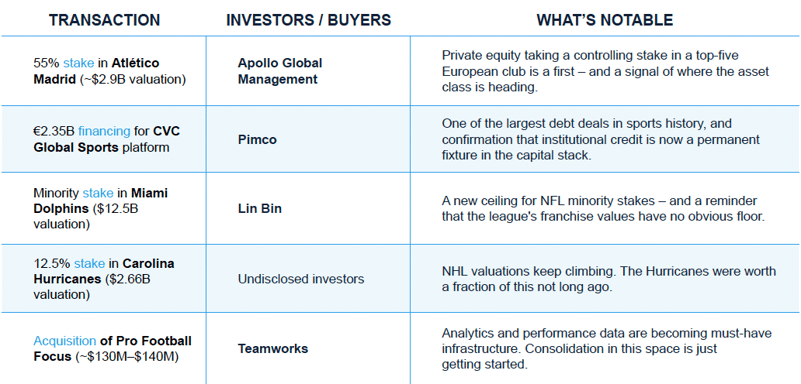
Apollo is acquiring a 55% controlling stake in Atlético Madrid at a ~$2.9B valuation – one of the largest private equity control deals in European football to date. In North America, minority stakes were on the menu: Tom Dundon agreed to sell a 12.5% stake in the Carolina Hurricanes at a $2.66B valuation, while tech billionaire Lin Bin picked up a minority stake in the Miami Dolphins at a record $12.5B valuation – a number that would have seemed like science fiction a decade ago.
Bertram Capital joined the ownership group of Liga MX club Querétaro F.C., partnering with American investor Marc Spiegel's Innovatio Capital as a significant, non-controlling partner. The deal marks the fourth platform investment for Bertram's Ignite fund.
Financial Institutions Build the Plumbing
Rising valuations need infrastructure to match. Deutsche Bank announced plans to expand sports lending for wealthy clients, reflecting growing appetite among family offices and UHNW investors. On the credit side, Pimco anchored a €2.35B debt financing tied to CVC's global sports platform.
Vestible, a US-based sports investment platform, partnered with boutique M&A advisory firm Pinto Capital to broaden capital access for professional clubs. The model allows clubs to raise growth capital tied to future sale outcomes – funding facility upgrades or player acquisitions without giving up ownership or operational control.
Serie A acquired a 51% stake in Fantacalcio, Italy's leading fantasy soccer platform, in a deal valuing the property at over $40M. It's a notable move for a league investing directly in fan engagement infrastructure.
New Leagues Test New Models
Not all the action was in legacy properties. The Global Fight League launched as a publicly traded MMA organization and opened a $5M equity raise aimed at letting athletes and fans buy in directly. Meanwhile, the newly formed Indian Golf Premier League secured $100M in franchise commitments from ten ownership groups – the largest private investment in Indian golf to date.
Weatherford Capital, a Tampa-based private investment firm, joined BellTower Partners' strategic investment in the USL, backing the league as it prepares to launch USL Premier – a new Division One men's league set to debut in 2028 with promotion and relegation, a first for any major US professional sport. The investment adds institutional weight to a league that is simultaneously running the Gainbridge Super League and pursuing stadium-anchored development projects in markets nationwide.
Marc Lasry, through his Avenue Sports Fund, invested $40M into the NWSL's NC Courage at a $155M pre-money valuation. The deal is awaiting league approval and does not include a path to full control – but it adds another institutional name to a women's soccer landscape that continues to attract serious capital.
Shelby Companies Limited, a subsidiary of Knighthead Capital Management, completed the acquisition of Birmingham City Women's Club, taking a 97% stake. The remaining 3% was taken up by a group of prominent female business leaders and global sports executives.
Top 5 Deals of the Month
In Focus
A closer look at the forces shaping sports capital
Inside Synergy Sports Capital's Bet on Emerging Sports
When Terrence Murphy Sr.'s NFL career ended before it ever really began – a career-ending injury in his rookie year cutting short what had been a record-setting career as a wide receiver at Texas A&M – he didn't have the luxury of waiting until retirement to start thinking about his financial future. He was 22 years old, and he got to work.
"I didn't make crazy NFL money," Murphy said in a recent interview with Dakota. "So I had a little bit of seed capital and I just started my financial literacy journey right then and there because I had to."
More than two decades later, that early start has translated into a multi-billion-dollar real estate and investment track record spanning thousands of transactions, over 100 portfolio companies, and a career that has taken him deep into the worlds of private equity and venture capital. Now, Murphy is channeling that experience into his most ambitious project yet: Synergy Sports Capital. The Houston-based private equity firm is targeting approximately $150M in capital commitments for its inaugural fund, built on the thesis that the most compelling value creation opportunity in sports today is taking controlling positions in emerging leagues before the rest of the market catches on.
"Right now, most big investors are putting their money into established teams that are already priced at the top of the market," said Murphy, who serves as founder and managing partner. "We see a bigger opportunity in emerging leagues where fan bases are growing, media deals are expanding, and team values are still on the rise. In those environments, strong leadership and hands-on involvement can really move the needle over time."
Not Your Average Sports Fund
The fund is focused on controlling stakes across three interconnected investment pillars: emerging leagues and teams, sports-related real estate development, and sports-adjacent ventures.
The distinction between controlling and minority ownership is central to everything Murphy is building. "We want voting rights. We want controlling rights," he said. Passive minority stakes, he added, are exactly what Synergy is designed to avoid.
That operational orientation is baked into the firm's infrastructure through what Synergy calls its “Sports Operating System” – a centralized platform designed to deploy technology, data analytics, media strategy, and stadium-anchored real estate development across portfolio assets. The idea is to treat the portfolio as a unified, integrated platform rather than a collection of standalone bets, compounding value across each of the three pillars over time.
Synergy is also open to co-investment structures with other PE firms, and Murphy indicated the firm has already fielded significant inbound interest on that front, with over 100 messages through the firm's website within the first 48 hours of launch. "There are a lot of people saying, 'Hey, we have this team we're working on, are you guys able to co-invest with us,'" he said. "And yes, we'll partner with other PE firms and invest. We don't have to own 100% of the teams. We just want a seat at the table, voting rights, and some type of controlling stake."
Heisman Trophy winner and former NFL running back Reggie Bush, a partner in the fund, reinforced that operator-first orientation in the firm's launch press release. "Synergy stood out because they're not just investing in teams – they're actively shaping how they grow, operate, and scale, while building smart, long-term value around them. Terrence brings the mindset of someone who has built businesses at scale over 20+ years, and that hands-on, conviction-driven approach is what makes this strategy so compelling."
Reading the Signals
Murphy doesn't pretend that every sport making headlines qualifies as a serious investment opportunity – and part of Synergy's edge is knowing the difference.
What he is looking for are sports that have deep participation bases, rising cultural momentum, and expanding media and sponsorship ecosystems – sports that aren't new, but whose moment has arrived. He points to women's soccer, volleyball, and motorsports as categories he was publicly bullish on years before the mainstream investment community came around.
"NWSL – I called that in 2019," he said. "I was talking about women's soccer because I was coaching my little girl and seeing the movement happening. I called volleyball three or four years ago when I was involved with my fifteen-year-old as a setter. I called racing when I saw what was happening around motorsports and Formula One."
The pattern, Murphy argues, isn't coincidence, but the product of being genuinely immersed in the sports ecosystem rather than viewing it from the outside. It's a competitive advantage he takes seriously, and one he believes is underappreciated by investors who come to the space from purely institutional backgrounds.
"There are people trying to invest in sports who know nothing about it," he said. "They may have worked in PE, but they don't understand the sports ecosystem. They don't understand athletes. A lot of us in the firm are former athletes. We've been in sports our entire lives. You really have to be in it to understand it."
The Real Estate Angle
One of the most distinctive elements of Synergy's strategy is the deliberate integration of real estate development as a core part of the value creation model and a financial stabilizer for the portfolio.
The logic is grounded in what Murphy sees happening across the country: cities eager to anchor community development around sports infrastructure. "Cities are looking for engagement. They're looking for ways to entertain their local population and keep them there," he said. "So there's a lot of motivation around it."
The firm's first portfolio investment, Atlético Dallas – a professional soccer club competing in the USL, which Murphy is warehousing into Fund One – illustrates the strategy in practice, and Murphy said USL currently is in active discussions with around 70 cities about stadium districts and practice facilities. Synergy intends to be at the forefront of that development wave with the Dallas franchise.
"If you're an LP and you own a portion of that team and you also own the real estate around it, now you're diversified within that one investment," Murphy explained. "We gave you access to it through Synergy Sports Capital."
Matt Valentine, chairman and founder of Atlético Dallas, described Synergy's approach in the press release as exactly what the team needed at this stage of its growth. "They understand how to connect team performance, fan growth, and real estate infrastructure development into one cohesive strategy, and that alignment is critical as we scale."
The real estate integration also serves a more structural function: providing liquidity pathways for LPs that don't depend entirely on a full team exit – a chronic challenge in traditional sports investment structures. Murphy broke it down by bucket. Each of the fund's three pillars carries its own monetization characteristics, with the team side offering exits through media deals or selling the team as it grows, and the real estate and sports-adjacent buckets each providing their own return timelines. The result, by design, is a portfolio where LPs have multiple opportunities to see capital returned rather than waiting on a single exit event.
Who's at the Table
Synergy's target LP base reflects Murphy's broader vision for who should have access to this asset class. The firm is focused on family offices, institutional investors, and high-net-worth individuals – including, notably, athletes.
Murphy sees an opportunity to use Synergy as something of an on-ramp for athletes looking to build investment literacy and ownership exposure earlier in their careers than has historically been possible. He draws a direct parallel to the transformation wrought by NIL in college athletics – a system that finally gave athletes a seat at the table that had long been denied to them.
"We as athletes realized that we're the fabric that holds it all together. At the end of the day – franchises, teams, even university athletic programs – without us as the source of talent and entertainment, it's just not happening. So it's our time. We've been needing to do this."
Murphy is planning to formalize that mission through a series of summits that would bring together ownership groups, athletic associations, PE firms, family offices, and athletes in one place – creating a two-way exchange of access and opportunity. "That's a vision of mine," he said, "to give access to the athletes but also access for firms that want to connect with athletes."
The Risks, Honestly
Murphy is bullish, but not naively so. Asked about what could go wrong with an emerging sports thesis, he offered a candid assessment.
The biggest risk, in his view, is poor deal selection: chasing leagues that aren't validated, getting in too early, or paying too much at entry. "You make your money when you buy. That's true in real estate, venture capital, private equity, sports teams – everything. If you overpay and you don't give yourself enough room to grow the asset, that's where you can get stuck."
He's equally wary of the broader market risk of undisciplined capital flooding the space. "People chasing too many leagues that aren't validated – that's the balance. You get in too early and you run too much risk. You get in too late and you miss the upside."
For Synergy, the answer to that challenge is pipeline discipline. Murphy said the firm currently has approximately 25 high-quality investment opportunities under evaluation, the majority of which he describes as proprietary deals sourced through relationships and pattern recognition rather than broadly shopped processes. "A lot of those deals I generated myself just through my background and perspective. These aren't deals that have hit your desk ten times."
What Success Looks Like
Murphy's five-year vision for Synergy is straightforward: strong returns in Fund One, a launch of Fund Two, and a growing track record of emerging sports investments that validate a thesis he has been developing – and, in some cases, publicly advocating – for years. Additional investments are already in the pipeline, including in women's sports, with announcements expected in the coming weeks.
By Murphy's own account, the investment journey that led to Synergy's launch began not with a strategic plan but with necessity – a 22-year-old former NFL draft pick figuring out what came next.
"I've been in sports my entire life. And I've also been in venture capital, private equity, M&A, and real estate. Now we're bringing those worlds together. To me that's a competitive advantage."
Capital Roster
More than endorsements: athletes shaping the business of sports
Going Back Home
Luka Dončić is backing an investment group in preliminary talks to acquire Italian pro basketball team Vanoli Basket Cremona, with plans to relocate the club to Rome. He left Europe for the NBA at 18. He may be heading back – this time with a deed.
Former pro soccer player Carlos Vela acquired a minority stake in LAFC – the club where he became a legend – at a $1.25B valuation.
Cade Cunningham acquired a minority stake in the Texas Rangers through Sportsology Partners – a hometown investment for the Detroit Pistons guard, who grew up in the Dallas area.
Canada native Shai Gilgeous-Alexander backed the development of Hamilton's TD Coliseum, a new sports and entertainment venue in his hometown. He's spent his career making the line work for him. Now he's putting his name on one.
Building Something New
Steve Young's private equity firm HGGC closed its fifth flagship fund at $3.2B – oversubscribed, exceeding both its $2.5B target and its original $2.8B hard cap, and secured in approximately twelve months. The firm manages more than $10B and focuses on middle-market transactions.
Cristiano Ronaldo acquired a 25% stake in Spanish club UD Almería through his newly formed CR7 Sports Investments company, partnering with majority owner Mohammed Al-Khereiji and his Saudi-led consortium.
Thibaut Courtois joined the ownership group of French club Le Mans alongside Novak Djokovic and several Formula 1 drivers.
Former USMNT striker Jozy Altidore joined an ownership group working to bring professional soccer back to Oklahoma City, alongside NBA star Russell Westbrook.
Drew Brees, Tim Tebow, and Mark Ingram II are among roughly 200 shareholders backing Garden City Equity, a Charlotte-based holding company that raised $255M for its next tranche of investments. Founded by former DocuSign executive Michael Arrieta, the firm targets family- and founder-owned businesses in the South and Southwest with an explicit focus on employee well-being – think chaplains, financial literacy classes, and no-interest loans alongside the usual benefits.
Off the Course
Anthony Kim became an equity partner in golf lifestyle brand Malbon Golf – a fitting move for a player who just recorded his first professional win in nearly 16 years at LIV Golf Adelaide. The comeback has a business card now.
Beyond the Big Leagues
Where passion meets portfolio: investments in the sports you already play
No billion-dollar valuations required – though at this rate, don't rule it out. Recent deals spanned sailing, triathlon, table tennis, golf entertainment, and youth basketball.
- American Magic co-founder Doug DeVos acquired the Danish ROCKWOOL Racing SailGP Team in a deal valued at over $60M. Title partner ROCKWOOL stays on through 2032.
- The Professional Triathletes Organization (PTO) acquired a majority stake in Challenge Family, the leading global triathlon race series, consolidating three major racing properties into a single competition framework beginning in 2027. An athlete-owned body reshaping the structure of its own sport.
- Major League Table Tennis raised new funding to support league expansion and event production.
- Swing365 Golf secured strategic private investment to accelerate expansion of its corporate golf entertainment venues across California, Georgia, and Texas.
- Prep Network acquired Coast 2 Coast Preps, a national leader in middle school basketball events and coverage, integrating it with Prep Hoops, its existing basketball content and rankings brand. Financial details were not disclosed.
- Zenniz, a provider of smart tennis court solutions, closed a $6M funding round backed by Nordic funds including Butterfly Ventures and Superhero Capital, France's Seventure Partners, and South American fund Bromélia Capital. Wolt founder Miki Kuusi also joined as an investor.
On Deck
Tracking the next moves in sports capital
- Seattle Seahawks up for sale: Fresh off the team’s Super Bowl victory, the Paul G. Allen Estate officially launched a sale process for the franchise, which would represent one of the most significant NFL ownership transitions in years. No timeline or valuation has been disclosed, but expect this to dominate sports business headlines in the months ahead.
- Indian Premier League (IPL) cricket franchise stakes are attracting some of the biggest names in global sports capital. Avram Glazer – via his Lancer Capital vehicle – submitted a reported $1.8B non-binding bid for Royal Challengers Bengaluru (RCB), the reigning IPL champions, currently being shopped by owner Diageo. David Blitzer, co-founder of Harris Blitzer Sports & Entertainment, is also in the mix – bidding for either RCB or Rajasthan Royals. Competing interest includes Advent, Carlyle, Temasek, PAG, and Indian billionaire Adar Poonawalla. Meanwhile, Sanjiv Goenka's RP-SG Group is exploring a sale of up to 15% of the Lucknow Super Giants, adding another franchise to an increasingly active IPL liquidity market. Final bids for RCB are due mid-March.
-
Canadian Soccer Media and Entertainment (CSME), the commercial arm overseeing Canada’s national teams and the Canadian Premier League (CPL), is formally opening to institutional investors, backed by a new 11-year commercial deal with Canada Soccer and an ambition to scale the CPL into a global media and content platform.