Building the Rails Around Sports Capital
Recent deal flow had less “changing the scoreboard” energy and more “installing the stadium wiring.” Ownership still matters, but the momentum is in the systems around it – especially minority-stake transfers and new access vehicles.
That backdrop sets up this edition’s In Focus on sports secondaries. Elsewhere, we track that same “build the rails” mindset across advisor-friendly access vehicles, youth-sports infrastructure, and a growing wave of athlete-operators – from Sergio Ramos to Mookie Betts – taking on bigger roles.
Capital Vehicles and Access Infrastructure
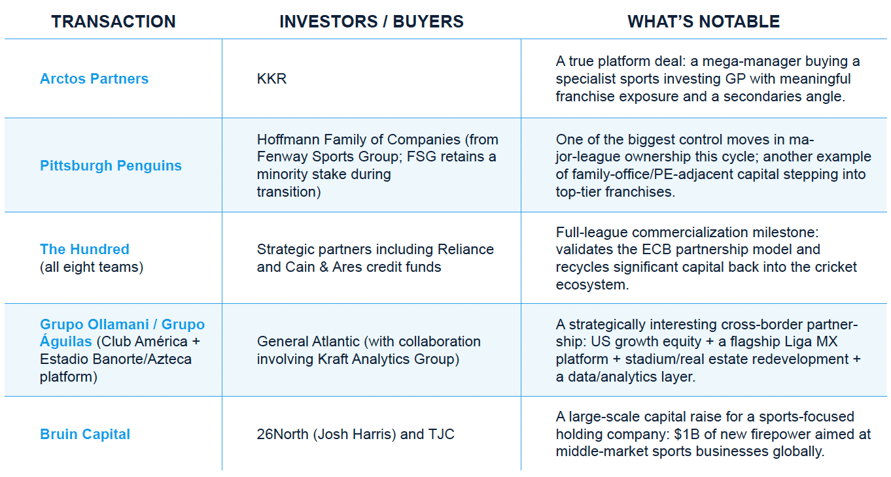
KKR’s agreement to acquire Arctos Partners, valuing the sports-specialist investment firm at approximately $1B with performance incentives that could push the price higher, marked a watershed moment. The deal would give KKR immediate scale across minority stakes in major NFL, NBA, and MLB franchises and underscores growing demand not just for teams, but for platforms that aggregate and manage exposure to them.
Arctos also looks to be keeping its fundraising engine running: it recently filed for Sports Partners Fund III, with J.P. Morgan Securities listed to help place it. The prior vintage set a high bar – Sports Partners Fund II closed at over $4.1B in April 2024.
CAIS launched its Sports, Media and Entertainment Fund, anchored by Arctos and Eldridge, offering accredited investors lower minimums and semi-annual liquidity. Meanwhile, Bruin Capital secured a $1B investment led by Josh Harris’s 26North and TJC, positioning the firm to deploy significant capital into middle-market sports businesses globally.
Gabelli is offering the actively managed GOLS ETF, packaging sports and live entertainment exposure into public equities across the ecosystem – another sign that “sports access” is increasingly being productized outside of private funds.
League, Conference, and Governance-Led Capital
The Big 12 moved toward a $500M RedBird-backed credit facility designed to provide liquidity to member schools without diluting control – a clear response to rising athlete compensation and operating costs. The University of Utah followed a similar path, advancing plans to launch a for-profit commercial subsidiary with Otro Capital to monetize media, sponsorship, and ticketing assets while retaining governance oversight.
In Europe, British Cycling separated its commercial rights into a new subsidiary to court private investment, echoing similar moves by other governing bodies seeking growth capital without fully privatizing their core institutions.
Top 5 Deals of the Month
In Focus
A closer look at the forces shaping sports capital
The Quiet Rise of Sports Secondaries (and Why Private Capital Should Care)
Sports teams have been “investable” for decades in the loose, trophy-asset sense: scarce supply, long-duration brand equity, and a history of valuation appreciation. But for anyone who has ever had to answer an LP’s favorite question – “What’s the exit?” – sports ownership had a structural problem: minority stakes were effectively illiquid.
That’s starting to change. Over the past few months, a steady drumbeat of minority-stake transactions – some purely secondary, some hybrid recapitalizations – has made it harder to dismiss sports as permanent capital that only clears at control-sale events. The market still isn’t “liquid,” but it’s increasingly transferable, and that distinction matters for both underwriting and fundraising.
What “sports secondaries” actually means (in fund language)
In classic private markets, secondaries are simple: you’re buying an existing interest from an existing holder. The capital goes to the seller, not the underlying asset, and you underwrite (a) governance and transfer restrictions, (b) cash-flow/valuation visibility, and (c) a realistic path to exit.
A sports secondary is the same concept applied to a franchise cap table:
- Buyer purchases an already-existing minority ownership stake from a current owner (or limited partner).
- The team doesn’t “raise a round” the way a company does.
- The transaction is consent-gated – with leagues playing the role that a GP or board consent would play in a typical private transfer.
Why this market is forming now
Three structural shifts are converging:
1. League rules have evolved to accommodate institutional money and repeat buyers.
A clear recent example: the NBA allowing investment firms to own equity in as many as eight franchises, up from five.
2. Valuations have scaled to the point where small percentages are meaningful transactions.
When a 1% stake can represent a nine-figure check, sellers are more willing to navigate approval processes and buyers are more willing to pay diligence costs.
3. The seller base is real (and motivated).
Legacy minority owners, estates, and long-term partners have practical reasons to seek liquidity: diversification, succession planning, or balance-sheet cleanup – especially when operating headwinds (e.g., regional sports network turbulence, debt loads) tighten.
Arctos: a “secondary platform” disguised as a sports investor
If you want a single case study for the rise of sports secondaries, Arctos is the cleanest anchor because it behaves like a standing bid for minority stakes.
In December 2025, Monumental Sports & Entertainment (Ted Leonsis’ platform that includes the Wizards, Capitals, Mystics, Capital One Arena, and Monumental Sports Network) announced Arctos as a new minority investor, alongside an increased stake from Qatar Investment Authority. The press release is notable for how it frames Arctos’ role: “Founded to provide growth capital and liquidity solutions to premium sports franchises…,” and “approved to own equity” across major North American leagues.
Then, the NBA rule shift (raising the cap to eight teams per investment firm) created a clearer runway for the “portfolio of teams” model. In practice, Arctos’ Wizards exposure is tied to its Monumental investment, alongside its existing reported positions in the 76ers, Jazz, Kings, and Warriors, and it has also been reported to hold a minority stake in the Grizzlies.
For fund managers, the key point isn’t the brand name – it’s the function: a repeat, pre-approved buyer with capital and process reduces friction in a market that historically had no obvious clearing mechanism for minority exits. The practical result is a shorter list of unknowns in a minority sale: who the buyer is, whether they clear approvals, and whether they’ve done this before.
Not every minority deal is a “secondary.” Follow the money.
Here’s the nuance that makes this topic useful (rather than hype): in sports, “minority sale” can mean three different things:
1. Pure secondary (owner-to-owner liquidity): proceeds go to the selling owner(s).
2. Primary/recap (capital into the franchise): proceeds strengthen the team’s balance sheet (debt paydown, liquidity, growth).
3. Hybrid: some cash out, some capital in.
Each category underwrites differently – especially around leverage, distributions, and governance.
A great example of the “hybrid/recap” flavor is the Minnesota Twins. The Twins finalized new limited partners – Glick Family Investments, George G. Hicks, and Craig Leipold – while the Pohlad family retained control; the club said the investments will help pay down a “significant amount” of its $500M of debt. External valuation pegs for the club have clustered around the mid-to-high $1B range, reinforcing how meaningful a minority check can be at today’s prices.
This is not a “secondary” in the purest sense if proceeds are used to de-lever the organization – but it does increase investability by normalizing minority ownership transfers and creating a more finance-like capital stack conversation around a franchise.
The “proof of clearing” is spreading beyond institutions
Institutional platforms matter, but so does the broader buyer universe – because liquidity requires more than one bidder archetype.
- Tech executives entering NFL ownership: In December 2025, the San Francisco 49ers announced that OpenAI chairman Bret Taylor acquired a minority stake, approved at an NFL league meeting. Reporting indicated Taylor’s stake is about 1%, with the York family retaining majority control. Other tech- and finance-linked groups bought into the 49ers earlier in 2025, reinforcing the widening “approved buyer” set.
- Strategic local HNW/celebrity capital: On Dec. 16, 2025, the Nashville Predators announced that an entity controlled by Nick Saban and Joe Agresti purchased a minority stake, joining Bill Haslam’s ownership group; Haslam became majority owner on July 3, 2025.
Individually, these are not “market structure” events, but collectively, they support a bigger claim: minority sports ownership is becoming more transferable, and the approved buyer base is getting deeper.
Why this all matters
This isn’t about pretending sports are liquid. It’s about improving the answer to three LP questions:
1) Can you exit a minority position without a control sale?
Historically, “no (or not really).” Increasingly, “sometimes – if you know the buyer set and the league process.”
2) Is there a repeatable price discovery mechanism?
Still limited. But the presence of repeat institutional buyers (plus more HNW buyers) makes valuation anchoring less theoretical.
3) What’s the duration?
Still long. But long duration with optional liquidity is a different product than long duration with no liquidity.
In practice, those three questions collapse into one: how transferable is this interest under league and ownership-group rules? That’s why liquidity in sports is a governance problem. The diligence checklist is less about “team quality” and more about transferability:
- Approval + caps: how transfers clear and what limits apply
- ROFR: whether owners can match or block a sale
- Exit buyer set: who can realistically buy in 3–5 years
- Proceeds: seller cash-out vs balance-sheet recap (or both)
The Bottom Line
Sports secondaries aren’t an exchange and aren’t even a fully formed market. They’re a mechanism: negotiated transfers enabled by league rule changes, scaled valuations, and the rise of repeat, pre-approved buyers.
For private capital, that’s enough to matter. Sports ownership doesn’t need to trade often to be an asset class – it just needs to be able to trade at all.
Capital Roster
More than endorsements: athletes shaping the business of sports
This month’s athlete and executive capital activity leaned less toward passive investing and more toward ownership, governance, and platform-level influence.
Buying in
Nick Saban and Joe Agresti acquired a minority stake in the Nashville Predators, extending Saban’s business footprint beyond football – and into a league that doesn’t allow him to call defensive coverages from the bench.
Sergio Ramos partnered with an undisclosed American fund to launch a €400M takeover bid for Sevilla FC, positioning himself as the public face of a proposed full acquisition aimed at stabilizing the club’s finances.
Bret Taylor, chairman of OpenAI and former Salesforce co-CEO, acquired a minority stake in the San Francisco 49ers, adding another enterprise software executive to the NFL’s ownership ranks.
Indian cricketer Virat Kohli remained active on the operator side as well, selling his One8 lifestyle brand to Agilitas Sports while reinvesting as a minority owner – opting for a vertically integrated partner rather than a traditional licensing model.
Building the business
Mookie Betts invested in Home Run Dugout, joining as brand ambassador and chair of its Athlete Advisory Board – continuing a pattern of treating side pursuits with the same seriousness that once produced a televised 300 game on the PBA Tour.
Shawne Merriman’s combat sports platform Lights Out Sports secured a controlling majority investment from Applied Real Intelligence following a multi-year media rights agreement with ESPN and Disney+.
Cristiano Ronaldo added to his tech portfolio with an investment in Perplexity AI.
Former NBA and Israeli Basketball Premier League small forward Omri Casspi expanded Swish Ventures with a fully subscribed $100M Opportunity Fund, bringing firm AUM to $300M and reinforcing his transition from player to institutional GP.
Patricof & Co. launched P/Co Metals, a precious metals vehicle tailored specifically to athletes – a reminder that when career timelines are short and income is volatile, gold starts to look less old-fashioned and more pragmatic.
Cricketer Ajinkya Rahane joined Senora Asset Management as an investor and board member, highlighting how athlete credibility is increasingly being deployed inside financial services.
Beyond the Big Leagues
Where passion meets portfolio: investments in the sports you already play
Padel sports investment news took a breather over the holiday season, but the rec-and-emerging pipeline didn’t exactly go quiet. The NFL still found a way onto the calendar with flag football – further proof that football is now less a sport than a distribution strategy, and that it may be one scheduling decision away from claiming Christmas outright from the NBA.
Deals to Know:
- The NFL, via 32 Equity, committed $32M to launch a professional flag football league ahead of the sport’s 2028 Olympic debut.
- Unrivaled Sports acquired the Twin Creeks Sports Complex in Santa Clara County, expanding its national venue network.
- PlayMetrics sold Student Sports (Elite 11 and Area Code Baseball) to Elysian Park Ventures, sharpening its focus on youth sports operations software.
- Upper Hand was acquired by H3 Partners, reinforcing consolidation across youth facility and training management platforms.
- FloSports acquired the Lucas Oil Late Model Dirt Series, securing ownership of a key grassroots motorsports IP.
- Parella Motorsports Holdings, backed by Velocity Capital, acquired Racing America to build the largest integrated grassroots motorsports network in North America.
- WIN Reality acquired Yakkertech to power its SmartPark automated training system, with more than 2,500 installations already committed.
Trendlines to Watch:
Investors will be watching utilization and durability: do facilities stay booked year-round, do training platforms embed deeply into development pathways, and can niche leagues pair participation with scalable media economics?
On Deck
Tracking the next moves in sports capital