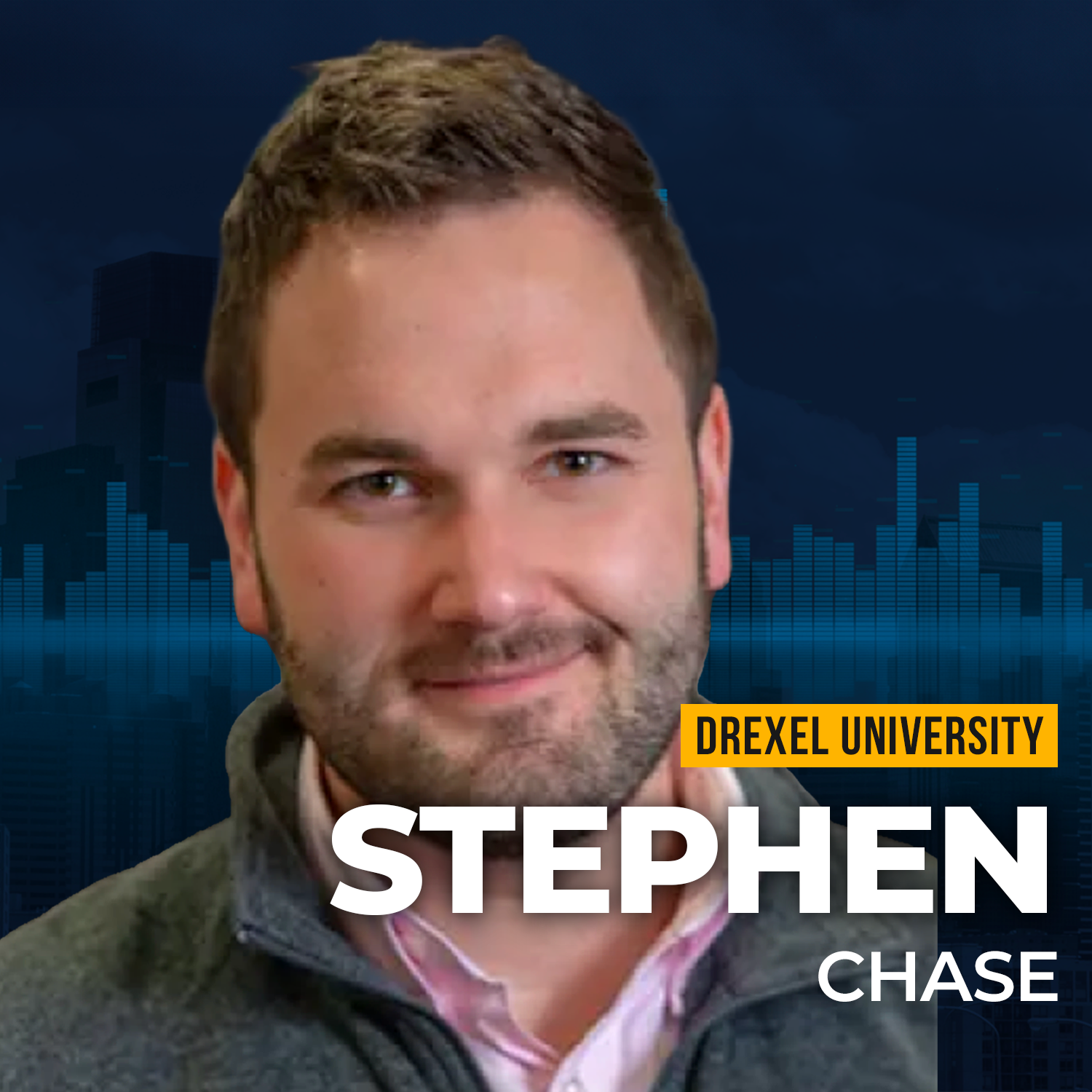
Robert Morier: Our guest today is Stephen Chase, Associate Director of Investments with Drexel University's Investment Office. In his role, Stephen helps support the management of Drexel University's endowment and investment portfolio alongside the broader Investment Office team. The office oversees approximately $1.25 billion across the Drexel University and Academy of Natural Sciences Endowments and focuses on long-term portfolio construction, manager research, risk management, and alternative investments. Before entering the investment industry, Stephen worked across operations, sales, marketing, finance, and research roles connected to both his family's business and a Philadelphia-based public relations firm specializing in crisis communications. He later earned his MBA from Drexel University's LeBow College of Business with a concentration in finance Alternative Investments after previously earning his undergraduate degree in anthropology from Trinity College. Within the investment office, Stephen operates inside a lean institutional environment where analysts often gain exposure across manager due diligence, portfolio monitoring, private markets, and investment operations rather than working in highly siloed functions. Drexel University's investment office manages capital with a long-term orientation and has publicly discussed increasing exposure to private markets over time, reflecting broader trends across the University endowment space. The office also maintains
close ties to student investment education initiatives such as the Dragon Fund and experiential finance programs across the university. Stephen, welcome to the Dakota Live podcast. Welcome to the Philadelphia studio.
Stephen Chase: Thank you. It's great to be here. I'm very honored to be here on behalf of Drexel.
Robert Morier: Well, my favorite episodes are when I get to speak with my colleagues. So this is one of them. You are the third of a three-person team. So I've hit all of the major employees at the Drexel University Investment Office, which is great. And I think that's actually really great for our audience as well, because more often than not, when they're calling an endowment, foundation, family office that does have a lean staff, uh, there might be only 3 or 4 people, and you're not really sure who to call and how to call. So I think bridging all 3 of you into kind of this stream of, of conversations is really helpful. So thank you for being here.
Stephen Chase: Oh, absolutely, it's a pleasure.
Robert Morier: Hopefully we're not going to talk about any crisis communication. So when you specialize in crisis communications earlier in your what was that like for you?
Stephen Chase: It was fast-paced. You really had to get up to speed on what was the task at hand, really. And you learn to be adaptive, flexible, curious. You need to read a lot and then sort of disseminate that information and come up with a plan, either act or not act. It was a great first career out of college. Being an anthropology major, I, I, had great skills in writing and then communicating. And so it fed really nicely into the sort of public affairs part of communications.
Robert Morier: How did you land on Trinity College?
Stephen Chase: It was— I wanted to be somewhere on the Amtrak Northeast Corridor in a city, not in Philadelphia because I'm from this area. So I want to be a little bit further away from home in a small college in a smaller urban area. So Trinity fit the bill— smaller class sizes, had a great study abroad program, and was flexible in the course study. So I was able— I went in as an economics major, or I first wanted to be an economics major, then I discovered anthropology, cultural anthropology, not, uh, not, you know, dinosaurs and whatnot, although that is a part of anthropology. It allowed me to follow what I was interested in and study what I part of the humanities that, uh, really interested me.
Robert Morier: What were the aspects of cultural anthropology that interested you the most?
Stephen Chase: The way you go about thinking about a topic is very different from any other way of thinking, and it's something I really value in the humanities. I had a professor, my advisor, who said it's— in anthropology, you find your brick. And it's— I want to— it's not that I want to study all of New York City, or I want to study the culture of the Upper East Side, or I want to study the culture of Carnegie Hill and the history of that. I want to study that brick on that street corner and how it got there and why it was significant. And so you can't really turn that off. And so once I had my first course in anthropology, that was it. I found a way to bring economics into it and study sort of both of them at the same time, but with an anthropological lens. And it worked out really well. So I'm an anthropology major. I found a way to incorporate economics, macro, micro healthcare economics, and I've really studied consumer behavior, how we make decisions, how we make investment decisions. So it all sort of fed into what I say I'm really good at. I'm really good at reading, talking, and asking questions, then writing about it and creating either a recommendation or an action plan on what to do or not do. It worked great in my first career. When I decided to branch out and work with a family business, I, it helped in being able to manage a lot of different things all at once and then gain some additional skills. And it's a great skillset to have in what I do now and what we do as a team because we're talking constantly, we're reading constantly., and then we're trying to figure out what's the right thing. What is the brick that we need to add to our portfolio? What's the right thing for us?
Robert Morier: When you think about consumer behavior and your studies of consumer behavior, what have you seen change, or both in your studies and then since you've entered the investment industry? So the way that you all, you know, consume asset managers, uh, the way that asset managers are, are feeding you information, has, has the delivery changed and the, the Does the psychology remain the same or is it all different?
Stephen Chase: The delivery is very different. There's a lot more of it. It's much faster. And I feel I still like scholarly resources. So Google Scholar still exists, so you can still get peer-reviewed research on a topic. But then there's all of the additional information, especially in the investment world. You have white papers that come out, weekly reports, daily emails on different perspectives. So the, the amount of information is so much greater, the delivery is much faster. And so it is hard to slow down and figure out what do I want to focus on. But now there are tools that can help us boil down 6 different white papers into one, you know, sort of streamlined thought where you have 2 sides or competing perspectives. For me, the analysis remains the same. I'm still very much a pen and paper. I want to read it. I want to take notes on it and then go from there. My office is at home is, it's not messy, it's organized, but it's a lot of papers because I like to read things, make notes, and I may never look back at those notes again, but it's in my head. So that's how I learn. But I think for others who are younger, the role of technology,
the ability to have a document read to you, that didn't really, exist in, you know, the popular landscape that it— that you have today.
Robert Morier: When you're someone who likes to sit down and read and take notes, what are those tools that you find are most useful today that you're utilizing to at least create some more efficiencies in how you digest all— you know, it's like drinking water out of a fire hose. So, and you could go back to the, you know, the brick metaphor. It's like you've got lots of bricks in front of you. How do you choose that one?
Stephen Chase: I usually flip to the end. I mean, that's one of my big things with, uh, research is I flip to the end. I want to see what the conclusion is what the sort of parting statement is. Um, and that'll help me decide if I want to read through and gain all the information and knowledge that led up to that point. So it's, it's sort of jumping the gun a little bit, but the other thing is, uh, generative AI, the ability to upload several different PDFs and get a concise, efficient, well-written sort of synopsis of what that topic is, then you ask more questions. And that's the thing about anthropology is you're never done asking questions. It's never just going to be, okay, I understand that brick, that's it. And a lot of the ethnographies that are written, it's deep research, it's fieldwork. And that's sort of what we do. We're always talking and we find ways to add to that knowledge by talking and getting different perspectives, competing perspectives. I never want everybody to be in agreement. Because then that sets off some red flags. It's finding the sources that I like and trust, finding a way to consume them in an efficient manner. The new tools that are out there are very helpful, but I'm still a, I will print it out, I will recycle. I use my iPad a lot, I take notes on that. So technology's been a great help.
Robert Morier: Put your cultural anthropologist hat on and to kind of look outside of what you do on the inside at Drexel's investment office, what or how would you describe the culture of Drexel University's investment office?
Stephen Chase: We're very collaborative, and I think that is one of the things that makes our small team, and sometimes we're 3, 4, or 5, we often have graduate co-ops or undergraduate co-ops or interns with us. So we want to learn from each other. I am not a finance undergrad major who then went and got my CFA to then, you know, an MBA. I have a completely different background. So I think a little bit differently. I don't have the jargon and the sort of industry knowledge down at the start as my colleagues have. But what I add is a different perspective to looking at a manager, and I pick up on slightly different things. We all see the same things., but we all think differently. So the, our 3 different brains together add up to a really good analysis of something. Um, and the way of looking at portfolio construction and risk about, uh, cash flow, all of those various aspects and all those little levers that we're constantly moving and checking and, and ensuring that from a governance perspective, we're, we're doing our, our duty properly. We're very
collaborative. Trust is a big thing. Our CIO trusts me, trusts my, you know, our managing director and deputy CIO when she's on vacation to tackle that, trusts me to have a call with legal. So that's a big part of our team dynamic as well.
Robert Morier: You're celebrating two milestones, the first of which is that you've just hit your 5-year anniversary at the investment office. So congratulations. The second of which is that you've recently been named associate director. So you were promoted. So you've, you've been moving up the ranks within the investment office. So Congratulations there as well. When you think about your career progression and I guess a couple things. One, you know, you've been building the bike while riding it, you know, because you're getting used to the jargon and you're getting used to maybe the more practical operations of the industry while, you know, trying to learn the mechanics of the investment office. What have been the most successful kind of keys to your progression within the investment office as you see it?
Stephen Chase: It's asking questions. I don't shy away from asking questions at all. I'm a self-advocate. I'm dyslexic, so I think a little bit differently. I learn a little bit differently. So for me to learn that jargon is, yeah, I have to ask questions. I'm not going, I mean, I can go and Google it and figure out what, what contango means when it comes to a commodities investment, but I'd rather hear it from somebody who deals with it every day. So I'm going to ask that. What does that mean? You can take it a step back, and I find that others appreciate that because we're not in the weeds on those topics every day. So for us, it's good to, you know, have that question answered by the expert. I joke and say I don't read books, I read PDFs. It's very true. I am a non-fiction person, so I want I'm constantly reading and learning about not just my job, but everything related to what we do and how we live and all of that. So I like that psychology, sociology aspect of, of learning.
Robert Morier: If you don't mind me asking, how old were you when you were diagnosed with dyslexia?
Stephen Chase: 7 or— yeah, younger. 7, 7, 8.
Robert Morier: And, um, I just find it interesting. So you ultimately, uh, when you decided to study, you decided to study reading and writing and, you know, very critic, not just critical thinking, but critical application that can be challenging with dyslexia. So when you think about those challenges that you faced, how do you think it's impacted the way that you approach your job?
Stephen Chase: I put a lot more effort into it. I want to be prepared for a meeting. I don't ever want to come off looking as unprepared for something. That's something that I spend a lot of time doing. I want to make sure I'm ready for what we're going to tackle. So if we're heading into a meeting with a manager in a specific niche
sector, I'm going to read a lot about what that is, and I'm going to pull it from a couple different sources. I'm going to, I'm going to Google Scholar search that industry and find out what was written on investing in that space. And then I'm going to find a more recent report. So for me, it's preparation. It's owning my mistakes. I think that's a really big one. And always asking for feedback because that's part of the, my learning process is I can only get better if I'm, you know, finding out what could be better. Um, and that's especially true in writing. And writing an investment recommendation is a very different— there's a different tone than writing a memo or talking about a potential good investment. You have to boil a lot of the information down. And that's probably what crisis communications and that public affairs world taught me. It was how to have very high-level conversations with senior leaders, C-suite individuals about either a lot of money or a very critical occurrence and not have all the fluff in there and to really boil it down and, and sort of get out what you need to get out. So that taught me that.
Robert Morier: I know that's a skill that asset managers work on all the time is distilling all this information into something that's, you know, repeatable, you know, so that when they give you that pitch, you know, they know that you're going to talk to your two colleagues. So you have to deliver it in a way that's consistent with the way that they did it. I'm just thinking about, um, one of comments you said about flipping to the end. When you sit down with a manager for the first time and they put their pitch book in front of you, are you flipping to the end? Are you flipping to performance? Are you, are you taking your time with it? How do you approach the manager meeting relative to the way that you approach research?
Stephen Chase: Everyone does it differently, but I am, in a way, I'm flipping to the certain page that I, that I know I need to look at because it's, that'll be a line where we, it may be a no-go. Just in its terms. So there's certain terms that fit for others that don't fit for us. I envision it as a puzzle that's always changing and will never be completely finished. And sometimes a couple pieces fade away every year. Maybe that's a manager or a part of the investment universe that we're, we're departing. And maybe we're adding another row of puzzle pieces, and maybe those are small puzzle pieces. And so we're constantly trying to find the right piece that fits the Drexel Endowment puzzle. And not everyone is, is going to be the right fit for us, but we love to learn and have those conversations. So certain terms don't fit for us. I like to see how they distill their strategy down into that sort of elevator pitch, that bite-sized piece, because when I need to go and talk about it, am I using what they wrote? Where am I having to rewrite that? And so getting that down is really important, and it helps us as a team talk about it so we're not constantly going back and saying, okay, so what do they do again? It's— it, it makes sense to us, and it helps the process move forward, which with 3 people, it, it takes us time.
Robert Morier: Cathy Ulozas, the Chief Investment Officer, and Matt DeAngelo, the Deputy Chief Investment Officer, have been on the show. Kathy a couple
times, and they've both discussed increasing private market exposure. Um, and, but when you think about terms and the liquidity needs, what has that exercise looked like in, in kind of in practicality? You know, when they're, when you are all looking to, you know, increase private equity exposure, or I, I don't think private credit, but maybe private equity. I've heard Kathy talk about private credit. We could talk about that, uh, in the back half of the conversation. When you think of the liquidity needs relative to the desire to increase into asset classes that are typically less liquid, illiquid, what does that exercise look like?
Stephen Chase: We always want to know or have a good sense of what that liquidity risk premium is. Are we, are we better off being in that and locking up liquidity than being in public markets in global equities? So If that is true, then we want to understand the strategy. But going into it, we're long-term investors. We're not market timers. We operate with the mindset that these are investments forever. You know, we're never— the Drexel Endowment will exist into perpetuity. That's our mindset. So when looking at a private fund, in the back of my mind, depending on what it is, it may be in existence for 20 years. So after, when I'm nearing retirement, if that's full, finally being fully realized, am I okay with that? So I don't want to say we're, we're thinking about our exit strategy or anything like that, but I want to know, do I trust that manager for the next 20 years? Because I am locking it up for potentially that amount of time, maybe 10, but you know, we've seen funds go pretty long so that I, we go into it with, or at least for me, I go into it with that mindset that these are long-term investments. Investments, do we need to trust our partners in this? And we're, we're selecting individuals to manage money on behalf of the university.
Dakota Marketplace provides the industry with the highest quality and most up-to-date GP, LP, private company, public company data, as well as performance benchmarking and a number of other of different datasets that the investment industry is fueled by. We're excited to announce that all of that data is available now via our customizable and bespoke APIs. You can create an API that will plug into any CRM or use some of our pre-built APIs with Salesforce, Snowflake, and a number of other CRMs that you can find on our website. To learn more about Dakota's API offerings and create a custom package that best suits your business, go to dakota.com/api.
Robert Morier: You mentioned trust twice. How do you build trust with a manager? And the other way to ask this, which is how I typically ask it, but I think I really would like to know it from your perspective. One way to ask it is, how does a manager build trust with you? But how do you establish trust? Because it goes both ways. Trust is, you know, I think on these shows, particularly like Dakota Live, that the thought is it's a one-way street that, you know, the, the, um, uh, the asset manager is, is doing his or her best job, you know, to make sure that they are trustworthy so that when they, um, take an allocation from you as fiduciaries, they
are, you know, they're, they're going to be stewards of that capital. Um, but there's also trust on the other side that you're not going to call them in 6 months and try to redeem earlier than you were supposed to, which is arguably what's happening right now in private credit and some of these other private assets is that that retail investor is withdrawing faster than maybe the trust contract was, you know, was laid out. So how do you think about trust?
Stephen Chase: I go into it wanting to see how they talk about their track record. What were the challenges? And if there haven't been challenges, there's going to be something. So even if all of the portfolio companies have done really well, there's going to be challenges within. We want to hear that because that's really important to know long-term about how they will handle different market cycles. And maybe it's C-suite leadership they have to change out at a portfolio company, you name it. So gaining that trust from a manager comes from just those conversations and really gauging how they talk about their track record. That's one. Terms. Previous clients of theirs, redemption history, things like that. For a manager to trust us as a partner, we need to present ourselves as a really, a good institutional investor, a good partner. And then for us being very open and communicative about our process. So shedding light on, we're not going to be able, if we are, have high conviction in a strategy, we're not going to be able to do something in a month. So being honest about, you know, this is not right now. We like this puzzle piece, but it's, I don't have a spot for it yet. Let's revisit it at the next fund. Uh, or, you know, in 2 months we will have the bandwidth. I think that helps build trust. So, and it, and we're being honest about our process. So I think that helps.
Robert Morier: Yeah. I think the amount of time from what I've heard from Matt and Kathy and yourself, um, the amount of time you take with a manager also tends to help things. I think that's a difficult pill swallow sometimes for the asset manager is the, you know, the institutional sales cycle is not short. One thing I do wrestle with as an observer in the industry, you know, I'd been there before sitting across from you and, you know, trying to sell you a strategy. I get to be a fly on the wall now and talk to folks like you in a different fashion. And what I hear often from market commentators is that it's more important for you to do the talking as the allocator than it is the portfolio manager. And I think that sounds great, but in practice, when you're sitting across from someone and I'm trying to get you to speak for 30 minutes of the hour or 40 minutes of the hour, when I'm trying to convey what I do and why this puzzle piece is right for your board, Where do you see the, the reality? You know, we're experiential educators. You know, we've both been in the classroom. It sounds theoretically excellent. You know, like, that's, that's, that's going to come up on Google. That's, that's ideal. That's going to come up on Google Scholar. That's how you should, that's how you should manage a meeting based on the way that the academics say. Um, but the reality is that you, you get in, one of you is running late, uh, one of you, uh, didn't get a chance to
print out the presentations, there are no presentations. And, and I know That's also some advice too. Forget the book, leave it behind. But there's the reality. So where, where does the reality sit with you in terms of the actual experience?
Stephen Chase: Preparation is key on both sides. I feel having worked in sales and I understand both sides. And so for a manager, they need to get in front of as many allocators as possible. For us, we need to assess what's the right fit. For, for our investment program. It often happens where a manager is really excited about their fund and, and their investment approach. We have a lot of questions. Sometimes it's hard to formulate them in, in the moment, so it's a bit more of an 80% manager, 20% us, but we have no problem scheduling a follow-up to, to ask those questions, especially if it's something we find really interesting. Going into that meeting again with preparation is key. Can't always have that high level of preparation. So I've heard others will cancel a meeting until they, they have that ability to be super prepared. We are somewhere in the middle, um, because we, we like to collect a lot of ideas and figure out what's right for us. So the ideal scenario in, in a meeting with a manager is understanding what they're trying to show us and what I need to get out of it. And yes, if, if before the meeting we said I need all of these things and they provided all of those, that would be perfect. But then I'm not getting a sense of their ability to problem solve and have more of a conversation like we are today. I think that conversational meeting with a prospective manager those are the best is where we can talk about the industry, talk about the ups and downs, and really get a sense of how they think.
Robert Morier: When you think about in-person meetings versus remote meetings, you're 5 years in, so almost, you know, to the month of the COVID you know, pandemic. So maybe in some ways you didn't have the luxury of what it was like before, but you know, you're still, you know, experienced enough to know what an in-person meeting feels like relative to the hybrid or the Zoom. So when you think about the in-person meeting, how important is it for you, for an asset manager to visit you here in Philadelphia?
Stephen Chase: It's important. We can accomplish a lot over Zoom, but that human element of being in the same room, being able to read sort of both sides, them to read our, I almost said our body language.
Robert Morier: I was gonna ask you, do you read body language?
Stephen Chase: Absolutely. I mean, You're a professor, you know when someone is not really paying attention. Well, usually if they're on their phones. Exactly. So that's a big one. But I would say visiting a manager in their, on their turf is a great way to build that trust. It shows that we're invested in really learning about this strategy and we're making a commitment to make the trip. It's also a great way to see how they interact with each other on their own turf. It's great to bring folks to
Drexel as well. We have an amazing campus. Our experiential learning component of Drexel's education is really important. So to be able to show that is just as, just as critical and for them to understand us as an investment partner.
Robert Morier: Before we walk through an example of the underwriting process, just going back to the terms one more time, is that where fees reside for you and how important is that component as it relates to the overall terms? You touched on liquidity. But how does, how does, how do, how do fees come up in that preliminary examination?
Stephen Chase: There's a lot of different ways of talking about fees and there's a lot of different ways of calculating fees. So it's not exactly in the number, it's more in what's behind the number. And so you learn that in, in legal docs. And so that's another place where I like to start. We have found that the terms, and not just that term sheet or that page, but the additional terms, how expenses and all those various facets play into it. And it's not a deal breaker at all. It's just we want to understand the full picture because again, for 20 years we're, we're signing up to be with this investment partner and we're agreeing to these various items. So it's not the number, it's what,, but what's behind the number? What else is there that really build up to that?
Robert Morier: We'll keep using this analogy of the puzzle. So when you're, you know, when you're thinking about adding the next row, what is in, just in general, you don't have to speak specifically maybe about the sector, industry, or asset class, but if you think about what's going to be the next row in this puzzle and for the audience, if you wouldn't mind explaining how you're going to underwrite that next row. So if I'm using an example of biotech is the next row, what does that underwriting process look like from the top down?
Stephen Chase: I'm not well versed in biotech, so for— and I would say my two colleagues maybe aren't as well. So we, we need to go and get some education in that space. And so we'll talk to managers. We also have a great network here at Drexel, and we will pick up the phone or email, uh, some in our science department here at Drexel to help understand where that industry is heading, where are investments being made. And again, it's, it's conversations. So our process would very much start with initial research, almost like, you know, a research, project, understanding who are the investment managers out there who are operate in that space. We'll look at track records and then start talking with because the quantitative aspect of underwriting, it tells everything previous, and you can make assumptions and build models that, you know, will help project out what DPI might look like and how cash flows might flow back into the endowment and capital calls and all that. But everything quantitative is backwards looking. So for us, we need to, to come up with the plan to understand what's going to happen in the future. That's market, that's macro. It's various aspects of that sector that we
need to understand and gain comfort in. And that's, that's really just by talking a lot, reading, and assessing the portfolio. And if it's a component, a risk component that we want to add in, and when we look at our total portfolio and we stress test frequently, um, we, we look at liquidity, we build pro formas to look at cash flow. I want to understand what that exposure does to our risk to the other parts of the portfolio. Biotech, for example, what does that mean with our other technology exposure? Where else do we have tech exposure? When you look at real estate, for example, we have real estate all over the portfolio. It's in global equities, it's in fixed income, it's, it's everywhere. So we're not just looking at our private real estate investments, we're looking at real estate overall.
Robert Morier: So what are you researching now? So if you think about, you know, your time as a research budget, where are you budgeting your time right now? Just personally and then also as the endowment.
Stephen Chase: Tech, AI has been very big. We have a large exposure to technology. I, most portfolios do. It is one of the largest parts of the economy. We're looking at real assets. We like a physical asset. That produces a steady cash flow, a yield, that in a down scenario, there's a physical asset that can be sold and you're protected in, in a way. So we like, we like to look at the downside scenario. Uh, what is the worst-case scenario? What is, what is the potential exit? So physical assets have that, not just real estate, but it's toll roads, cell towers, ships, railcars, everything, manufacturing equipment, all of that, all of that has a physical component that we like. So industrials, real assets, things that make the economy move, that is a part of the portfolio. That's that sort of next row. And there's different ways of going about that. There's alternative vehicles, there's exposure on the marketable side. We're figuring that out. Because at the same time we're trying to balance liquidity. We know every day what our cash needs are, what if all of our managers called all of the capital all at once, plus the spend that is provided to the university. We know that number. So we want to make sure that we're liquid to satisfy that and then some.
Robert Morier: When you think about real assets kind of overall and the deployment of capital that'll ultimately happen or is kind of progressively happening within the investment office, Is there a cultural bias towards a generalist who's going to help you capture all of that or as much of that exposure in one mandate? Or will you look at a group of specialists that you can then organize, allocate, and then ultimately, you know, construct?
Stephen Chase: Both. It, it really depends on where, where we need to add in the portfolio. And so taking energy, and energy's a huge topic. You have upstream, you have midstream, you have renewable energy, you have portable energy, you have natural gas, you have every aspect of energy. You have utilities that play into that. So if we were looking outside of energy, we may want a dedicated manager
that focuses on, say, transportation, for example, or in the running of infrastructure, of deploying sort of a spend in improving infrastructure, toll roads, for example, improving roads, infrastructure, highways. There's opportunities there, but a diversified manager that has a good track record and good sort of bench strength in those, in their specialties, that's key. But we will also go into a sector-specific or a strategy-specific knowing that it's, it's a great diversifier to add to the portfolio.
Robert Morier: You did mention AI. I don't think, uh, podcasts would exist today if it didn't talk about AI in one shape or form. Um, maybe if you wouldn't mind coming at it from two perspectives. One is within the office itself, you know, how, how do you think about implementing and integrating AI as part of your workflow? And then secondly, what are your expectations around the asset manager as it relates to how they are integrating AI as part of their workflow, as part of their operations and, and process?
Stephen Chase: So again, from both sides, it's on operations. It's to help improve our sort of the manual entry. If we can automate or, or find ways of becoming more efficient when looking at cash flows or performance reporting, and we have performance from a couple different places and at the end of each month, like right now, they all need to line up. And so that had been a very manual process, a lot of VLOOKUPs, a lot of different spreadsheets. We can use sort of Agentic AI and build some tools that help automate that or at least speed that process up. There's also a manual check of all of that. It's pretty good at spotting sort of some of the manual entry errors. That's— AI is great at helping with the operational aspect and sort of that performance reporting. It's also great at synthesizing information. So I talked about writing manager recommendations. It's a unique type of tone and You're talking a lot about quantitative and qualitative data. And so I have found in writing, you always have to, with AI, you always have to start with your own original idea, but it is a great writing partner, I have found. And then for our managers speeding up their process in providing us with information, I have found that in the due diligence process, we will dive into cybersecurity, their SOC tests, we'll dive into accounting and treasury functions within a manager, all of that. Their ability to answer some of our questions because they've been asked that before. Instead of regenerating those, they have them built and they have tools through AI that can help respond to us faster and help our due diligence process move a little bit quicker. So I think that's great.
Robert Morier: Step aside from AI because that's a, you know, an artificial tool, a natural tool, or I should say an organic tool, is your network. So when you think about, um, you, you know, your last 5 years, it’s really interesting. You're, you're kind of a, you're a sitting, a walking case study in how to build a network of LPs in an industry that historically and still does tends to rely heavily on, on network connections and, and advice and insights about how or what or who an LP should be looking at from the GP pool of opportunities. How have you built that network
and what do you find are the most important attributes of the folks that you talk to the most?
Stephen Chase: So much of this job is, and the learning of this job is, it's apprenticeship-like. You know, you learn so much on the job and it's not a big community of institutional investors, but it's a huge part of you have available capital to invest. So talking about it, I hate to go back to that whole point, but going to events and, you know, I'm, I'm an introvert with extroverted tendencies. So I have to push myself to when I'm at an event or a conference to go and talk to others, find out what they're, what's on the horizon for them. We learn so much from one another. Share managers and even with managers finding out what they hear about because they're— everybody's connected in one way or another. And we have this, you know, digital network as well, which has been really great. My email is, you know, a great source of information. And when we are looking for that next puzzle piece, in a sense, I will go and search my email for those that maybe we talked about you know, something in real assets or private credit or real estate a couple years ago, and I'll return to that and shoot them an email and have a quick call about, you know, what their approach is for their portfolio and their investment program to that space.
For years, legacy data providers have made private fund performance benchmarking complex and expensive. That's why we launched Dakota Performance and Benchmarks, the first-ever benchmarking platform built by people who are using the data themselves every single day. We've made our benchmarking affordable, customizable, and very, very easy to use. You can log in to Dakota Marketplace today to start creating your own benchmarks and viewing our created benchmarks, or you can learn more and book a demo at our website at dakota.com.
Robert Morier: Last question for you, just in terms of the underwriting process. What's your favorite format? Is it over lunch, over coffee? You know, it's a, it's a small office, so do you like to be in the conference room? Uh, I know we, we talked about the, the advantages of being in person relative to Zoom, but where do you like to go?
Stephen Chase: I don't, I don't mind a lunch meeting. I also don't mind a conference room setting or just over coffee. I mean, Putting all the papers and pitch decks and all of that away and just again, what's that elevator pitch like? That's really the key for me to understand what makes this a good investment and why this team versus another.
Robert Morier: We would not be good Drexel University stewards if we didn't have some students here to answer or ask some questions of you as well. So we're going to get to that in a minute. Before we do, I was hoping we could have a little
bit of fun. I could ask you a couple of questions. Fill in the blanks. I was thinking about the kind of completing a sentence as you think about it, a little bit more open-ended. So a great investor is?
Stephen Chase: Patient, comes to mind.
Robert Morier: And how about a great allocator?
Stephen Chase: Curious.
Robert Morier: What do you think most allocators underestimate?
Stephen Chase: The length of the relationship goes back to, you know, an investment isn't done, you know, your underwriting isn't done when you sign the docs and fund the investment. It's a relationship for a while.
Robert Morier: What do you think that the investor— so the, the GP or the asset manager— what do they tend to overestimate in your opinion?
Stephen Chase: I would say just overconfidence in, in different market cycles.
Robert Morier: It's probably a combination of overestimating and underestimating. When you are an asset manager and you're operating, you know, every day in the same asset class, in the same portfolio, with the same names, you, you can forget that there's an asset allocation exercise going on with the relationship that you're trying to access. So understanding the fit, um, I think it gets underestimated. And then the overestimation is that you are a bigger piece of the puzzle than you think.
Stephen Chase: Yeah, I, I fully agree with that. We're not perfect for each other all the time. And Kathy, our CIO, will joke and say, you know, it's— you can tie this to relationships, um, and dating quite a bit. You know, we're not the fit. Um, and so yeah, we may not be right for you and they may not be right for us.
Robert Morier: Yeah, I used to think about it in those terms about construction, because then what can happen is the allocator can call you and say, um, well, a brick, are you willing to shave down that corner? We still like the brick, but that corner doesn't quite fit into the way. So it could be an adjustment in liquidity terms, uh, it could be if it's a public equity portfolio, it could be, um, you know, a limit on cash instead of 20%, uh, because you've got enough cash already. We don't need that cash in our overall portfolio. So that's really helpful.
Stephen Chase: When docs change and there's, there's changes to certain agreements and LP agreements, it's something we have to, to really, um, focus on because is it a change in strategy? So when you're changing that brick, it makes
our jobs a little bit harder because we've got gotta now, in a sense, rewrite this. And we can't get out of it, but we have to now understand the different risks and how it plays into the portfolio.
Robert Morier: What's a contrarian belief in the portfolio today?
Stephen Chase: That cash is not king. You know, cash is still really important, and optimizing cash and making sure that you're not a forced seller, um, so not getting over your skis in terms of commitments, I think that that's been lost sight of a little.
Carter Garrison: Hey Stephen, thanks for being here with us and taking the time to answer a couple questions. Um, I was really interested in your anthropology background and kind of how you approach your investment decision process differently. I wanted to really understand what exactly is different about what you're seeing than what your colleague might be seeing who has more of a traditional finance background.
Stephen Chase: I say that the, my background in anthropology or, you know, humanities in general, it gives you that qualitative data, um, that approach to gaining qualitative data. When I went and got my MBA, I wanted to learn the quantitative data and how to read a balance sheet and how to look at and underwrite and value an investment so that the two parts of my education sort of work together. When we look at something, I start with the qualitative and I, my colleagues, some of them, um, and others in our, our space start with the quantitative. And so that's why I'll flip the deck on, on to the back and I'll look at sort of not just the terms, but the, the information about sort of how the investment works. So I'm starting with more of the text. They may be starting with more of the numbers.
Luke Dougherty: Stephen, one thing that really stuck with me while you were talking was your analogy to the brick. And being able to learn everything about his background. Now I'm curious, you're working on a relatively lean team, only 3 people managing roughly $1.25 billion. How has that kind of changed the way you've thought about the vast majority of asset classes and managers you work with? Is— you're focused on kind of the 1-inch wide, mile deep. How has that changed a lot you have to cover?
Stephen Chase: We have to divide and conquer it when we're focused on different parts of the portfolio. So I'm not an expert in fixed income. Um, my, our CIO and Deputy CIO, they are, so they take the lead on those. And I'm more junior, so I, I want to learn. So I'm, I'm definitely involved and listening to all of those conversations. It is restrictive in the sense that we can't do a lot all at once, but I think going back to being a patient investor, it's sort of built in that we have to be patient. We have to be a bit more calculated and we're slower. So we can— we
move at a different pace than those who are managing a lot more and moving a lot more levers to really optimize.
Colin Kummings: Thank you again for taking the extra time to answer our questions today. I really appreciate it. Being an undergraduate student, I've noticed that a lot of my peers begin to focus on technical skills very early on You graduated undergrad with an anthropology degree that we've been talking about. So you mentioned how that gave you a lot of valuable skills in communication. So as a young professional, what are some soft skills that you would say are especially valuable as I'm entering the workforce?
Stephen Chase: I was told a long time ago by a mentor that having those— that ability to write really well was really important and be able to to disseminate information as well as take a lot of information from different places and synthesize it. That's a skill that is learned over time. Um, and it's, it, practice makes perfect. So write a lot, read a lot, and then maybe don't write about it, but talk to yourself about it when you're in the car. Like, okay, listen to this, or I read this topic on, you know, XYZ part of the market. How would I explain it? How would I go and teach it to someone else? So that's a great way of sort of learning that. The analytical skills you can learn and all the tools make it a lot easier where you don't have to— building a DCF model is much easier than it had been. So you can learn all of that fairly quickly. It's being able to communicate and then sort of convey why this may be a good investment. That's really key. And then write about it as well. Thank you.
Chief Owusu: I'm sophomore from Drexel. Thank you Thank you for coming on the show. I'm currently reading a book called The Psychology of Money, and it speaks about— the second chapter speaks about luck and risk. So it gives this analogy of how Bill Gates, being one in a million students, fortunately his high school having a computer for him to think about Microsoft and Google. I want to ask you, when you're evaluating like a manager, their strategy, their investment decisions, how do you think about Um, you're the manager from the luck and the risk, um, kind of aspects.
Stephen Chase: It's going to be talking with them about their, their history, their track record, and how they approach volatile markets and challenging investments. We want to see how their brain in a sense works and what steps they've taken, not just abandoning an investment because the market wasn't right. There's always something you can do. And so that understanding and having an interest in their market and understanding the market that they play in is really important. Every risk is different. So understanding their unique set of risks is critical to understanding how they're going to go about solving that problem.
Chief Owusu: Do you think some managers are lucky?
Stephen Chase: Some managers will tell you that they got lucky, and I appreciate that. Um, I appreciate when they had a, a home run investment and they will say this was right place, right time. I appreciate that, but what did they learn from that? And they may not be able to replicate it, but what, what can they do to increase the likelihood of being able to do that same thing? Because you learn from everything. You learn from the good and the bad and the ones that are, you know, okay. So what did they learn from that luck. Um, but just saying, we get lucky, we get lucky— uh, luck is not a strategy. Hope is also not a strategy.
Robert Morier: I want to thank Stephen Chase again for joining us on the Dakota Live! Podcast. This was a wonderful episode. Again, as I mentioned before, what made this episode so unique is that when you are trying to call an endowment like Drexel University with a small staff, understanding how all those pieces of the puzzle operate and work together is incredibly important. So we want to thank Stephen again for being here on the show. If you want to learn more about Stephen, Drexel University, and the Investment Office, please visit their website, our website at drexel.edu. You can find this episode on Spotify, Apple, or your favorite podcast platform. We are also available on YouTube if you prefer to watch while you listen. And again, if you want to find any additional information on Dakota or Dakota Live content, please visit our website at dakota.com. Stephen, thank you again for being here. And to our audience, thank you for investing your time with Dakota.