We're Not Talking About Faster APIs
For the past two decades, the data feed has been synonymous with the API. You have data. I want data. You give me an endpoint. I write integration code. I query your endpoint. I get JSON back. I parse it, store it, and build something on top of it. It works. It has worked. And it will keep working, for a while.
But a new paradigm has arrived quietly and is now accelerating fast: the Model Context Protocol (MCP) server. And for anyone building on top of data, or selling access to it, the implications are profound.
The MCP server doesn't just deliver data. It delivers data in a way that AI agents can natively understand, reason over, and act on. That is not an incremental improvement. That is a category shift.
"An API answers your question. An MCP server lets an AI agent ask the right questions and know what to do with the answers."
What Is MCP? Model Context Protocol, Explained Without the Jargon
The Model Context Protocol is an open standard, pioneered by Anthropic, that defines how AI models and agents connect to external data sources, tools, and systems. Think of it as a universal language that allows AI to talk fluently to the outside world.
Where a traditional API is a data pipe (structured calls, structured responses), an MCP server is a contextual interface. It exposes not just the data, but the meaning and capability behind it. An MCP server tells an AI agent: here's what I know, here's how to ask for it, and here's what you can do with it.
This means an AI agent connected to an MCP server can:
- Understand what data is available without being explicitly programmed to handle it
- Compose multi-step queries dynamically based on a user's natural language request
- Combine data from the MCP server with reasoning to produce actionable outputs
- Take action, including drafting emails, updating CRMs, and generating reports, based on what it finds
This is categorically different from an API. An API requires a developer to anticipate every use case in advance. An MCP server lets the AI figure it out in real time.
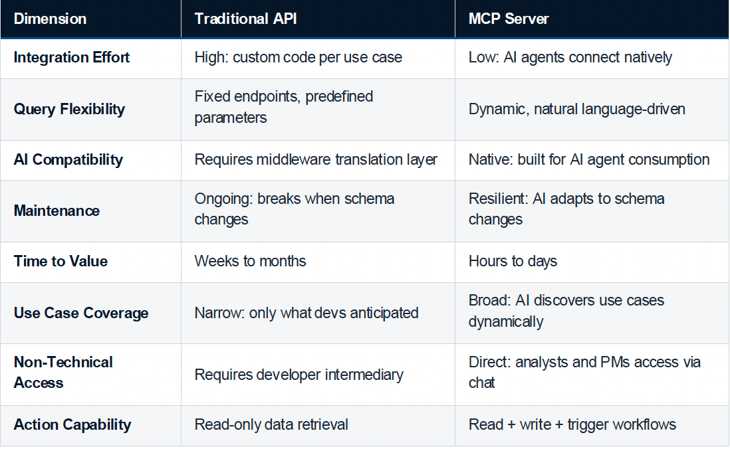
API vs. MCP: The Head-to-Head
Here is how the two paradigms compare across the dimensions that matter most to financial data consumers:
Why It Matters: Five Structural Advantages of MCP Servers
1. AI Agents Are the New Integration Layer
The future of enterprise software is agentic. AI models like Claude don't consume REST APIs the way developers do. They need context, not just endpoints. MCP servers are built from the ground up for this world. When your data is available via MCP, it becomes accessible to every AI agent, assistant, and workflow built on top of any major model.
2. Zero-Code Data Access for Business Users
Your analysts, portfolio managers, and relationship managers don't write code. An MCP-connected AI means they can ask "Show me all public pensions in the Midwest that invested in first-time managers in the last three years" in plain English and get an answer. No ticket to the data team. No waiting on a developer.
3. Composability Across Data Sources
An AI agent can connect to multiple MCP servers simultaneously and synthesize across them. Your LP data, your CRM, your market intelligence: an AI with MCP access to all three can answer questions that no single API could ever serve on its own.
4. Dramatically Faster Time to Value
Traditional API integrations require scoping, development, testing, and maintenance cycles. An MCP server integration can be stood up and producing value in hours. For data providers, this means faster customer adoption, stickier usage, and lower support burden.
5. The Data Becomes Part of the Agent's World
With an API, data sits outside the AI's reasoning process. It's retrieved and handed off. With MCP, data is woven into the agent's decision-making in real time. The AI doesn't just look up an LP's contact info. It understands that LP's investment history, mandate, and recent activity in context, and acts accordingly.
Product Announcement: Dakota's MCP Server for LP & GP Data
Dakota Marketplace is launching its MCP server, making the industry's most comprehensive LP and GP database natively accessible to AI agents and AI-powered applications.
The Dakota MCP server exposes structured, curated intelligence on thousands of institutional investors, including public pensions, endowments, foundations, family offices, sovereign wealth funds, and insurance companies, along with private fund data and GP profiles. All of it queryable in natural language, in real time, by any AI agent with an authorized connection.
This means your Claude-powered application, your internal sales agent, or your research workflow can ask for Dakota's data layer directly, and get answers the way an experienced analyst would give them, not the way a database returns rows.
Once connected, an AI agent can reason over Dakota's full data layer: LPs by asset class mandate, geography, commitment history, contact names, GP profiles, fund vintages, and more, as naturally as it reasons over anything else in its context window.
What You Need to Know, By Role
For Distribution Leaders
- Your AI sales agent can now query LP data, draft outreach, and update your CRM in a single workflow, with no developer required.
- MCP removes the middleman between your reps and your data. Answers to prospect questions happen in seconds, not days.
- An MCP-connected AI can surface which LPs match a new strategy's mandate automatically, turning research from a manual process into an always-on intelligence engine.
- Data hygiene becomes an AI function. Your MCP-connected agent can flag stale contacts, cross-reference commitments, and identify warm paths into new allocators.
- The competitive moat is no longer "who has the data." It's "who has the data connected to the smartest agent." Dakota's MCP server gives you both.
- Ask your data team one question: "Is our LP database MCP-accessible?" If the answer is no, you are building your AI strategy on a foundation that will require a rebuild.
For Data & Technology Teams
- MCP is a server that exposes your data through a set of structured functions that AI agents call dynamically. Think of it as a typed, described API built for LLM consumption.
- Authentication is handled at the MCP layer. OAuth, API keys, or token-based auth can all be implemented. Access control is as granular as you want.
- Schema changes that would break an API integration often don't break an MCP integration. The AI adapts. This dramatically reduces maintenance overhead.
- You can expose read and write capabilities. An MCP server can allow an agent to query LP data and push updates back to a CRM or internal database in the same session.
- MCP servers support streaming responses, critical for large datasets and real-time intelligence use cases where you can't wait for a full payload before beginning to reason.
- Evaluate your current data infrastructure against MCP readiness now. The teams that expose clean, well-described data via MCP first will own the most capable AI applications in private markets.
The Intelligence Layer Is Being Rebuilt Around MCP
The enterprise software stack is undergoing its most fundamental restructuring since the move to the cloud. SaaS applications are being unbundled by AI agents that can replicate their function through natural language. The winners in this new world are not the companies with the best interface. They are the companies with the best data, exposed in a way that AI agents can natively use.
That is precisely what an MCP server does. It takes your proprietary data, the hard-won, curated, verified intelligence that represents years of institutional knowledge, and makes it a first-class citizen in the AI era. Not an afterthought bolted onto an LLM. Not a retrieval-augmented footnote. A live, intelligent, queryable layer that sits at the center of how work gets done.
For private markets, where relationships are everything and information asymmetry is the edge, this is not a distant future. It is happening now. The funds, the placement agents, and the data providers that move first will define the new intelligence standard for the industry.
"Dakota's MCP server is the data feed rebuilt for the AI era: not just accessible, but genuinely useful to every agent, assistant, and workflow in your stack."
Connect Dakota to Your AI Stack
Ready to make your LP and GP intelligence natively available to every AI agent in your organization?
Dakota Marketplace tracks thousands of institutional investors, including public pensions, endowments, foundations, family offices, and sovereign wealth funds, along with GP profiles and private fund data. All of it now MCP-accessible, in natural language, in real time.
Request MCP Access here!