Key Takeaways
Public pensions continued to commit significant capital to private markets in 2025.
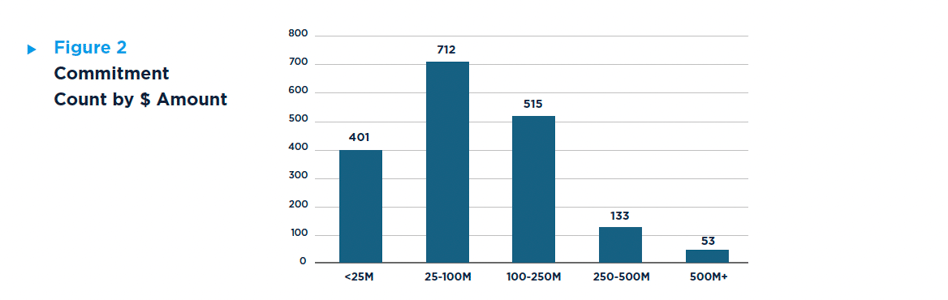
Dakota tracked more than 1,800 commitments totaling $192.7B, including 53 commitments of $500M or more that added up to about $40B, showing that a handful of very large checks still drove a meaningful share of total dollars.
The market backdrop made it easier for plans to maintain pacing.
Public markets performed well and rates came down, so many pensions were in a stronger funding position and had more room to rebalance. Deal activity and exits also picked up, which helped free up cash for new commitments.
Private credit remained a core allocation and is set to gain share.
Pensions continued to commit heavily to private credit for income and steadier cash flows, and we expect it to attract more dollars in 2026 and beyond as plans lean on credit to pace commitments and manage liquidity.
How plans put capital to work mattered as much as their allocation mix.
Many commitments were re-ups with existing managers, and there was more use of co-investments, separate accounts, and platform mandates to deploy efficiently without adding a ton of new managers.
The setup for 2026 looks supportive.
If plan assets stay higher, many pensions may need to commit more dollars just to maintain target weights. We expect private credit to keep gaining share because of its cash flow profile, private equity to remain the main growth engine, and real assets to stay relevant with its diversification benefits.
Executive Summary
Public pensions sustained active private markets commitment activity in 2025, with deployment guided by pacing discipline, liquidity positioning, and policy targets. Dakota tracked more than 1,800 publicly reported commitments totaling $192.7B across 185 plans, 663 managers, and over 1,200 distinct strategies.
The market backdrop became more supportive as the year progressed. Lower rates and strong public equity performance improved funded status for many plans and, in some cases, lifted total plan assets above forecast. That shift changed the denominator effect, giving plans more room to rebalance and making it easier to stick to their pacing targets. Cash-flow conditions also improved versus prior years, with stronger deal activity supporting deployment and improved exit momentum. Secondary markets and selective IPO activity contributed incremental distributions where available. Even with these tailwinds, fundraising remained competitive and high LP underwriting standards persisted, reinforcing a bias toward managers and structures that offered execution certainty.
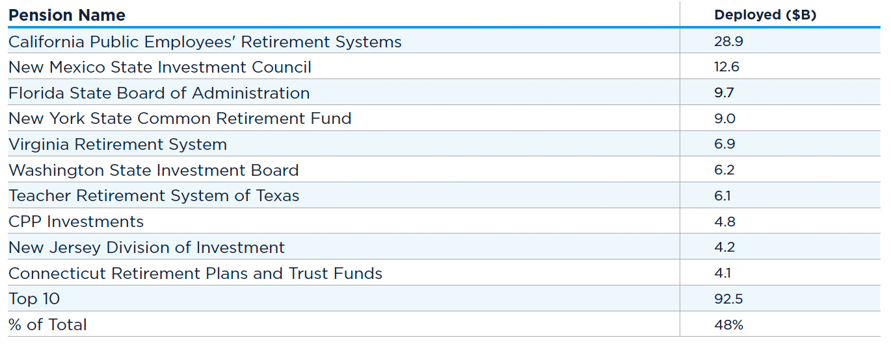
Implementation in 2025 reflected that preference. Commitments skewed toward re-ups and incumbent relationships, with increased use of co-investments, SMAs, and platform-style mandates to deploy capital efficiently without materially expanding manager rosters. Ticketing patterns were consistent with diversified pacing: the median commitment was approximately $59M (while the average was $106M), and about 90% of commitments were below $250M. A small number of large approvals materially shaped totals, with 53 commitments of $500M or more totaling roughly $40B (about 20.7% of dollars), including nine commitments of $1B or more. Concentration was also pronounced at the plan level, with the top 10 pensions representing about 48% of total dollars tracked (top 20: 64.3%), meaning aggregate trends were driven disproportionately by pacing and sizing decisions at the largest programs.
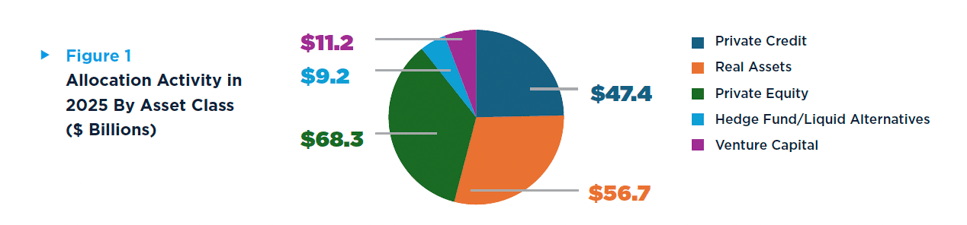
Most public pensions kept putting the bulk of their private markets capital into the core primary asset classes. Private Equity ($68.3B; 35.4%), Real Assets ($56.7B; 29.4%), and Private Credit ($47.4B; 24.6%) accounted for roughly 90% of tracked dollars. Venture Capital ($11.2B; 5.8%) and Hedge Funds/Liquid Alternatives ($9.2B; 4.8%) were smaller in aggregate but remained relevant in select programs through pacing and a limited number of large commitments. Looking ahead, the setup for 2026 appears constructive: stronger plan asset levels may require higher nominal commitment budgets to maintain policy weights, while improving realizations should support liquidity and continued deployment. We expect activity to remain relationship- and structure-driven, with private credit well positioned to capture incremental share given its cash-flow profile, private equity continuing as the primary growth driver, and real assets remaining a focus area, but with changes driven more by shifts in sub-asset classes rather than a broad-based step-up in total pacing.
The shape of allocation behavior in 2025: ticket sizes, pacing, and concentration
Commitment activity in 2025 reflected diversified pacing with selective sizing-up. The median commitment was approximately $59M (average - $106M), with the difference driven by a limited number of very large approvals. Approximately 90% of commitments were below $250M, indicating that most plans continued to deploy through steady, multi-vehicle pacing rather than concentrating annual activity in a small number of headline commitments.
Large tickets nonetheless contributed meaningfully to aggregate dollars. Dakota tracked 53 commitments of $500M+ totaling roughly $40B (about 20.7% of deployed capital), including nine commitments of $1B+. While limited in count, these approvals materially influenced year-end totals and highlight where institutions demonstrated the capacity and conviction to deploy at size.
Concentration was even more pronounced at the plan level. The top 10 pensions represented approximately 48% of total dollars tracked by Dakota, and the top 20 represented 64.3%. As a result, aggregate public pension trends in 2025 were disproportionately driven by pacing, sizing, and rebalancing decisions among a relatively small group of the largest plans.
Top 10 Pensions by Capital Deployed ($B) in 2025
Asset Class Deep Dives
Private Equity
Private Equity recorded the highest level of activity in 2025, with 702 tracked commitments totaling approximately $68B of deployed capital. Commitment volume built steadily through the year and peaked in Q4 ($20B), consistent with a strong finish to pacing and year-end approvals.
By sub-asset class, deployment was concentrated in the core components of pension private equity programs. Middle Market Buyout ($21.6B) led activity, followed by Large Cap Buyout ($13.6B) and Growth Equity ($12.0B). The mix indicates pensions continued to anchor exposure in buyouts, particularly the middle market, while maintaining meaningful growth allocations. The data also suggests a continued down-market tilt at the margin, with incremental preference for strategies focused on smaller companies. This mix was influenced in part by fundraising timing as well, as several mega- and large-cap focused managers were not in the market during the period.
Implementation in 2025 was further shaped by the use of co-investments, which totaled more than $5B and functioned as a pacing and portfolio construction tool. Co-investments allow plans to deploy incremental capital alongside incumbent sponsors, improve fee efficiency, and manage exposure without expanding manager rosters commensurately with deployment.
Alaska Permanent Fund Corporation expressed co-investments & directs as a focus area in 2026. They plan to:
1. “Enhance sourcing, screening and relationship building efforts”
2. “Leverage additional team capacity and skill sets to increase execution pace”
3. “Develop processes to capitalize on smaller, harder to access opportunities with partners”
*Focus Areas - FY 2026 - Alaska Permanent Fund Corporation
At the fund level, commitment activity reinforced the emphasis on established relationships. Great Hill Equity Partners IX and Advent International GPE XI each attracted commitments from more than a dozen pension plans, underscoring how 2025 favored re-ups into familiar franchises. Large single approvals provide additional context on where institutions were willing to write “big checks,” including a $1B commitment to Blue Owl GP Stakes VI and a separate $1B commitment to Evergreen Park Investment Fund. These examples reflect two distinct implementation approaches: platform exposure through GP stakes and flexible deployment through an evergreen structure.
Private Credit
Private Credit captured $47.4B of commitments across 348 tracked transactions in 2025. Activity was weighted to the second half of the year, with the strongest quarter in Q3 ($16.5B) and a still-strong Q4, consistent with steady pacing and continued demand for private credit exposure.
By strategy, capital was directed primarily to direct lending and then complemented by opportunistic and structured allocations. Corporate Lending led the asset class at approximately $19.2B (40%), followed by Special Situations at roughly $9.5B (20%). Pensions also allocated meaningful capital to Diversified Credit ($5.9B; 12%) and Asset-Backed strategies ($5.4B; 11%), suggesting pensions are balancing steady, core lending exposure with allocations to higher-yielding credit. A notable trend within the category is the continued adoption of asset-backed strategies, supported by new product launches and increasing investor appetite for diversified, collateral-based credit exposure.
Large commitments reinforced private credit’s role as a primary private markets allocation for many public plans. Notable examples included CalPERS’ $1.58B commitment to Ares Special Opportunities Fund III and $1.2B to OHA Senior Private Lending Fund (OLEND), illustrating willingness to write large checks across both opportunistic and direct lending mandates.
Manager-level activity highlights institutional preference for platforms capable of underwriting consistently at size. Ares Management and Oak Hill Advisors ranked among the largest managers by total tracked dollars. Taken together, the data points to continued emphasis on manager capacity, underwriting repeatability, and deployment reliability within an allocation that has become foundational in many pension portfolios.
Real Assets
Real Assets totaled $56.7B across 510 tracked commitments in 2025 and was the primary driver of the year’s Q3 spike. Commitments peaked in Q3 ($21.1B) versus Q1 ($7.9B), indicating that many of the largest mandates were approved and disclosed in the second half of the year.
At the sub-asset class level, Real Assets was defined primarily by Real Estate and Infrastructure. Real Estate accounted for roughly $27.0B (47.6%) and Infrastructure totaled approximately $19.7B (34.8%), with the remainder allocated across smaller allocations such as natural resources and real assets debt. The mix reflects differentiated portfolio roles, with infrastructure providing longer-term exposure backed by contracts or steady cash flows, while real estate offered a wider range of implementation options across risk profiles and return objectives. Growth in infrastructure remains notable, led by data center exposure and other more focused strategies within the infrastructure universe.
Within real estate, allocations leaned toward strategies that sat higher on the risk/return spectrum. Opportunistic ( $12.5B) and Value-Add ($8.9B) together exceeded Core and Core-Plus ($5.5B). This skew suggests plans emphasized managers positioned to generate returns through leasing, repositioning, development, and sector rotation rather than relying primarily on stabilized income.
Large individual commitments further illustrate how pensions sized exposure across distinct Real Assets mandates. Examples include a $1.4B commitment to Charter Hall Convenience Retail Fund (Core/Core-Plus real estate) and a $1.33B commitment to Japan DC Partners I (Infrastructure). Taken together, these allocations highlight how plans balanced stabilized, income-oriented real estate exposure with longer-duration infrastructure deployment within the same pacing year.
Manager selection patterns indicate that a meaningful share of Real Assets dollars flowed to established managers able to absorb large mandates in infrastructure and opportunistic real estate, while overall commitment counts reflected a broad set of specialist strategies. In 2025, Real Assets functioned both as a destination for large mandates and as a toolkit for targeted exposures, depending on sub-asset class and implementation style.
Venture Capital
Venture Capital totaled $11.2B across 203 tracked commitments in 2025. Activity was concentrated in earlier-stage exposure. Early Stage (Series A/B) accounted for approximately $7.9B (70.6%), while Late Stage (Series C+) represented roughly $1.9B (17.3%). The split suggests pensions expressed venture exposure primarily through early-stage managers and fund programs, with early-stage pacing materially outpacing later-stage commitments. This pattern is consistent with investor preferences shifting earlier in the risk curve, including increased emphasis on AI, defense, and other deep tech-oriented themes, where differentiation and value creation are often underwritten earlier in company lifecycles. Early-stage pacing also tends to be a more consistent mechanism for maintaining venture exposure over time, while late-stage activity is more sensitive to entry valuations and the near-term exit environment. Overall, venture capital remained a deliberate but contained allocation in 2025, rather than a primary destination for incremental private markets dollars.
VC totals were meaningfully influenced by a small number of large programs. CalPERS represented approximately $3.9B (35%) of total VC dollars tracked, and the New Mexico State Investment Council represented roughly $2.3B (20%). Combined, these two plans accounted for more than half of the VC dollars in the dataset. CalPERS’ prominence is also notable in the context of market access: its California location and proximity to key venture networks can support relationship depth and information flow, and its ability to commit at meaningful size allows it to remain relevant in capacity-constrained areas of the market. This dynamic is reflected in CalPERS’ activity with established venture franchises such as Lightspeed, Thrive, and Base10, where allocations are often tightly managed and access can be relationship-driven. As a result, year-to-year movement in aggregate venture totals can reflect pacing decisions at a limited number of large programs rather than a broad shift across the public pension universe.
Hedge Funds / Liquid Alternatives
Hedge Funds and Liquid Alternatives totaled $9.2B across 50 tracked commitments in 2025. It was the smallest category by both commitment count and dollars, but average ticket sizes were larger, with a median commitment of approximately $150M. Activity was driven by a relatively small number of sizable allocations, with notable examples including a $500M commitment to Capula Tail Risk Fund, $450M to Man AHL Alpha, and $408M to Mariner Atlantic Multi-Strategy.
The combination of fewer approvals, larger ticket sizes, and activity clustering later in the year suggests hedge fund commitments functioned primarily as a tactical tool for portfolio risk management and diversification, rather than an allocation managed through the same continuous pacing framework used across private markets. This dynamic is also consistent with the asset class typically exhibiting lower portfolio turnover at the plan level, which results in fewer individual allocations over time as investors make more periodic, higher-conviction adjustments rather than frequent new commitments.
Key Insights
Pensions are underwriting capacity and implementation, not just expected returns
A central takeaway from the 2025 commitment data is that many pensions are prioritizing implementability alongside return objectives. For larger plans, the underwriting question is not only whether a strategy is attractive, but whether it can absorb a large check without changing mandate behavior, increasing concentration risk, or forcing inefficient fragmentation across too many vehicles. In practice, this is as much a capacity and governance question as it is an investment question.
This helps explain why dollars clustered in strategies and structures built for larger commitments. Multi-strategy and diversified credit vehicles, infrastructure and real assets programs, and managers with established co-investment capabilities serve as both exposures and deployment channels. They allow plans to commit meaningful capital, maintain pacing, and manage portfolio construction without continuously expanding manager rosters, while still preserving diversification and implementation consistency.
As private markets allocations grow, pacing discipline and the ability to execute become binding constraints. Uneven deployment increases the risk of cash drag, vintage concentration, and unintended exposure skews. Repeatable relationship structures, co-investment programs, and separate accounts help reduce those risks by improving deployment reliability and giving plans more control over timing, sizing, and exposure.
Private markets investing is becoming more structured and repeatable.
The 2025 data suggests LPs are becoming more methodical in how they maintain exposures over time. Most commitment dollars continue to flow to the primary private markets asset classes, including buyout, growth, venture, private credit, and real estate and infrastructure, reflecting the extent to which these allocations are managed as durable program exposures rather than opportunistic reallocations. This shift is visible in pacing frameworks that emphasize multi-year commitment budgets, vintage diversification, and staying invested through cycles. The core question has increasingly become how much to commit each year to keep each allocation at the intended weight, not whether to allocate in a given year. Co-investments and SMAs have become more prevalent within this framework because they support execution, enabling more consistent deployment, improved fee efficiency, and exposure adjustments without materially increasing manager count.
A three-sleeve portfolio posture: growth, income, and duration
The asset class mix suggests a relatively clear role assignment across the major private markets sleeves:
-
Private Equity: primary growth exposure over a long horizon
-
Private Credit: income generation and downside-oriented return profile
-
Real Assets: duration exposure and diversification via contracted or asset-backed cash flows
Private equity continued to serve as the primary growth sleeve, led by buyout and growth strategies that plans can pace predictably across vintages. Private credit functioned as a core allocation, supporting yield and providing the ability to allocate across direct lending, opportunistic credit, and structured segments depending on the opportunity set. With base rates higher in recent years, private credit has increasingly competed with private equity within pension portfolios. Real assets, particularly infrastructure and real estate, provided longer-duration cash flows and diversification characteristics distinct from both equity and credit.
Overall, 2025 commitment behavior is consistent with pensions reinforcing a balanced private markets design, with each sleeve expected to deliver a specific portfolio function. The emphasis appears to be on program durability and execution discipline, rather than reallocating aggressively toward narrow themes.
Private Market Pacing Plans: How will allocations shift in 2026
Note: Hedge Funds are not analyzed here, as most plans don’t manage them with the same commitment and cash-flow pacing process used for private markets.
Leveraging Dakota’s documented repository of public pension pacing plan materials, we reviewed a select set of plans to assess how 2026 commitment budgets are evolving by asset class. These documents translate strategic policy targets into annual commitment budgets and are typically informed by expected capital calls, distributions, NAV growth assumptions, and total plan asset forecasts.
Across the plans reviewed, the primary implementation lever is the annual commitment budget, which is used to manage allocations back toward policy targets over time. When private markets exposures drift below target, often because total plan assets grow faster than private NAV, plans increase commitment budgets to close the gap. When allocations are at or above target, plans may reduce budgets and allow exposure to trend down through distributions and natural runoff, while maintaining sufficient primary activity to preserve vintage-year diversification and sustain ongoing manager relationships.
Connecticut Retirement Plans and Trust Funds (CRPTF) provides a clear example of scaling commitment budgets toward targets, particularly in Private Credit, where the step up from 2025 to 2026 (72%) is notable. It also highlights how larger plans can increase annual commitments without changing policy weights, where higher budgets reflect pacing needs and cash-flow assumptions rather than a shift in strategic allocation. For 2026, CRPTF sets sizable commitment budgets across Infrastructure and Natural Resources, Real Estate, Private Credit, and Private Equity:

CRPTF notes that stronger-than-expected asset growth and state contributions lifted total fund assets above prior projections. This matters from a pacing standpoint. As the denominator grows, plans need larger nominal commitments to maintain or rebuild the same policy weights, even if target percentages are unchanged. In practice, rising commitment budgets tend to show up first in sleeves that can absorb large annual programs, particularly private credit and private equity, with real assets adjusting in parallel as plans balance target exposures with liquidity and cash-flow management.
Private Equity/Venture Capital
*Most plans treat venture capital as a sleeve within the private equity program for policy and pacing purposes. VC is therefore included in this section.
Across the pacing plans reviewed, private equity is generally where the largest commitment budgets appear. This reflects the mechanics of maintaining exposure over time. When realizations and distributions reduce NAV faster than it is replenished through new commitments, allocations can drift down unless annual pacing increases, particularly for programs targeting consistent vintage diversification.
The Kansas Public Employees Retirement System (KPERS) illustrates this dynamic. Following a policy change that increased its private equity target from 9% to 11%, KPERS recommended a higher 2026 annual commitment range of $800M to $900M, up from $650M to $750M in 2025. KPERS attributes the higher pacing to a larger-than-forecast plan market value and to distributions exceeding contributions, a notable datapoint given broader market commentary around muted DPI in private equity and venture capital.
The Orange County Employees Retirement System (OCERS) provides a contrasting example. OCERS reports private equity at approximately 17% versus a 15% target, within a 10% to 20% policy range. The plan continues to underwrite sizable annual commitments, at roughly $750M in both 2025 and 2026, while modeling the allocation trending down over time. This approach is consistent with pacing designed to preserve program continuity and vintage-year diversification without increasing an existing overweight.
Overall, the pacing plans suggest a modest upward bias in 2026 private equity commitment budgets, but the direction is not uniform. The clearest increases appear among plans that have raised policy targets or require higher commitments to offset realized NAV and distributions. Where allocations are already at or above target, pacing is better understood as maintaining the program rather than adding net exposure, and large commitment budgets can persist without implying a higher long-term allocation.
Real Assets
Across the pacing plans reviewed, real assets budgets are generally managed through portfolio positioning decisions rather than headline commitment levels, with the most visible adjustments occurring within real estate. In Aksia’s real assets pacing plan for the Nebraska Investment Council, 2026 commitments of roughly $150M to $200M are paired with an intent to consolidate relationships with core open-end managers while continuing to increase value-add exposure. The implication is a deliberate shift in implementation and risk posture, with commitment dollars used to reshape the portfolio rather than materially expand it.
Callan’s review for the Chicago Teachers’ Pension Fund reflects a similar framework. With real estate modestly above target, near-term pacing is framed around maintaining program continuity and refining exposures within policy bands, rather than adding incremental real estate risk. The emphasis is on mix and manager selection, not increasing total real estate exposure.
For infrastructure and natural resources, pacing is more mixed and tends to be target-driven. Where plans are underweight or still building exposure, commitment budgets can move higher, as suggested by CRPTF’s infrastructure and natural resources pacing. Where allocations are already within range, pacing is more programmatic, with the focus on manager selection, sector and geographic mix, and structure rather than a material increase in the headline budget. The result is continued activity, but with less evidence of a uniform step-up across plans.
The State of Michigan Investment Board, through its Real Estate and Infrastructure Division (REID), continues to deploy capital in real assets, but with increased scrutiny:
“While market fundamentals are showing signs of stabilization, investor sentiment remains cautious. Transaction volumes continue to be subdued as macroeconomic uncertainty and geopolitical risks weigh on capital deployment decisions. In the real estate sector, scarcity of future new supply and increasing replacement costs are setting the stage for rent increases, especially in prime markets. [...]We continue to build exposure to both traditional and emerging real estate sectors that are positioned to become institutionalized and offer potential for long-term outperformance.
“In the infrastructure sector, REID continues to focus on fundamentals and partnering with managers with top performing track records and best in class investment teams, who are pursuing opportunities in sectors with attractive risk adjusted return potential”
* State of Michigan Retirement System Real Estate and Infrastructure Review (December 17th 2025)
Overall, 2026 real estate pacing appears roughly flat to modestly higher, with increases concentrated among plans that have been underweight and are rebuilding exposure, rather than reflecting a broad-based step-up across the public pension universe. CRPTF is a clear example, with 2026 planning materials indicating the plan is evaluating a higher real estate commitment budget, on the order of $1.0 to $1.2B, following a period of below-expected deployment, which is consistent with a catch-up response when exposure has drifted down. By contrast, where plans are already at or above target, pacing is generally framed around maintaining commitment continuity and adjusting mix across core, value-add, and opportunistic strategies, rather than increasing net real estate exposure.
Private Credit
Across the pacing plans reviewed, private credit is the clearest lever for adjusting overall private markets exposure, largely due to its more predictable draw and repayment profile relative to private equity. Plans also use private credit pacing as a liquidity management tool, smoothing net cash flows while maintaining broader private markets commitment programs.
Contra Costa County’s plan (CJERS) provides a straightforward build-and-maintain example. With a 7% private credit target, CJERS recommends annual commitments of $60M for 2026 to 2028, followed by $50M per year thereafter. The stepped schedule is designed to reach the target and then stabilize exposure through ongoing pacing.
At the larger plan level, CRPTF’s aforementioned $2.75B private credit budget for 2026 indicates credit is being used as a primary pacing lever alongside private equity. The plan’s framing underscores that private credit sizing is evaluated in the context of liquidity planning and expected call and distribution dynamics, not solely as a return-seeking allocation decision.
In aggregate, the pacing documents suggest private credit commitment budgets are biased higher into 2026, particularly among plans seeking to close allocation gaps and sustain deployment when private equity realizations are harder to forecast. The broader setup supports continued LP interest, even as managers describe a more competitive and execution-focused fundraising environment.
“The private debt markets continue to expand and evolve. Increased deal activity bodes well for new deployment as well as refinancings and realizations in existing portfolio [...]Due to regulatory pressure, banks continue to pull back from several markets. The financing gaps being left behind provide opportunities for private debt managers to step in and offer alternative solutions for borrowers.”
*NEPC Private Debt Outlook
Outlook
The setup for 2026 is constructive for private markets. Strong public markets have lifted plan assets and improved funded status, and for plans managing to policy targets this creates a denominator effect that can require higher commitment budgets to maintain private markets weights. At the same time, improved deal activity in 2025 and a supportive forward backdrop should support realizations and distributions, helping reduce dry powder and unfunded commitments and improving liquidity for new commitments.
In this environment, commitment activity should remain healthy but concentrated in repeat relationships and structures that facilitate efficient deployment. Re-ups are likely to remain the primary driver of activity, alongside continued use of co-investments, separate accounts, evergreen vehicles, and secondaries as tools to manage pacing, fees, and concentration.
By asset class, private credit is positioned to capture a larger share of incremental commitments given its more predictable cash-flow profile and its role as a pacing lever when private equity realizations are harder to forecast. Private equity should remain the primary long-horizon growth allocation, with budgets stepping up mainly where plans are underweight, have raised targets, or are replenishing realized NAV. Real assets should remain active, with infrastructure and select real estate strategies attracting capital, and changes driven more by mix shifts and targeted gap-filling than by a broad-based increase in overall real assets pacing.
Dakota Marketplace
Dakota is a financial, software, data and media company based in Philadelphia, PA. Dakota’s flagship product, Dakota Marketplace, is a database of LPs, GPs, Private Companies and Public Companies used by fundraising teams and deal sourcing teams to both raise money as well source investment opportunities. Over 1,300 global investment firms use Dakota daily.
For more information, book a demo of Dakota Marketplace!