Evergreen funds now represent one of the fastest-growing segments of the private markets. Dakota tracks more than 600 evergreen vehicles across private equity, private credit, real estate, and hybrid strategies, and we've identified nearly 100 additional funds that weren't previously categorized as evergreen structures.
The growth isn't slowing down. Allocators from high-net-worth individuals to pension funds are increasing their exposure to these perpetual vehicles, drawn by their flexibility, continuous deployment, and periodic liquidity. For fund managers, this shift creates both a fundraising opportunity and a competitive intelligence challenge.
This article breaks down what evergreen funds are, why allocators are moving into them, and how Dakota's new Evergreen Performance Benchmarking dataset helps both fund managers and allocators navigate this expanding market.
What Makes Evergreen Funds Different
Traditional private equity and credit funds operate on fixed timelines, typically 10-year cycles with defined investment and exit periods. Investors commit capital upfront, wait for it to be deployed through capital calls, and eventually receive distributions when the fund winds down.
Evergreen funds work differently. They're open-ended structures with no set expiration date, allowing capital to flow in and out at scheduled intervals. The key structural differences:
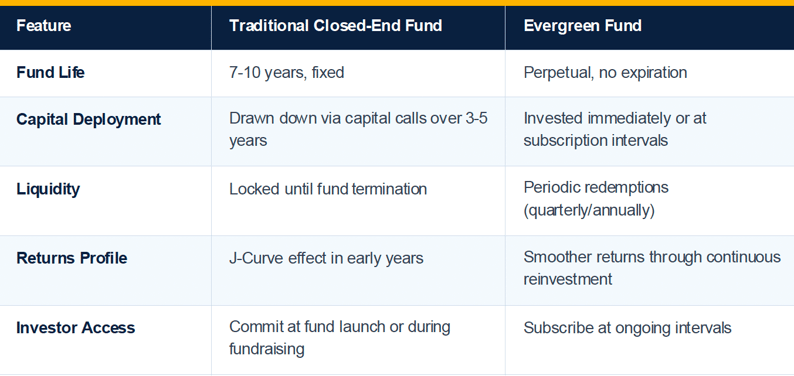
The perpetual structure means fund managers can hold investments longer when conditions warrant, rather than being forced to exit on a predetermined schedule. For allocators, it eliminates the capital call management burden and provides a more predictable deployment timeline.
Why Allocators Are Moving Into Evergreen Structures
The shift toward evergreen vehicles isn't happening by accident. Several structural forces are driving adoption across multiple allocator channels.
1. The Wealth Channel Wants Access
High-net-worth individuals, family offices, and registered investment advisors have historically faced barriers to private market investing: high minimums, long lockups, and capital call complexity. Evergreen funds solve these problems.
Major managers including Blackstone, Apollo, Ares, and Blue Owl have built evergreen vehicles specifically for the wealth channel, with lower minimums and quarterly subscription windows. The pitch is straightforward: private market exposure without the operational complexity of traditional drawdown structures.
2. Institutional Investors Need Yield
Pension funds and insurance companies face the same challenge: generating sufficient returns to meet long-term liabilities in a rate environment that has whipsawed over the past several years. Evergreen private credit funds have emerged as a core allocation for these investors, particularly as banks have pulled back from direct lending.
The evergreen structure offers continuous deployment (no uninvested cash drag) and predictable income, both of which matter for liability-matching investors.
3. The J-Curve Problem Is Real
Traditional private equity funds often show negative returns in their early years. Management fees drag on a portfolio that hasn't yet generated realizations, creating the well-documented J-Curve.
Evergreen funds mitigate this effect. Because capital is deployed immediately into an existing portfolio and returns are reinvested rather than distributed, performance stabilizes faster. For allocators benchmarking their alternatives programs, this smoothing effect simplifies reporting and reduces the tracking error that comes with vintage year dispersion.
4. Diversification Across Vintages
A single traditional fund concentrates investments in a narrow time window. If that vintage happens to coincide with peak valuations or a market downturn, the entire fund suffers.
Evergreen vehicles invest continuously across market cycles, providing built-in vintage diversification. An investor subscribing today gains exposure to a portfolio that was built over multiple years, not a single deployment window.
The Performance Transparency Problem
Here's where it gets interesting for fund managers and allocators alike.
The evergreen market has grown rapidly, but transparency has not kept pace. Performance data has been scattered across regulatory filings, inconsistently reported, and difficult to aggregate. Despite this, Dakota has been able to systematically review regulatory filings, including SEC disclosures and related documentation, and identify performance data for more than 600 evergreen funds. During this process, we uncovered nearly 100 additional evergreen vehicles that weren't widely tracked or categorized as evergreen strategies.
The result is one of the most comprehensive evergreen benchmarking datasets in the market.
What Dakota's Evergreen Performance Benchmarking Includes
Dakota's Evergreen Performance Benchmarking dataset consolidates publicly available performance data into a standardized, benchmark-ready format:
- 600+ evergreen funds tracked across private equity, credit, real estate, and hybrid strategies
- Standardized performance metrics normalized across different reporting formats
- Fund information including strategy details, AUM, fee details, and more
- Strategy classification enabling peer comparison within asset classes
All performance data is sourced from publicly available filings. Dakota organized it into a format that allows both fund managers and allocators to benchmark the market systematically.
How Fund Managers Use This Data
If you're raising or managing an evergreen vehicle, competitive intelligence matters.
Understand the Landscape → See how peers are structuring their evergreen products, what liquidity terms they're offering, and how they're positioning relative to traditional drawdown vehicles.
Benchmark Reported Performance → Compare your fund's performance against the relevant peer set. When an allocator asks how you stack up against comparable evergreen vehicles, you need data, not anecdotes.
Track Capital Formation Trends → Monitor which strategies are attracting capital in the evergreen format. Private credit dominates today, but real estate, infrastructure, and secondaries are expanding.
Identify New Market Entrants → Know who's launching evergreen vehicles before you face them in a competitive process. Early visibility on new market entrants helps you position your fundraising conversations.
How Allocators Use This Data
For investment teams evaluating evergreen allocations, the dataset provides the underlying transparency that has historically been missing.
Benchmark Against Peers → If you're invested in evergreen vehicles or considering them, you need performance context. How does your current exposure compare to the broader universe?
Compare Structures and Terms → Liquidity provisions vary significantly across evergreen funds. Some offer quarterly redemptions with 5% gates; others have different mechanisms. The data enables systematic comparison.
Track Sponsor Expansion → Major sponsors are rapidly building out their evergreen product suites. Understanding which managers have evergreen offerings, and how those vehicles have performed, informs allocation decisions.
Monitor Market Trends → The evergreen market is evolving quickly. Having visibility into fund launches, capital formation, and performance across the space helps allocators stay ahead of the curve.
The Bottom Line
Evergreen funds have become a core part of private markets distribution, driven by wealth channel demand, institutional yield-seeking, and structural advantages over traditional drawdown vehicles.
For fund managers, the growth creates opportunity, but also intensifies competition. Knowing how your evergreen vehicle stacks up against peers, and having the data to prove it, becomes a fundraising differentiator.
For allocators, the expansion of evergreen offerings increases choice but also complexity. Systematic performance data helps separate signal from noise.
Dakota's Evergreen Performance Benchmarking dataset brings transparency to a market that has operated without it. Whether you're raising capital or deploying it, the data is now available.
Explore Dakota's Evergreen Fund Data
Dakota Marketplace tracks 600+ evergreen funds with standardized performance metrics, regulatory filings, and sponsor-level analysis. Filter by strategy, structure, liquidity terms, or performance range. Book a demo to see the full evergreen dataset and explore how it fits your workflow.