February extended the momentum seen in January. M&A activity improved and venture funding reached new highs, led by OpenAI’s $110 billion financing, the largest private technology round ever, and Anthropic’s $30 billion Series G. At the same time, Anthropic’s latest model releases triggered a sharp sell-off in global software stocks as investors reassessed sector valuations.
The repricing quickly moved into credit markets. Public BDCs with meaningful software exposure traded lower, while spreads widened and underwriting tightened. Lenders are increasingly focused on how the AI platforms could reshape competitive dynamics and challenge the durability of certain software business models.
Despite the volatility, private market activity remained constructive. Investor attention is increasingly shifting toward a potential reopening of the IPO market. SpaceX may test the window as early as June, while OpenAI and Anthropic are frequently discussed as candidates for listings between 2026 and 2027. Even one of these offerings could rank among the largest technology IPOs in history and help restart the distribution cycle.
Key Market Indicators – February 2026
- Capital Concentrates in AI Leaders: OpenAI reportedly raised $110 billion, the largest venture round on record, while Anthropic secured $30 billion, highlighting the scale of capital flowing into frontier AI platforms.
- AI Innovation Pressures Software: Anthropic’s latest model release triggered a sell-off across global software equities as investors reassessed disruption risk for legacy SaaS and services businesses.
- Credit Markets Turn More Selective: Public BDCs signaled a more cautious stance toward software-heavy portfolios, with greater scrutiny on revenue durability, leverage, and customer concentration.
- Large-Cap PE Fundraising Holds: Veritas Capital raised $15.3 billion for Fund IX, while HGGC Fund V and Novacap Technologies Fund VII also closed above target despite a more selective LP backdrop.
- Secondaries Remain in Demand: Ardian, Blue Owl, and CVC each raised multi-billion-dollar vehicles as LPs continue to seek liquidity and portfolio rebalancing solutions.
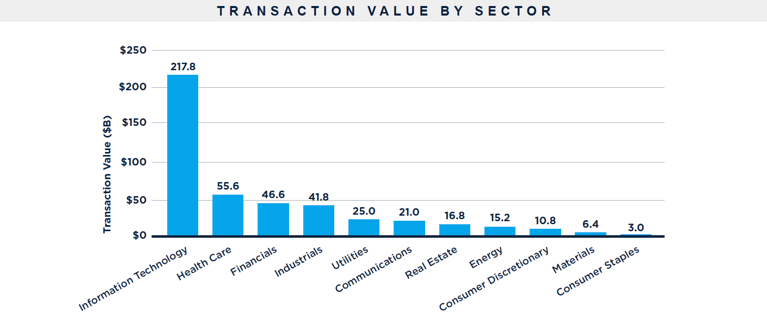
Dakota tracked approximately 1,500 announced private capital transactions totaling ~$460 billion in disclosed value in February, up ~47% month-over-month from $312 billion in January. Activity stayed concentrated in AI, infrastructure, and healthcare, where investors continue deploying capital behind structural growth themes.
Fundraising Highlights
February maintained strong fundraising momentum, with several flagship vehicles closing above target and liquidity-focused strategies drawing significant commitments. Veritas Capital led the month with the $15.3 billion final close of Fund IX, exceeding its predecessor and marking one of the largest private equity fundraises of the year. In the middle market, HGGC Fund V ($3.2 billion) and JLL Partners Fund IX ($1.4 billion) both surpassed targets, while Novacap secured nearly $3.8 billion for its technology-focused Fund VII.
Secondaries remained a focal point for LP capital. Ardian advanced $5.2 billion for Infrastructure Secondary Fund IX, Blue Owl raised more than $3 billion for its inaugural strategic equity and GP-led secondaries vehicle, and CVC exceeded its target for Secondary Opportunities Fund VI. Sector-focused mandates also gained traction, including Otro Capital’s $1.2 billion debut sports fund and BlueFive Capital’s $3 billion technology-oriented Onyx Fund I, anchored by Gulf sovereign investors.
Private credit fundraising centered on secondaries, continuation vehicles, and capital solutions. Tikehau Capital closed more than $1 billion for Private Debt Secondaries II, while Coller Capital structured a $1.3 billion continuation vehicle backed by Ares’ U.S. direct lending portfolio. Arcmont secured $1.8 billion for Capital Solutions II, and Capza held a $1.7 billion first close for its European private debt strategy targeting unitranche and subordinated lending.
Infrastructure and energy credit vehicles also advanced. These included Allianz Global Investors’ $1.3 billion infrastructure credit fund and Breakwall Capital and Vitol’s third upstream energy partnership.
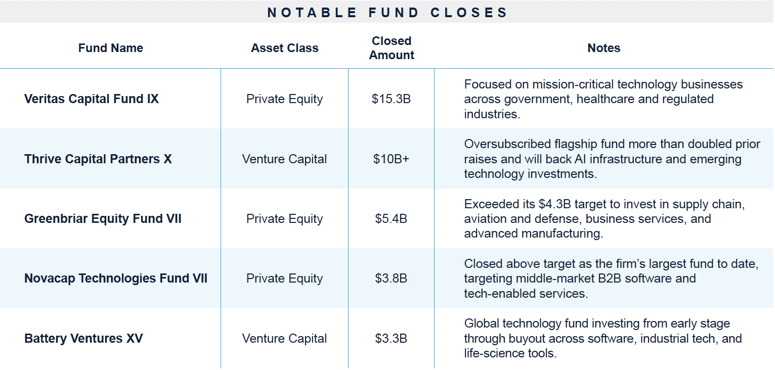
Venture fundraising was focused on established managers and AI-focused strategies. Thrive Capital reportedly raised more than $10 billion for Fund X, its largest vehicle to date. Battery Ventures closed $3.3 billion for Fund XV, while Peak XV Partners secured $1.3 billion across India and APAC mandates. Mundi Ventures held an $884.5 million first close for Kembara Fund I.
Thematic vehicles targeting healthcare and climate innovation also advanced. These include Obvious Ventures’ $360 million fifth core fund and Yosemite’s oncology-focused Fund II, which has surpassed $200 million.
Institutions were active across private equity, private credit, real estate, and liquid alternatives. The New York State Common Retirement Fund approved $600 million to Great Mountain Partners’ Saranac Holdings and related co-investments. Los Angeles County Employees Retirement Association committed $412 million to Clarion Lion Properties Fund and $400 million to PGIM PRISA. Washington State Investment Board backed Francisco Partners VIII with $400 million, while the New Jersey Division of Investment allocated $350 million to Golub Capital’s direct lending strategy. Arkansas Teacher Retirement System committed $400 million to Sands Capital’s Scaling Innovation Fund.
Overall, February fundraising activity reinforced several prevailing trends. LP capital continues to concentrate with established managers. Secondaries remain in high demand. Sector-focused mandates, particularly in technology and AI, continue to attract significant commitments across private markets.
M&A Activity
February dealmaking was driven by large-scale AI financings and strategic technology acquisitions, reflecting the rapid buildout of next-generation computing infrastructure. Investors and strategics continue to prioritize companies developing foundation models, cybersecurity platforms, and autonomous systems as AI adoption expands across industries.
Two of the largest transactions of the month highlighted the scale of capital required to compete in frontier AI. OpenAI completed a landmark financing backed by Amazon, Nvidia, and SoftBank, reinforcing the growing role of hyperscalers and global capital providers in funding AI infrastructure. Anthropic followed with a major financing led by Coatue Management and GIC, supporting continued investment in frontier model development and large-scale compute capacity.
Together, these transactions reinforce a market structure in which a small number of well-capitalized platforms are emerging as core providers of large-scale AI capabilities.
Strategic buyers were also active in cybersecurity. Palo Alto Networks’ acquisition of CyberArk reflects a broader push to integrate identity, machine, and agentic security into unified platforms capable of protecting increasingly complex digital environments.
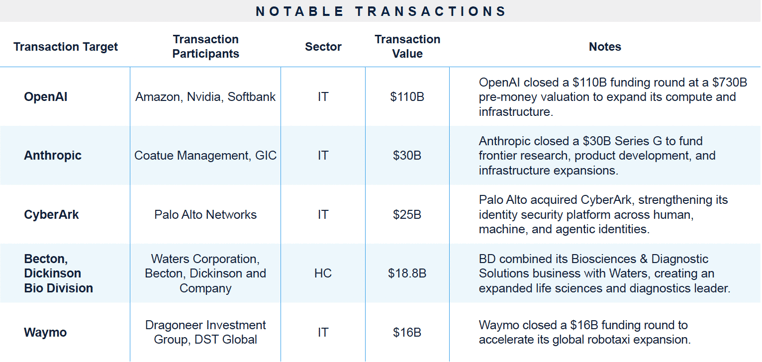
Healthcare transactions continued to focus on life sciences tools and diagnostics platforms, where consolidation is driven by the need for integrated capabilities across research, clinical testing, and biopharma manufacturing. The combination of Becton Dickinson’s Biosciences and Diagnostic Solutions business with Waters illustrates how strategics are building platforms to support increasingly complex drug development pipelines.
Infrastructure and energy transactions highlighted the growing importance of power and grid assets as electrification and AI-driven data center demand accelerate. Engie’s agreement to acquire UK Power Networks reflects continued investor demand for regulated utilities that provide stable cash flows while supporting large-scale grid modernization.
Advanced computing also remained a key area of activity in Europe. UK-based Wayve raised a $1.2 billion Series D to support the development of its autonomous driving systems, while Finland’s IQM is set to become one of Europe’s first listed quantum computing companies.
Overall, February activity underscored several structural themes shaping private markets. Capital continues to concentrate around AI infrastructure, cybersecurity platforms, life sciences tools, and regulated infrastructure assets, sectors positioned to benefit from long-term technological and industrial transformation.
Closing Thoughts
Year-to-date, private markets are regaining momentum as deal activity accelerates and capital begins to recycle more efficiently across the system. Fundraising remains constructive, strategic transactions are increasing, and the IPO window is gradually reopening. These developments are creating clearer pathways for realizations and renewed liquidity.
As exits improve and distributions rebuild, sponsors and institutional investors are positioned to redeploy capital into a broad and expanding opportunity set.
Dakota Marketplace
Dakota is a financial, software, data and media company based in Philadelphia, PA. Dakota’s flagship product, Dakota Marketplace, is a database of LPs, GPs, Private Companies and Public Companies used by thousands of fundraising, deal, and investment teams worldwide to raise capital, source deals, track peers, and access comprehensive data—all in one global platform.
For more information, book a demo of Dakota Marketplace!