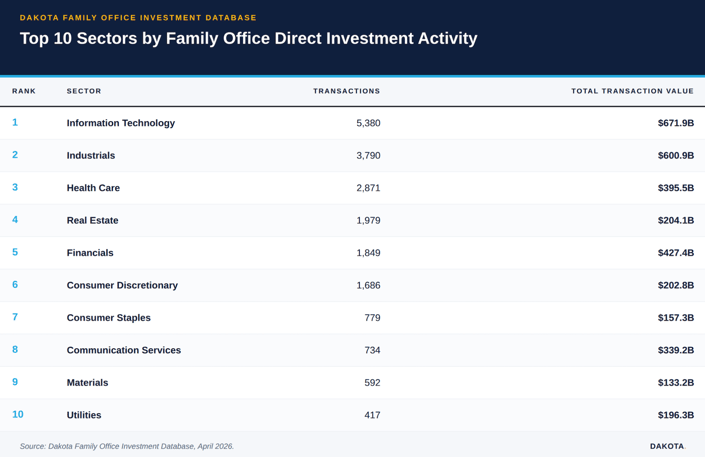
Family offices have deployed $3.83 trillion across 21,702 direct investments tracked in Dakota's Family Office Investment Database. That activity concentrates heavily: the top three sectors (Information Technology, Industrials, and Health Care) account for 55% of all tracked transactions and $1.67 trillion in deal value. The sector breakdown below draws from the same dataset that powers Dakota's Global Family Office 2025 Report.
The sectors below are ranked by direct investment activity, not survey-reported preferences. This reflects where family capital has actually moved into portfolio companies across venture, growth equity, buyouts, private credit, and co-investments.
For fund managers raising capital, this is the signal that matters: family offices pattern-match on sectors where they already have direct conviction, and that history predicts future commitments far better than a prospect's stated allocation target. For the broader view on what's shaping family office strategy this year, see our Top 10 Investment Trends Shaping Family Offices in 2026.
Top 10 Sectors by Family Office Direct Investment Activity
For month-by-month deal-level coverage, see Dakota's March 2026 Family Office Deal Tracker.
1. Information Technology
5,380 transactions | $671.9B total value
Technology leads all sectors, accounting for 25% of family office direct investment activity. Goldman Sachs' 2025 Family Office Investment Insights report (September 2025, 245 family offices surveyed) found that 58% of family offices plan to overweight technology in the next 12 months, with 86% holding artificial intelligence exposure. Dakota's data shows deployment concentrated in enterprise software, AI infrastructure, vertical SaaS, and cybersecurity. For fund managers, thematic specialization raises more efficiently than generalist pitches: managers focused on specific sub-themes like AI infrastructure or vertical SaaS should expect co-investment requests alongside primary commitments.
2. Industrials
3,790 transactions | $600.9B total value
Industrials activity has accelerated with AI-driven infrastructure demand and the domestic reshoring thesis. Goldman Sachs identified industrials as one of the sectors family offices favor for strong secular growth and cycle resilience. Dakota's data captures deployment across manufacturing, logistics and supply chain, automation and robotics, and electrical equipment. Managers raising industrials-focused capital should position around electrification, automation, and supply chain resilience themes, all of which map to documented family office investment priorities.
3. Health Care
2,871 transactions | $395.5B total value
Health care is being reframed from reactive treatment to longevity, biotech, and health-tech. Goldman Sachs reports that 34% of family offices are currently overweight health care, and UBS's 2025 Global Family Office Report (May 2025, 317 family offices surveyed, average AUM $1.1B) found that 35% have a clear investment strategy for health care and medicine. Activity spans biotech, medical devices, digital health, and health services. Family offices pursue health care for both financial and philanthropic alignment, which creates longer hold horizons; managers with therapeutic area specialization or platform biotech strategies tend to resonate.
4. Real Estate
1,979 transactions | $204.1B total value
Real estate is the fourth-largest sector by deal count, and family offices strongly prefer direct exposure over fund vehicles: Goldman Sachs found that 44% of family offices prefer direct investment in private real estate. Dakota's data shows activity concentrated in industrial and logistics, residential multifamily, data centers, and specialty property types. Many family offices want to see a direct deal pipeline alongside any fund commitment, not instead of it; managers raising real estate capital should come prepared to discuss co-investment opportunities as part of the pitch.
5. Financials
1,849 transactions | $427.4B total value
Financials ranks fifth by count but third by dollar value, reflecting larger deal sizes. Dakota's data shows activity across specialty finance, insurance, asset management rollups, fintech infrastructure, and bank holding companies. The pullback of traditional bank lending has created opportunity in specialty credit platforms; Goldman Sachs reported that nearly 75% of family offices are invested in private credit, with 26% planning to increase allocations further. For fund managers, private credit strategies with specialty angles (asset-based lending, middle-market direct lending, litigation finance) are actively gathering family office commitments.
Dakota's Family Office Investment Database tracks every deal above with portfolio company profiles, co-investor details, round structure, and sector tagging. Talk to an expert here!
6. Consumer Discretionary
1,686 transactions | $202.8B total value
Consumer Discretionary captures a wide range of activity: consumer brands, specialty retail, restaurants, travel and leisure, and home products. Families with operating business backgrounds in consumer goods disproportionately deploy here, pattern-matching against the playbooks that built their original wealth. For fund managers, the pitch that resonates is operator-led value creation, not financial engineering. Consumer funds with operating partner benches, brand-building expertise, or specific channel specialization (DTC, retail, wholesale) tend to raise most efficiently from family capital.
7. Consumer Staples
779 transactions | $157.3B total value
Consumer Staples is a smaller sector by count but one where family offices have historically been patient, long-duration capital. Activity concentrates in food and beverage platforms, household and personal care brands, and agriculture. The sector attracts family capital because of its cycle resilience and the prevalence of family-controlled companies available for minority stakes or generational transition deals. Managers raising capital for staples-focused strategies should emphasize pricing power through inflation and multi-generational alignment with founder-led businesses.
8. Communication Services
734 transactions | $339.2B total value
Communication Services is eighth by count but fourth by dollar value, indicating a smaller number of larger deals. Dakota's data captures activity in media and entertainment, digital advertising, telecom infrastructure, streaming, and creator economy businesses. Goldman Sachs identified sports as a growth area where 50% of family offices are either invested or interested in future investment. Capital in this sector often follows specific thematic conviction (sports, streaming, creator platforms) rather than sector-wide mandates, so specialization wins commitments.
9. Materials
592 transactions | $133.2B total value
Materials activity spans specialty chemicals, packaging, metals and mining, and building products. Family office interest ties closely to electrification, energy transition supply chains (battery materials, rare earths, copper), and industrial input demand from reshored manufacturing. UBS reported that 29% of family offices have a clear investment strategy for electrification, and materials deals are one of the primary ways that thesis gets expressed. Fund managers should position around energy transition supply chains and input security for domestic manufacturing.
10. Utilities
417 transactions | $196.3B total value
Utilities closes the top 10 with the smallest deal count but one of the highest average transaction values, driven by project finance structures and asset-backed infrastructure platforms. Activity concentrates in renewable power generation, grid infrastructure, water utilities, and energy storage. Family offices deploy here for yield, inflation hedging, and long-duration asset exposure. Infrastructure funds with renewable generation, grid modernization, or water positioning raise efficiently from family offices building out alternatives allocations.
How Fund Managers Use the Family Office Investment Database
Sector-level patterns like the ones above only drive fundraising outcomes when you can act on them at the family-by-family level. Dakota Marketplace's Family Office Investment Database is built for that workflow, tracking family offices and their direct transactions across every sector covered in this post, with deal-level visibility into stage, round, co-investors, and underlying portfolio companies.
Two patterns from the data consistently shape how fund managers work the database:
- Direct investment history is the best predictor of future fund commitment. A family office with 15 direct deals in industrial technology is a priority prospect for an industrial growth equity fund, even without prior fund commitments on record. Dakota's transaction data surfaces these families before competitors identify them.
- Thematic specialization wins over broad sector coverage. Family offices cluster direct investment in specific sub-themes (AI infrastructure within tech, biotech platforms within health care, electrification within materials). Sub-sector and co-investor filters match your fund's mandate to families with documented conviction in the same theme.
Filter by sector and sub-sector investment history, stage (venture, growth, buyout, credit) and deal size, geographic concentration, or co-investor overlap to build a targeted prospect list. For the full playbook on working this channel, see Dakota's Top 10 Best Practices for Emerging Managers Calling on the Family Office Channel.
The families investing directly in your sector today are the fund commitments you should be sourcing for next quarter. Talk to an expert here!