Public pension disclosures tracked by Dakota more than doubled during the month of March, with roughly $42.56B in reported private market commitments across 254 deals, up from about $18.76B across 207 deals tracked in February.
The March dataset skewed decisively toward private equity, private real estate, and private credit, while venture capital also posted a large step-up. Relative to February, the month’s reported mix appears to have broadened materially beyond the credit-heavy and liquid-alternatives-heavy pattern seen in prior disclosures, with several very large allocations from a small number of major plans driving a disproportionate share of total tracked volume.
Below is a breakdown of commitments by allocator and strategy, with a focus on the most notable tracked allocations with month-to-month analysis.
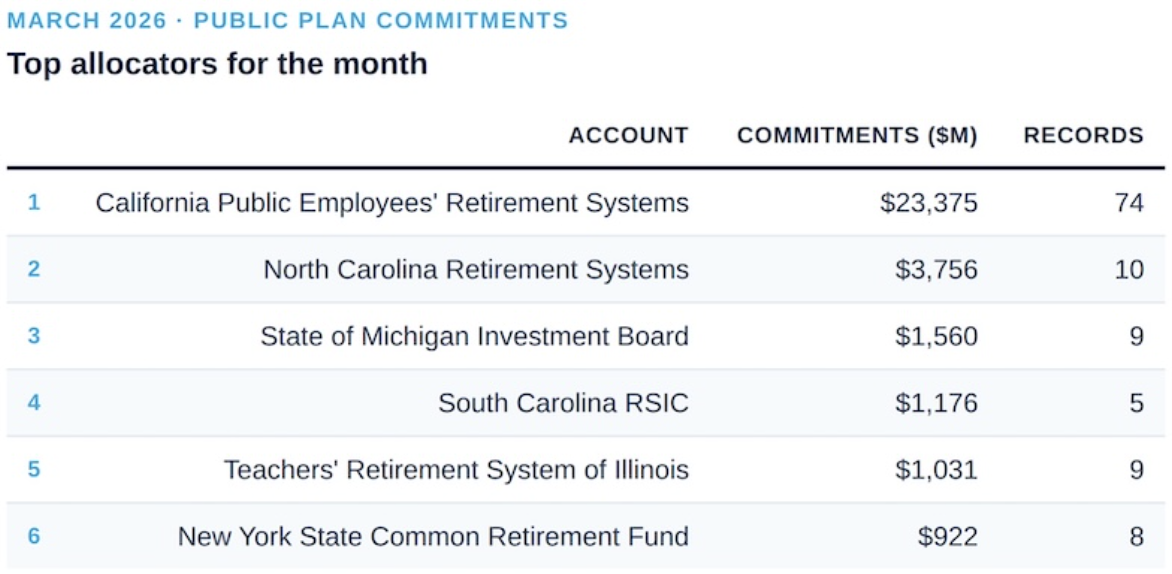
March disclosures were dominated by California Public Employees’ Retirement System (CalPERS), which accounted for about $23.38B across 74 tracked commitments, far ahead of North Carolina Retirement Systems at $3.76B across 10 deals and State of Michigan Investment Board at $1.56B across nine. South Carolina RSIC and Teachers’ Retirement System of the State of Illinois rounded out the top five by tracked dollars, at roughly $1.18B and $1.03B, respectively, while New York State Common Retirement Fund remained active with approximately $921.8M across eight disclosed investments.
The list marks a notable change from February, when New York State Common led tracked allocations at about $2.53B, followed by Florida State Board of Administration (SBA) at $2.32B and State of Wisconsin Investment Board (SWIB) at $1.58B. On a record-count basis, March showed heavy concentration through CalPERS’ 74 disclosed commitments, compared with February’s more distributed activity.
Asset Classes
Consistent throughout the first quarter, private equity remained the top asset class with the most recorded allocations from institutional investors in March at $15.67B across 118 tracked deals, or 46.5% of total reported commitments. Private real estate followed at $8.62B, private credit at $7.78B, venture capital at $4.07B, and private infrastructure at $2.77B, with hedge funds/liquid alternatives and real assets contributing $2.55B and $1.1B, respectively.
Compared with February, every major asset class expanded in dollar terms, but the largest absolute gains came from private equity, private real estate, and venture capital. Reported commitments to venture capital, in particular, jumped from just $526.1M the previous month, while private infrastructure and real assets also rebounded from below a billion in tracked commitments each in February.
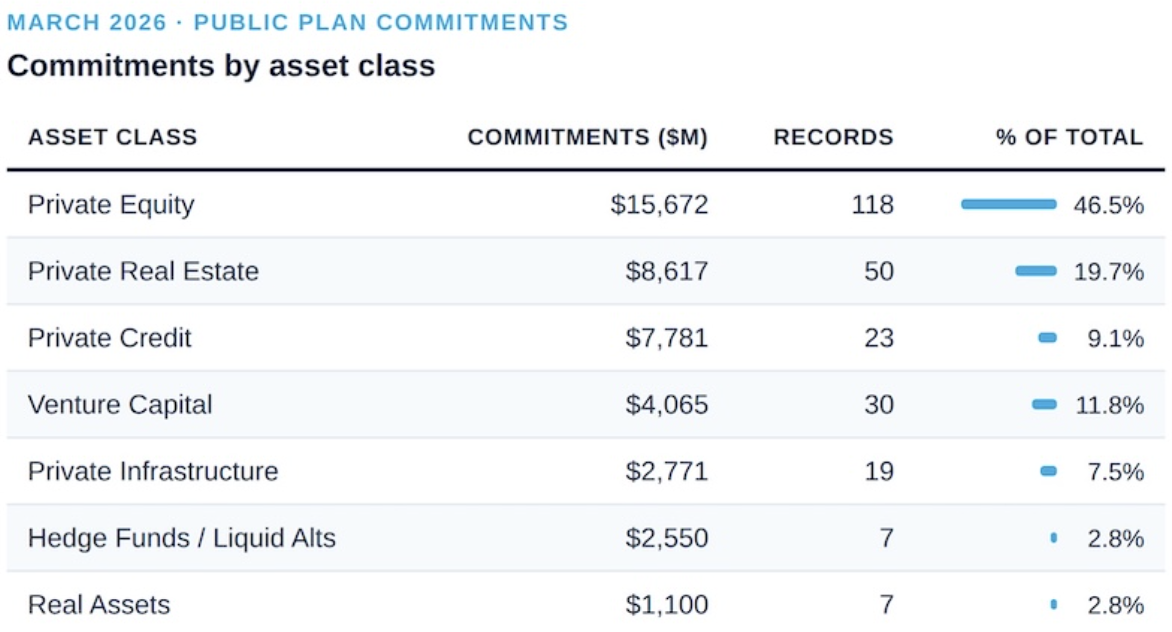
Approximately 51% (129) of the 254 tracked deals were individual commitments over $100M deployed by 33 distinct North American pensions and retirement systems. Fifty-eight of the deals were made in private equity, 25 in private real estate, 18 in private credit, 13 in real assets/infrastructure, seven in hedge funds/liquid alternatives, and eight in venture capital.
Among the largest tracked disclosures were CalPERS’ two $1.25B private credit commitments to OHA Senior Private Lending funds, alongside its $1B commitments to Golden Maple Infrastructure Partners, TechCore Fund, Blackstone Credit Series A-2 and its co-investment sleeve. North Carolina Retirement also reported a $1B allocation to AH 2026 Fund Multiplexer II in venture capital.
Sub-Asset Classes
Within private equity, buyouts were again the dominant bucket, but March represented a sharp step-up in scale rather than a steady continuation. Total buyout commitments tracked at $12.41B, nearly triple February’s $4.19B, with middle-market buyouts rising to $4.49B from $1.88B, large buyouts increasing to $2.44B from $1.84B, and lower middle-market buyouts climbing to $1.19B from $469.7M. Growth equity also surged to $3.24B from $1.04B.
Co-investments were another major differentiator in March. Across private equity, private credit, and real estate, tracked co-investment commitments totaled about $4.23B, versus roughly $1.12B in February. Private equity co-investments rose to $2.23B from $602.4M, private credit co-investments to $1B from $375M, and real-estate co-investments to $1B from $138M. Secondary private equity also expanded sharply to $1.5B from only $247.5M the previous month.
Meanwhile, venture sub-strategies showed one of the biggest directional changes in the entire dataset: early-stage venture jumped to $3.61B from $420M, while late-stage activity rose to $467M from $106.1M.
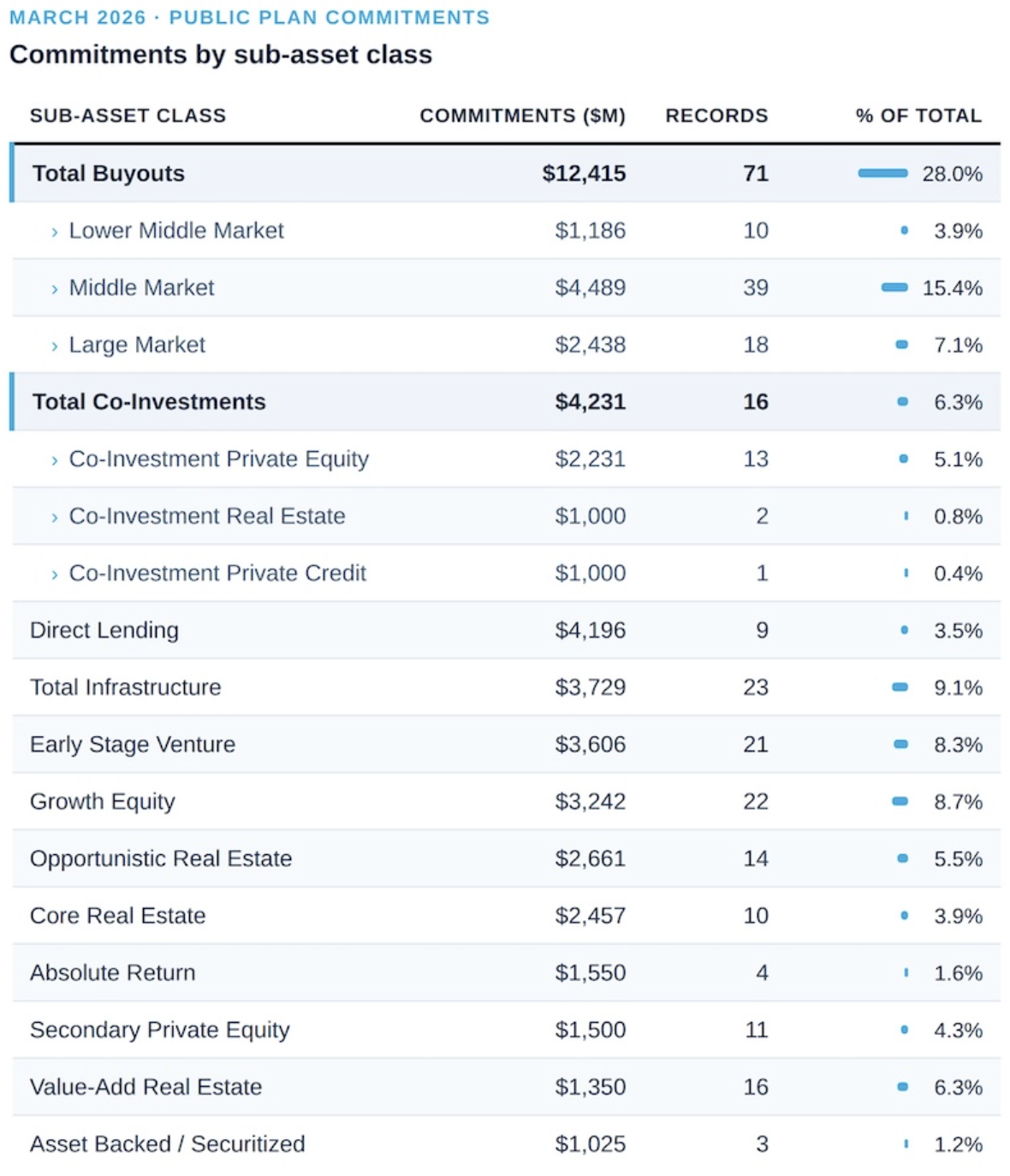
Within private credit, direct lending remained one of the clearest areas of acceleration, rising to $4.2B in March from $1.82B in February. Opportunistic private credit also moved higher, to $650M from $405M, while asset-backed/securitized strategies reached $1.03B and insurance-related credit rose to $620M from $400M in February. By contrast, special situations declined to $200M from $735M, indicating that March’s credit disclosures were more concentrated in large-scale direct-lending and structured-credit style exposures than in opportunistic or workout-driven sleeves.
Real estate composition also shifted materially. Opportunistic real estate climbed to $2.66B from $853.5M, core real estate increased to $2.46B from $986.7M, and value-add real estate rose to $1.35B from $1.01B. Core plus real estate, however, was a smaller portion of the March mix at $445M versus $361.8M in February, remaining relevant but not central to the month’s step-up
Infrastructure and adjacent real asset categories also strengthened: Total infrastructure-related commitments rose to $3.73B from $1.71B in February, led by value-add infrastructure at $1.67B compared to a mere $7.5M previously, while core infrastructure increased to $555M from $300M. Core-plus infrastructure, by comparison, eased to $399.3M from $700.1M, and other infrastructure commitments rose to $958.4M from $698M.
This analysis is based on Dakota Marketplace data capturing pension commitments across private equity, private credit, private real estate, private infrastructure, real assets, venture capital, hedge funds/liquid alternatives, and multi-asset strategies, sourced from public filings and other reports published during the month.