Looking to invest in RIAs? Within Dakota Marketplace you can see AUM growth over time, percentage of AUM by client, and HNW concentration of the client base. For M&A teams, Dakota Marketplace helps identify and prioritize RIA acquisition targets.
Key Takeaways From 2025:
Record wealth creation: Continued growth in HNW and UHNW assets increased advisory complexity, driving demand for integrated solutions across portfolio construction, tax, estate, liquidity, and private markets.
Independent RIA formation: In 2025, 511 new RIAs launched with $80.6 billion in AUM, more than double 2024 levels, driven by spinouts as advisors sought greater control over investments, client ownership, and economics.
Industry consolidation: M&A activity intensified at the middle and upper end of the market with over $2 trillion in AUM acquired across more than 370 transactions completed through November as platforms pursued scale, broader capabilities, institutional infrastructure and increasingly, distribution synergies tied to unified investment models.
Alternatives adoption: Alternatives are becoming core allocations, amplifying demand for income, liquidity, operational efficiency, and stronger governance and integration.
RIA Channel in 2025: Size, Growth & Structure
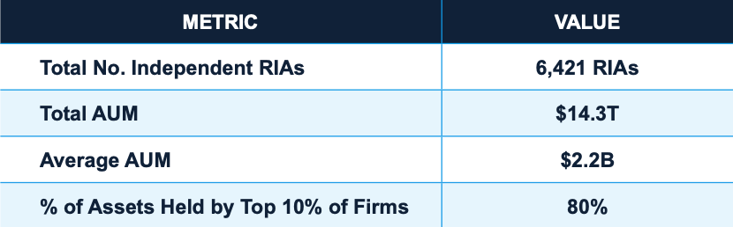
As of December 2025, Dakota Marketplace tracked 6,421 independent RIAs overseeing approximately $14.3 trillion in assets. Asset concentration among large platforms has intensified, but advisor migration away from centralized models continues to drive new firm formation, sustaining fragmentation at the lower end of the market.
RIA Market Overview
Market-at-a-Glance
Source: Dakota analysis as of December 2025
At an aggregate level, the RIA channel controls a substantial and growing share of U.S. household wealth. However, average firm size masks a highly skewed distribution of assets, with the majority of capital controlled by a relatively small subset of large firms. This concentration has important implications for competition, capital allocation, and the pace of consolidation across the industry.

Source: Dakota analysis as of December 2025
Nearly 70% of RIAs manage less than $700 million, yet collectively control less than 9% of industry assets. In contrast, firms with more than $1 billion in AUM represent just 22% of the market but control nearly 88% of total assets. This degree of concentration continues to fuel consolidation, as smaller firms seek expansion, succession solutions, and access to institutional resources, while larger platforms use acquisition as a primary growth and capability-building lever.
Ongoing Consolidation
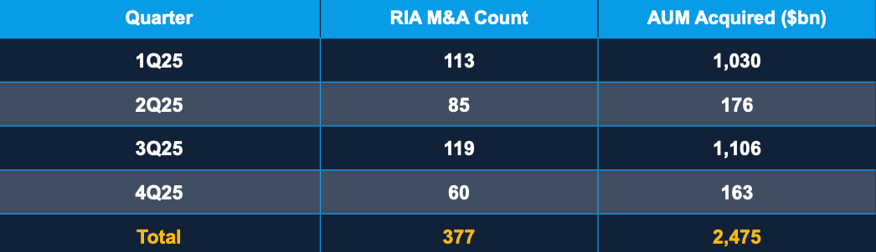
RIA consolidation accelerated meaningfully in 2025 and is on track to be the most active year on record. Including preliminary fourth-quarter data through October and November, the market recorded approximately 377 transactions totaling $2.5 trillion in acquired assets.
Activity remained elevated throughout the year:
Source: USD, Dakota analysis as of December 2025
While asset totals in Q1 and Q3 were driven by a small number of mega-platform transactions, Q4 data shows deal activity remained solid into year-end thus far. Average acquired AUM was inflated by a handful of very large deals, while the median transaction involved firms managing roughly $300 million to $2 billion in assets. This pattern highlights that consolidation is continuing across both mid-market RIAs and large platform acquisitions, not just at the top end of the market.
Beyond operational leverage and succession planning, consolidation in 2025 was in large part driven by private equity sponsors seeking to build scaled wealth platforms with embedded distribution capabilities. As alternative investments move into core portfolios, PE-backed RIAs provide a structurally advantaged channel to introduce proprietary or affiliated alternative products, centralized model portfolios, and institutional solutions across a broad advisor base. In this context, consolidation is no longer purely about asset aggregation. It is about controlling the point of allocation within the wealth management value chain.
Rise of Mega RIAs & Platform-Led Growth
Consolidation activity is heavily concentrated among a relatively small group of highly acquisitive platforms, often referred to as Mega RIAs, defined as firms with more than $10 billion in AUM. In 2025, the ten most active acquirers completed over 100 transactions, representing more than $880 billion in acquired assets.
Platforms such as Merit Financial, Mercer Global Advisors, Carson Group, Wealth Enhancement, Creative Planning, Mariner Wealth Advisors, and Corient continue to act as serial consolidators, bringing smaller RIAs into national or multi-regional platforms. Nearly all of these firms are supported by major private equity sponsors, including Bain Capital, KKR, Oak Hill Capital, Genstar Capital, TA Associates, General Atlantic, TPG, Berkshire Partners, Leonard Green, Mubadala, Stone Point, and Emigrant Partners.
At the upper end of the market, a few platforms stood out for pairing a steady flow of acquisitions with a small number of large, market-shaping deals. Creative Planning ended the year by acquiring SageView Advisory Group, bringing total assets to more than $240 billion and adding substantial capability in retirement alongside its core wealth business. Mariner Wealth Advisors also completed a major transaction with the acquisition of Cardinal Investment Advisors, adding roughly $292 billion in assets under advisement and expanding its institutional consulting business. Corient Private Wealth took a similar approach, combining multiple smaller acquisitions with its pending combination with Stonehage Fleming and Stanhope Capital Group, a move that would create one of the largest independent global platforms serving ultra-high-net-worth clients.
Increased Institutionalization
As RIAs scale, institutionalization across the channel continues to accelerate. Larger firms are building formal CIO offices, investment committees, dedicated research teams, and governance frameworks that more closely resemble those of traditional asset managers.
Recent developments illustrate this shift. Highland Private Wealth Management, a $2.8 billion RIA, hired its first CIO to formalize investment governance and expand internal research capabilities. Savvy Wealth, now managing more than $3 billion, added a veteran CIO to strengthen portfolio oversight and implement a more systematic investment process. Even mid-sized firms are adopting integrated trading, portfolio models, and enhanced governance as they prepare for continued growth. At the upper end of the market, firms are using strategic M&A to acquire OCIO platforms and expand their alternatives capabilities, with recent examples including Monticello’s combination with Cresset, Cerity’s acquisition of Agility, and Hightower’s acquisition of NEPC.
Advisor & Firm Segmentation
As asset concentration increases, the RIA market is becoming more clearly segmented by firm size, operating model, and investment governance.
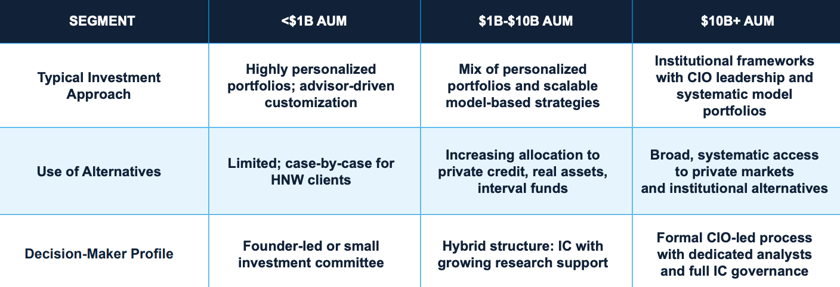
This segmentation reinforces a broader structural shift. As firms mature, investment authority is moving more consistently from individual advisors and toward CIO offices and committees. This transition has direct implications for asset managers, particularly around distribution access, model inclusion, and platform-level due diligence requirements.
Asset Allocation & Product Trends
The RIA channel has continued its structural shift from a public-market, long-only approach toward institutional-style portfolio construction. Persistent market volatility, higher interest rates, and rising client sophistication have accelerated demand for differentiated sources of return, income, and diversification.
Alternatives, particularly private equity, private credit, and real assets, have moved from tactical allocations to core portfolio components. Roughly 80% of advisors now allocate alternatives to accredited investors, reflecting the continued democratization of private market access.
This expansion has been supported by the rapid adoption of evergreen and semi-liquid structures such as interval funds, which balance private market exposure with managed liquidity and fiduciary requirements. These vehicles now approach $700 billion in AUM and are on a clear path toward becoming a trillion-dollar category.
As alternative allocations become more prevalent, due diligence and oversight demands have increased materially. In response, platforms are consolidating investment authority and acquiring institutional expertise. Cresset’s acquisition of Monticello Associates exemplifies this approach, embedding institutional-grade private market diligence and portfolio construction capabilities directly within the RIA platform. For private equity sponsors, this further reinforces the strategic value of large RIAs as institutional distribution channels for alternative products aligned with centralized CIO-led models.
Outlook
Looking ahead to 2026, the forces shaping the RIA channel in 2025 are expected to intensify. Continued consolidation will further concentrate investment authority into CIO offices and investment committees, accelerating the adoption of model portfolios as the default investment framework across multi-advisor organizations.
Model portfolios will streamline compliance, simplify post-M&A integration, and support a consistent client experience. As a result, model placement will become ever more critical for asset managers seeking meaningful distribution within scaled RIA platforms.
Within these models, the use of alternatives is expected to continue rising. Private credit, interval funds, real assets, and semi-liquid structures will more frequently function as core allocations as RIAs target income, diversification, and downside mitigation in a higher-rate, more volatile environment. Centralized evaluation will raise expectations around transparency, reporting, and operational robustness.
In a more consolidated, platform-driven RIA market, managers must adapt their positioning to central-authority decision-makers and model-based allocation frameworks. Competitive advantage will hinge on delivering differentiated, scalable strategies with clear portfolio roles that can be consistently deployed across client bases. Distribution success will steadily reflect platform alignment rather than individual advisor relationships.
Taken together, the RIA market is evolving into a smaller number of highly institutional platforms controlling an increasing share of client capital. Managers capable of integrating into RIA systems, supporting model construction, and delivering scalable, differentiated solutions will be best positioned to benefit from this transformation. Those unable to meet these rising standards will find access progressively constrained.
About Dakota
Dakota is a financial, software, data and media company based in Philadelphia, PA. Dakota’s flagship product, Dakota Marketplace, is a database of LPs, GPs, Private Companies and Public Companies used by thousands of fundraising, deal, and investment teams worldwide to raise capital, source deals, track peers, and access comprehensive data, all in one global platform. For more information, book a demo of Dakota Marketplace!