EXECUTIVE SUMMARY
Q1 2026 recorded 2,553 transactions totaling $568.4 billion in disclosed value, a 2.3% decline in deal count and a 1.5% contraction in value quarter-over-quarter. The headline figures obscure a market that was anything but quiet. Strategic M&A surged 32.4% to $378.1 billion, powered by transformative transactions across media, healthcare, infrastructure, and financial services. The proposed $110.0 billion Warner Bros. Discovery / Paramount merger defined the quarter: a survival-driven consolidation of US linear television. Private equity continued its structural shift toward platform scaling — deal count rose 29.5% to 1,084 transactions, but more than half were add-ons to existing portfolio companies. Corporate carve-outs expanded 23.4% to 137 transactions, providing a reliable supply channel less sensitive to interest rate conditions.
 KEY TAKEAWAYS
- Strategic M&A dominance: 1,150 deals totaling $378.1B (76.0% of total disclosed value); the Warner Bros. Discovery / Paramount deal at $110.0B was the defining transaction of the quarter.
- PE deal count: surged 29.5% to 1,084 transactions, though disclosed PE value fell 52.5% to $62.5B, signaling a market of high add-on volume and limited mega-buyout activity.
- Take-private activity: produced $71.1B across 25 transactions with an average premium of 34%; Clear Channel Outdoor (71%) and AES Corporation (40.3%) were notable outliers.
- Add-on concentration: reached 54.2% of all PE deals (587 of 1,084), the highest rate in our trailing dataset and a structural response to constrained financing conditions.
- Corporate carve-outs: expanded 23.4% to 137 transactions, providing a reliable supply channel less sensitive to interest rate conditions than primary buyouts.
- Geographic split: US domestic deals comprised 54.5% of volume and 62.4% of value; international activity softened 12.0% in count and 28.3% in value. London led international PE with 49 transactions.
MARKET OVERVIEW
Q1 2026 captured a market in transition, with high strategic deal value anchored in a handful of transformative transactions, set against a private equity landscape defined by add-on activity and modest buyout momentum. The quarter's $568.4 billion in total disclosed value includes $71.1 billion in public-to-private transactions.
Quarter-over-quarter comparisons show deal count declining modestly (2,553 vs. 2,614) while disclosed value contracted 1.5% ($568.4B vs. $577.3B). Beneath these headline figures, the composition of the market shifted materially: strategic acquisitions expanded as a share of total value, while PE buyout values compressed sharply.
VOLUME AND VALUE SUMMARY
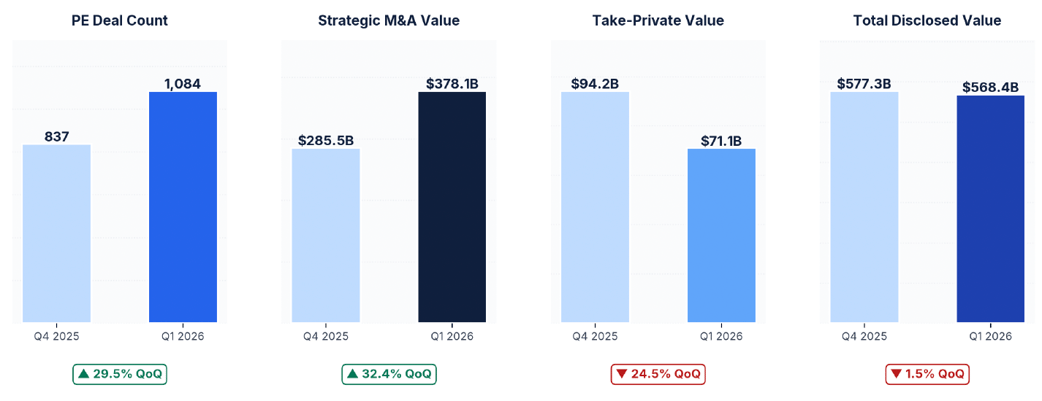 The chart above tells as textured story. PE deal count surged 29.5% to 1,084 transactions on the strength of add-on activity, while strategic M&A value jumped 32.4% to $378.1B, propelled by the WBD/Paramount mega-merger and a handful of other transformative transactions. Take-private value contracted 24.5% to $71.1B as the volume pullback outweighed larger average deal sizes. The net effect was a modest 1.5% decline in total disclosed value as strategic momentum offset PE value compression and softer take-private activity.
DEAL SIZE DISTRIBUTION
Consolidating disclosed transactions into four tiers reveals how concentrated Q1 2026 value was at the top of the size spectrum. Mega deals ($5B+) comprised just 5.5% of disclosed transactions but generated 54% of all disclosed value ($271.1B across 19 deals). The Warner Bros. Discovery / Paramount merger at $110.0B alone represented 22% of total disclosed value. Stripping out the five largest transactions, the remaining market generated $317.4B across 341 deals.
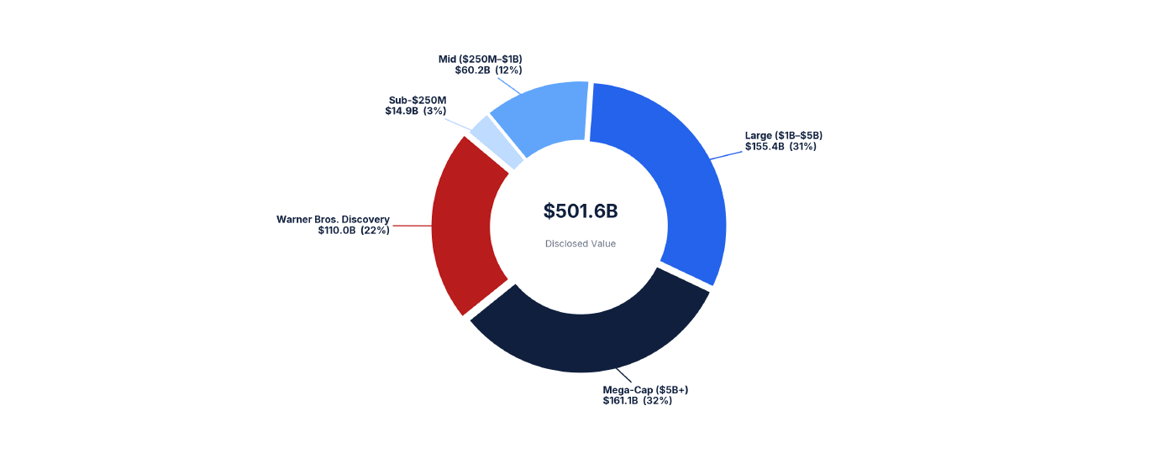
The high proportion of undisclosed deals (2,207 of 2,553, or 86.5%) is characteristic of the lower-middle market, where PE add-on activity and smaller platform acquisitions rarely require public disclosure of consideration. Of the 346 transactions with disclosed values, the mega tier ($5B+) accounts for 54% of value from just 5.5% of deals: a concentration ratio that underscores how sensitive aggregate market statistics are to a handful of large transactions.
SECTOR ANALYSIS
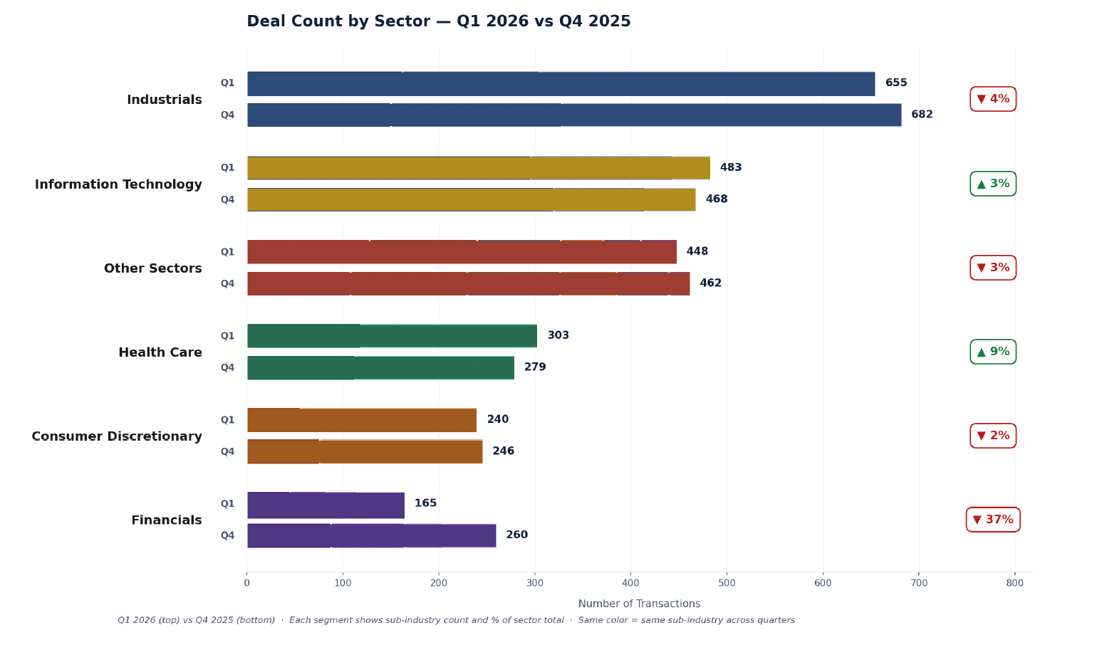
Industrials led all sectors by total deal count at 655 transactions, covering both PE add-on activity and strategic M&A. Communication Services generated the highest disclosed value at $139.2 billion, almost entirely from the WBD/Paramount transaction. Health Care stood out for biopharmaceutical M&A, with six pharma/biotech transactions exceeding $2 billion in value, including Boston Scientific's $14.5B acquisition of Penumbra, Danaher's $9.9B acquisition of Masimo, and Merck's $6.7B acquisition of Terns Pharmaceuticals.
ACTIVITY BY SECTOR
 TOP 5 SUB-INDUSTRIES BY DEAL COUNT
Financials was the table's biggest mover, contracting 37% QoQ, the sharpest sector decline of the quarter, as bank mergers and fintech consolidation cooled. Health Care (+9%) and Information Technology (+3%) were the only sectors to advance meaningfully, while Industrials and Consumer Discretionary held broadly flat despite the softer overall market.
The sector-level data masks meaningful divergence across strategic and sponsor-led activity. Health Care's expansion, for example, was driven almost entirely by strategic acquirers — biopharmaceutical companies extending pipelines ahead of patent cliffs — rather than by PE buyouts, which remained selective in the sector given valuation levels. Industrials' flat headline, by contrast, disguises the concentration of PE add-on activity within Commercial Services & Supplies and Aerospace & Defense, where platform roll-ups continued at pace while primary buyouts slowed. Financials' 37% contraction is similarly bifurcated: strategic bank and fintech M&A cooled sharply, but PE insurance distribution roll-ups — the sector's most durable PE thesis — held essentially flat with 23 deals versus 22 in Q4 2025.
Value concentration continued to separate meaningfully from deal-count concentration. Communication Services generated 28% of total disclosed value ($139.2B) on just 4% of deal count, entirely attributable to the WBD/Paramount mega-merger; stripping that transaction, the sector's activity was proportionate to the prior quarter. Utilities similarly skewed toward a small number of high-value transactions: the AES take-private and LS Power's PJM asset acquisition together represented the bulk of utilities disclosed value despite modest deal count.
NOTABLE SECTOR THEMES
Industrials — Aerospace & Defense and Transportation Infrastructure Quietly Accelerating
Aerospace & Defense held at 48 deals (up 4%), modest growth but strategically significant given geopolitical tailwinds and NATO commitment spending. Key transactions include Brink's Company's $6.6B acquisition of NCR Atleos Corporation (cash logistics infrastructure), and Leidos' $2.4B acquisition of ENTRUST Solutions Group from Kohlberg & Company (government security services). Transportation Infrastructure jumped 42% to 17 deals, anchored in port logistics, rail assets, and EV charging infrastructure as industrial policy pushes capital into physical supply chain. Commercial Services & Supplies (143 total, 102 PE deals) remain the dominant Industrials sub-sector. Leonard Green & Partners added 7 bolt-ons to Champions Group (life safety services), and Ardian similarly built its European industrial platform through Heat Transfer Systems, Enforce, and A Place At Home. Building Products (52 deals) and Machinery (68 deals) rounded out the sector's activity, reflecting sustained sponsor interest in industrial manufacturing platforms with recurring service revenue and pricing power. Several mid-market Industrials sponsors — including Trinity Hunt Partners (12 deals) and CVC (8 deals) — were among the quarter's most active buyers.
Information Technology — IT Services Is the Real Growth Story, Not Software
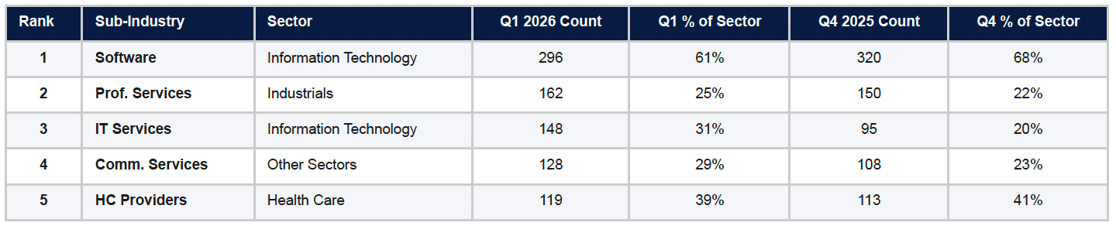
Software deal count declined QoQ (296 vs 320, down 8%) while IT Services surged 56% to 148 transactions. The standout transaction was KKR and Singapore Telecommunications' $5.1B acquisition of ST Telemedia Global Data Centres, a data center infrastructure play anchored to AI-driven hyperscaler demand. Facebook's $2.0B acquisition of Manus AI from Tencent Holdings and Benchmark Capital illustrated the appetite for frontier AI capabilities at any price. KKR executed 12 add-on acquisitions across its technology platforms, including Wenrix, Memetica, and Specialty Brokerage Services, in a diversified build-and-scale strategy. Semiconductor and cybersecurity activity remained active: Palo Alto Networks' pending $4.2B acquisition of Protect AI reinforced the consolidation of AI security, while several mid-market semiconductor equipment businesses changed hands at robust multiples. This split in the data matters: a maturing software M&A market is running into valuation resistance, while managed services and MSP roll-ups at lower multiples are gaining relative momentum. Dakota expects the divergence to persist through 2026 as LPs press GPs for deployment in durable, cash-generative IT assets over growth-equity-style software exposure.
Health Care — Life Sciences Tools & Services Emerging as a Deal Hotspot
Life Sciences Tools & Services expanded 125% QoQ to 18 deals, the fastest-growing Health Care sub-sector, powered by demand for lab automation, contract research, and AI-enabled drug discovery infrastructure. The sector's largest strategic deals defined the quarter: Boston Scientific's $14.5B acquisition of Penumbra, Danaher's $9.9B acquisition of Masimo, AstraZeneca's $7.8B acquisition of Centessa Pharmaceuticals, and Merck & Co.'s $6.7B acquisition of Terns Pharmaceuticals collectively underscore the urgency among large-cap pharma to acquire clinical-stage assets ahead of pipeline gaps and patent cliffs. Health Care Technology (46 deals, up 12%) follows closely, with clinical workflow automation and revenue cycle management attracting both PE consolidators and strategic acquirers. Health Care Providers & Services (87 deals) anchored the mid-market, as PE-backed physician groups, dental platforms, and specialty clinics continued to consolidate. Biotech activity was heavily weighted toward late-stage assets: eight of the ten largest Health Care deals targeted companies with Phase II or Phase III clinical programs, reflecting acquirers' preference for de-risked pipelines over earlier-stage science.
Communication Services — WBD/Paramount Dominates, with Active Mid-Tier Consolidation
Entertainment doubled QoQ to 20 deals, propelled by sports rights consolidation, gaming studio acquisitions, and theme park-adjacent assets, while Diversified Telecommunication Services fell 25% as legacy telco M&A cools. Interactive Media & Services expanded 60% to 16 deals, signalling renewed appetite for digital content platforms and social commerce assets. The Media sub-sector (71 deals) is bifurcated: legacy broadcast and print assets attracting distressed and turnaround capital, while digital-first and streaming assets command premium strategic multiples. The WBD/Paramount mega-merger skews the entire sector's value metrics but the underlying activity tells a more nuanced story of digital transition M&A at every size tier. Notable mid-market transactions included private equity sponsor-backed roll-ups of regional radio, outdoor advertising, and live-event production businesses, reflecting continued fragmentation-to-consolidation dynamics below the mega-deal threshold. Sponsor involvement in the sector skewed heavily toward exits rather than new platform formation, consistent with public-market volatility and uncertain regulatory posture on large media combinations.
Consumer Discretionary — Distributors and Automobiles Tell the Real Story
Consumer Discretionary held broadly flat by count (240 vs 246) but hides divergence: Distributors surged 400% (10 vs 2 deals, admittedly from a small base), Leisure Products climbed 60%, and Automobiles doubled. These moves all point to specific sector themes rather than consumer demand recovery. Automobile Components (19 deals, up 12%) tracks ongoing EV supply chain restructuring as Tier 1 and Tier 2 suppliers consolidate or divest combustion-engine-related assets. Hotels, Restaurants & Leisure (56 deals) remained active as hospitality asset-backed PE deals found more willing sellers — including several resort portfolio sales and restaurant franchise consolidations. Specialty Retail (44 deals) captures continued distressed retail M&A as omnichannel pressure persists and legacy store networks rationalize. Textiles, Apparel & Luxury Goods (22 deals) saw a marked uptick in premium brand carve-outs as conglomerates streamlined portfolios, while Household Durables trailed at 17 deals, reflecting housing-market-linked caution.
Financials — Insurance PE Roll-Up Intact Despite Sector Decline
The sector contracted materially QoQ: Insurance fell 49% overall (45 vs 88 deals), Banks fell 50%, Consumer Finance fell 75%. But Insurance PE activity held more resilient with 23 PE deals versus 22 in Q4 2025, essentially flat. This suggests the broader pullback stems from strategic financial sector M&A cooling (bank mergers, fintech consolidation), while the PE insurance distribution roll-up thesis — exemplified by Apollo's 7 add-ons to its insurance platform — continues at pace. Capital Markets held at 45 deals (flat QoQ) with strong activity in wealth management, RIA aggregation, and exchange-traded infrastructure acquisitions, pointing to continued fragmentation-to-consolidation dynamics at the advisor level. Financial Services sub-sector (38 deals) also held largely flat, led by payments infrastructure consolidation and specialty lending platform sales. Nuveen's £9.9B acquisition of Schroders — executed through Pantheon — was the quarter's landmark financial services transaction, creating a combined asset manager with nearly $2.5 trillion in AUM and setting a reference point for large-scale asset management consolidation ahead.
Materials — Metals Consolidation; Chemicals Retreatin
Metals & Mining saw major M&A activity: Zijin Gold International's $4.0B acquisition of Allied Gold Corporation and Eldorado Gold's $2.8B acquisition of Foran Mining reinforce the ongoing push for critical minerals consolidation. Apollo Global Management's divestiture of Metal Container Plants to Ball Corporation for $3.0B and Wendel's sale of Stahl to Henkel AG for $2.5B were the key PE exits in the sector. Chemicals fell sharply to 33 deals from 49 (down 33%), consistent with the end of a post-Covid specialty chemicals acquisition cycle. Containers & Packaging climbed 26% to 24 deals, powered by sustainable packaging mandates and e-commerce demand for protective materials. Construction Materials (25 deals, up 14%) benefits from the data center and infrastructure construction tailwind, with aggregates and cement businesses continuing to attract long-duration infrastructure capital. Strategic acquirers dominated the largest Materials transactions — consistent with the sector's historical pattern — while PE firms focused on mid-market specialty chemicals and industrial services platforms where operational value creation is more achievable.
Energy / Utilities / Real Estate — Renewables Dominate; Data Center Thesis Emerging
Transocean's $5.8B acquisition of Valaris Limited was the dominant energy deal of the quarter, consolidating offshore drilling capacity amid sustained deepwater demand. Mitsubishi Corporation's $5.2B acquisition of Haynesville Shale gas assets from Aethon Energy and Ontario Teachers' Pension Plan underscores Japanese corporate appetite for long-duration North American energy exposure. ENGIE's $14.0B acquisition of UK Power Networks from CK Infrastructure Holdings was the largest European infrastructure transaction of Q1, while LS Power's $5.0B acquisition of PJM generation assets from Constellation Energy and Vistra's $4.7B acquisition of Cogentrix Energy demonstrate active US power generation consolidation. Real Estate surged 59% to 27 deals, powered by data center development platforms, specialty logistics REITs, and last-mile industrial portfolios sold by sponsor-backed owners. Utilities activity was concentrated in regulated transmission assets and renewables developers, with Brookfield and KKR both active buyers. The combined Energy / Utilities / Real Estate complex is increasingly where mega-deal PE capital is being deployed: the $33.4B AES take-private by GIP, EQT, CalPERS, and QIA — to be discussed further in the take-private section — exemplifies this redirection of sponsor capital toward power infrastructure.
Taking the eight sector themes together, the through-line of Q1 2026 is that capital is flowing where it can find durable operating assets — infrastructure, specialty services, late-stage biopharma, sub-scale consolidation targets — and retreating from sectors where the value creation thesis relies on growth equity multiples or market-beta exposure. Dakota sees this pattern as consistent with the broader market narrative: sponsors are pricing for operational rather than financial alpha, and strategic acquirers are pursuing scale where regulatory and competitive dynamics reward consolidation. Expect these themes to compound through Q2 2026 as the sub-sectors that led in Q1 continue to consolidate and the weaker sub-sectors face another quarter of valuation pressure before operational or strategic catalysts emerge. The geographic, deal-type, and exit-channel analyses that follow connect these sector-level themes to the underlying sponsor and strategic actors driving the quarter's activity.
GEOGRAPHIC ANALYSIS
US domestic deals accounted for 54.5% of deal count (1,377 transactions) and 62.4% of total disclosed value ($310.5B), underscoring continued home-market bias in PE deployment and the outsized weight of US strategic mega-deals. International activity contracted materially in Q1, with deal count falling 12.0% (1,151 vs. 1,308 in 4Q25) and international value declining 28.3% ($186.8B vs. $260.5B).
US VS. INTERNATIONAL SPLIT

The US–international split widened meaningfully in Q1 2026. US volume expanded nearly 10% QoQ while international activity contracted 12%, pushing the domestic share of global deal count to 54.5% from 49.0% the prior quarter. The value concentration is even more pronounced: US transactions represented 62.4% of disclosed value, reflecting both the WBD/Paramount mega-merger and broader strategic pricing power of US-listed acquirers whose equity remained strong through the quarter.
TOP 10 US PE CITIES
New York City led US PE activity with 43 transactions, followed by Los Angeles (35), Chicago (34), and Dallas (32). Minneapolis recorded the largest quarter-over-quarter surge at up 300% (20 vs. 5 deals), powered by financial services and technology sector activity. San Francisco more than doubled (up 133%) and Denver nearly tripled (up 110%). All ten markets expanded QoQ: no US PE city in the top 10 declined.
TOP 10 US PE CITIES - Q1 2026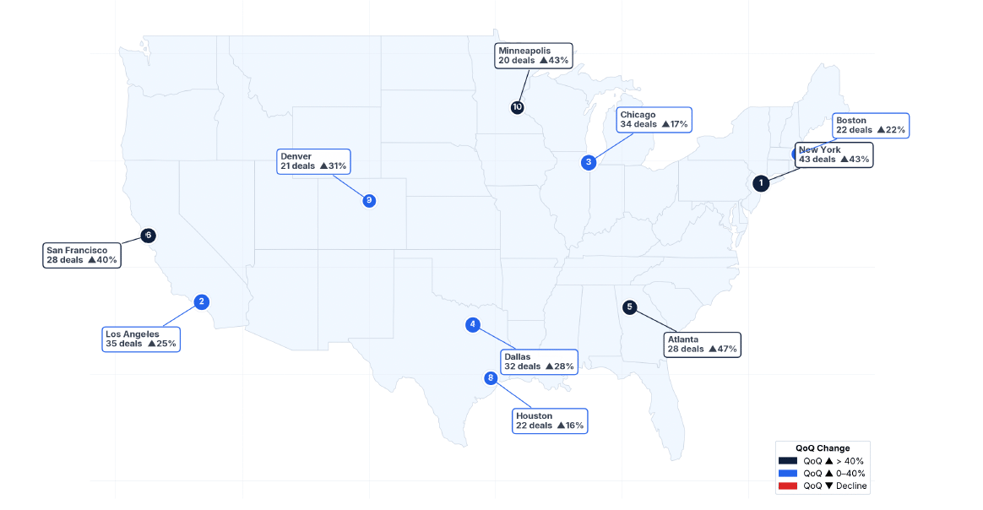
The geographic concentration story is one of broad PE recovery across every major US market. New York's 43 deals reflect continued dominance in financial sponsor activity and mid-market buyouts, while the coastal hub pattern (LA, SF, Boston) tracks with technology and life sciences PE concentration. Dallas and Houston's combined 54 deals reinforce Texas as the second-largest PE geography outside of New York, powered by energy services and industrial services roll-ups. Minneapolis' 300% surge and Denver's 110% expansion point to emerging secondary hubs where sponsors are building platforms at lower entry valuations than coastal markets command. With no top-10 US city contracting QoQ, the data suggests broad-based sponsor deployment rather than a concentrated flight to specific geographies.
TOP 10 INTERNATIONAL PE CITIES
London dominated international PE activity with 49 transactions, nearly double Paris at 28, reinforcing its position as Europe's primary PE hub. Rotterdam surged 100% to 8 deals and Manchester expanded 38% to 11, while Milan and Stockholm were the only European cities to decline. Toronto (11 deals, up 83%) and Montreal (7 deals, up 133%) also ranked in the top 10, highlighting the depth of Canadian PE.
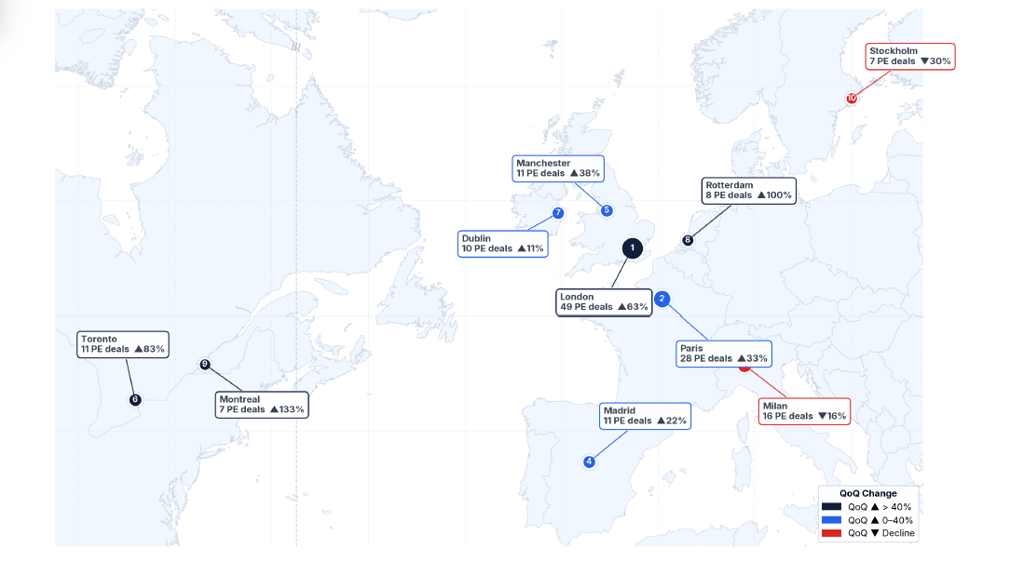 The Q1 data reinforces several enduring features of the international PE landscape. London remains structurally dominant in European sponsor activity, anchored by the concentration of mid-market and upper-mid-market firms headquartered in the City and Mayfair. The Benelux region continues to punch above its weight: combined Amsterdam, Rotterdam, and Brussels activity approached London-scale volumes when grouped together, reflecting the depth of family-office and industrial family-business PE transitions underway in the region. Canadian activity in Toronto and Montreal was disproportionately weighted toward domestic sponsors (Onex, Brookfield, Northleaf, Novacap) consolidating Canadian platforms rather than cross-border flow, a pattern consistent with the prior four quarters.
London's dominance at 49 PE deals (13.8% of all international PE activity) speaks to its continued role as Europe's primary PE hub — nearly double Paris at 28 deals despite the political and regulatory divergence post-Brexit. The appearance of Toronto (11), Montreal (7), and Rotterdam (8) in the top 10 highlights the underappreciated depth of Canadian and Benelux PE ecosystems. Stockholm's 30% decline (from 10 to 7 deals) is the only meaningful softening in the European PE city landscape, consistent with the broader Nordic market cooling seen through 2025. Continental Europe's PE capitals — Paris, Madrid, Milan — remained broadly active, while the combined UK hubs of London and Manchester delivered 60 deals, more than any other country represented in the top 10. Continental Asia-Pacific activity did not crack the top 10, but the underlying data suggests Tokyo and Singapore continue to anchor regional sponsor activity at lower absolute volumes.
PRIVATE EQUITY ACTIVITY
Q1 2026 saw a sharp increase in PE deal count (+29.5% to 1,084 transactions), powered almost entirely by add-on activity. The mismatch between volume growth and value contraction points to a bifurcated market: PE firms are deploying capital at scale across smaller portfolio company acquisitions while new platform formation at meaningful scale remains subdued.
The quarter's largest new platform investments were concentrated in infrastructure and energy transition. GIP and EQT's $33.4B enterprise value acquisition of AES Corporation, the largest PE-backed transaction of Q1, signals a decisive shift of infrastructure capital toward AI-driven power demand. Brookfield and Macquarie were similarly active in infrastructure assets, while Blackstone extended its industrial and logistics platform through 8 add-on acquisitions in the quarter.
PE DEAL TYPE MIX
Q1 2026 deal type composition captures a market where portfolio scaling has overtaken new platform formation as the dominant PE activity. Add-Ons accounted for 54.2% of all PE transactions at 587 deals, up 35.9% from 432 in Q4 2025, their highest share in the trailing dataset. Leverage Buyouts (261 deals, up 35.2%) showed meaningful recovery after several quarters of compressed activity, spurred by improving credit conditions in the upper-middle market. Secondary Buyouts held broadly flat at 99 transactions, while Corporate Carve-Outs expanded 23.4% to 137 deals, as corporate portfolios simplified at scale and non-core assets moved to market.
MOST ACTIVE PE FIRMS — Q1 2026
Blackstone and KKR were the most active PE buyers in Q1 2026, with 17 and 16 deals respectively. Both firms' elevated counts stem from add-on strategies within existing platforms, particularly in Industrials, Information Technology, and Infrastructure. On the sell side, CVC Capital Partners led with 9 exits, followed by Advent International, Mutares SE, and Apollo Global tied at 5.
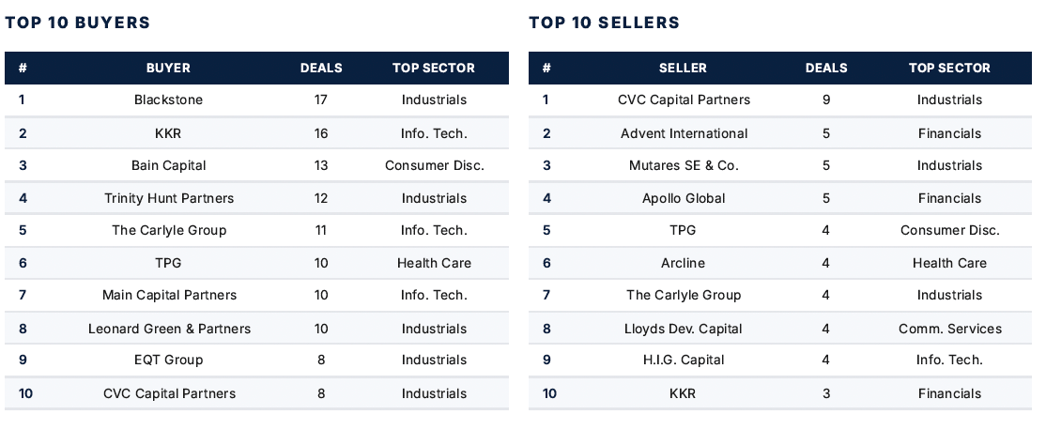
The concentration of add-on activity among a handful of sponsors signals a broader strategic shift in how PE firms are deploying capital in the current environment. With new platform formation constrained by financing costs and valuation gaps, the most productive use of capital for established sponsors has been extending proven platform businesses rather than initiating new buyouts. Firms with large existing portfolios (Blackstone, KKR, Apollo) have the most to gain from this model, as each bolt-on acquisition adds revenue and EBITDA to a platform already built, compressing the multiple paid on incremental earnings relative to standalone transactions.
On the sell side, the top 10 sellers cleared only 47 combined exits — a notably lower concentration than the buy side's top 10, which executed 115 deals. CVC Capital Partners led sellers with 9 exits spanning Industrials and Health Care, reflecting its deliberate portfolio rebalancing ahead of fundraising cycles. Mutares SE continued its distinctive model of exiting restructured carve-outs, while Apollo's 5 Financials exits were tied to its insurance distribution platform strategy. The relatively dispersed sell-side activity points to a market where realizations are happening transaction-by-transaction rather than through large-scale portfolio rotation — consistent with the broader narrative of GPs seeking selective exits in a narrow IPO window while LP distribution pressure continues to build.
ADD-ON ACTIVITY ANALYSIS
Add-on acquisitions reached 587 in Q1 2026, representing 54.2% of all PE deals, a 35.9% increase from 432 in Q4 2025, and the highest add-on rate in our trailing dataset. This is not a marginal shift: more than half of every dollar PE firms spent on deal execution in Q1 went toward scaling an existing portfolio company rather than creating a new one. The geographic split of 367 domestic (62.5%) and 220 international (37.5%) mirrors the overall PE domestic/international ratio, indicating sponsors are applying add-on strategies with similar intensity across both markets.
ADD-ON DISTRIBUTION BY SECTOR

IT Services (+188%), Health Care Providers (+156%), and Building Products (+300%) recorded the largest industry-level surges within the three leading sectors. These sub-sector surges point to three distinct structural trends: software-enabled IT services clustering around AI-driven automation platforms, fragmented physician practices rolling up into scaled regional health care delivery networks, and residential and commercial building products combining as housing and infrastructure demand sustains specialty distribution volume.
TOP ADD-ON BUYERS - Q1 2026
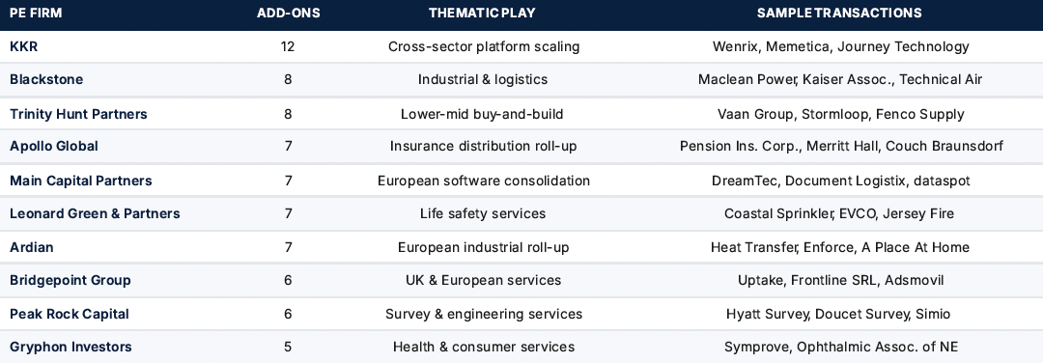
Across the ten most active add-on buyers, four distinct playbooks emerge. KKR's diversified build-and-scale strategy deploys capital across its portfolio rather than concentrating on a single sector. Blackstone, Trinity Hunt, and Leonard Green each run concentrated operating-intensive roll-ups in industrial and service sub-sectors where their operating teams have demonstrated pricing and integration advantages. Apollo's insurance distribution roll-up is a standalone thesis with durable premium growth tailwinds and limited cyclical sensitivity. European sponsors — Main Capital, Ardian, Bridgepoint — are compounding the Continental fragmentation thesis, acquiring smaller businesses across the UK, Netherlands, Germany, and France to build regional platforms of scale.
The economics behind the add-on model remain compelling in the current environment: lower purchase multiples on bolt-on targets relative to the platform, synergies that compress blended EBITDA multiples, and the ability to deploy modest equity checks while drawing on existing platform leverage facilities. Expect add-on activity to continue at these elevated levels through 2026, with the most active sponsors extending their platforms horizontally (new sub-sectors) and geographically (cross-border tuck-ins) rather than initiating new primary buyouts.
PE ACQUISITIONS VS. EXIT ACTIVITY
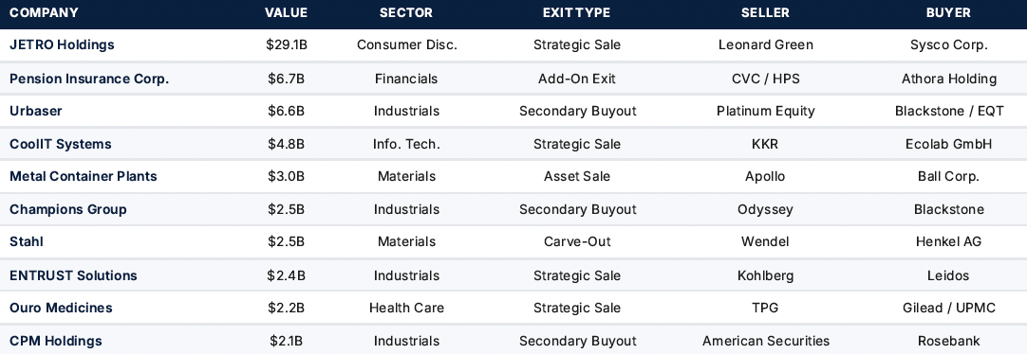
PE firms completed 115 exits totaling approximately $67.8B in disclosed value in Q1 2026. Strategic sales were the highest-value channel, with KKR's $4.75B sale of CoolIT Systems to Ecolab and Kohlberg's $2.4B sale of ENTRUST Solutions to Leidos representing PE sponsors successfully finding strategic acquirers for whole platform businesses. The largest exit of the quarter was Leonard Green & Partners' sale of JETRO Holdings (Restaurant Depot) to Sysco Corporation for $29.1B. CVC Capital Partners led all sponsors on exit count (9 transactions), while Platinum Equity's $6.6B secondary sale of Urbaser to Blackstone and EQT represented the quarter's largest PE-to-PE transfer.
Top PE Exit Transactions - Q1 2026
The top 10 exits by disclosed value tell a clustered story: one outsized strategic sale (JETRO Holdings at $29.1B) accounts for 47% of the top 10 total, with the remaining nine transactions clustered in the $2.1B to $6.7B range. Strategic sales and secondary buyouts split the field, with no meaningful IPO activity in the top tier. Sponsors are finding strategic buyers for industrial and technology assets (KKR to Ecolab, Kohlberg to Leidos), recycling infrastructure and environmental services assets through large secondaries (Urbaser, Champions Group), and executing financial services platform transitions through add-on exits (Pension Insurance Corp.).
STRATEGIC M&A
Strategic acquisitions dominated Q1 2026 by value, generating $378.1 billion across 1,150 transactions, representing 76.0% of total disclosed deal value. The value composition was top-heavy: the top five strategic deals accounted for $170.3 billion, or 45.1% of all strategic M&A value.
The defining transaction of the quarter was the proposed merger of Warner Bros. Discovery and Paramount Global at $110.0 billion, announced in February 2026. This media mega-merger stems from mounting pressure on legacy broadcasters to achieve scale against streaming platforms and marks a structural consolidation of US linear television. Together, WBD and Paramount would control a combined portfolio of CBS, CNN, HBO, Paramount+, TNT, TBS, and Discovery. The combination is a scale play that prioritizes survival through content aggregation over organic growth.
Sysco Corporation's $29.1B acquisition of JETRO Holdings (Restaurant Depot) was the most consequential strategic deal outside media. The transaction gives Sysco direct access to the independent restaurant and food service operator channel that JETRO has served as a cash-and-carry wholesaler, a distribution model Sysco had historically not controlled. For Leonard Green & Partners, which held JETRO as a PE asset, the exit represented one of the largest sponsor-to-strategic deals of the cycle.
TOP STRATEGIC TRANSACTIONS - Q1 2026

Beyond the top five transactions, strategic deal-making clustered in five sectors that drove the quarter's activity. Information Technology led by count, Industrials ran a close second, and Health Care carried the biopharmaceutical consolidation story, while Communication Services delivered an outsized value contribution through the WBD/Paramount transaction. Financials pulled back sharply.

Information Technology led strategic deal-making by count at 277 deals (+22 QoQ), with Industrials close behind at 269. Health Care contributed 176 deals, powered by biopharmaceutical M&A — six pharma/biotech transactions exceeded $2 billion in value. Communication Services delivered the highest strategic M&A value of any sector at $139.2 billion, anchored almost entirely by the WBD/Paramount transaction. Financials was the clear decliner, falling 40 deals QoQ as bank mergers and fintech consolidation cooled.
TAKE-PRIVATE TRANSACTIONS
Q1 2026 recorded 25 public-to-private transactions totaling $71.1 billion in aggregate enterprise value, a 52.8% decline in count from Q4 2025's elevated 53-deal pace. Despite the volume pullback, average deal size increased materially as several large-cap take-privates were announced or completed. The average premium paid to unaffected share prices across the top 10 transactions was approximately 32%, with a range from 23% to 71% that tells a more differentiated story.
TOP 10 TAKE-PRIVATE TRANSACTIONS
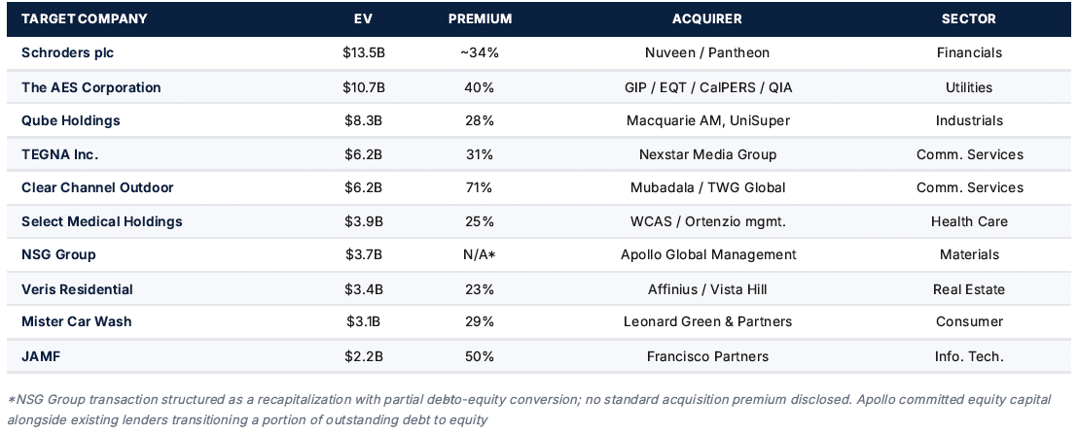
The wide premium dispersion stems from fundamentally different acquisition rationales. Clear Channel Outdoor's 71% premium (Mubadala Capital and TWG Global, $6.2B) was a recovery play; the stock had traded down to $1.42 in October 2025 before deal rumors emerged, and the $2.43 offer price still represented a modest multiple on normalized EBITDA. AES Corporation's 40.3% premium (GIP, EQT, CalPERS, QIA, $33.4B enterprise value) was a strategic infrastructure consolidation, with the consortium paying up to lock in AES's 11.8 GW of contracted clean energy supply ahead of anticipated US power demand acceleration. By contrast, Veris Residential's 23% premium (Affinius Capital, $3.4B) and JAMF's 50% premium (Francisco Partners, $2.2B) were orderly take-privates of businesses trading below intrinsic value, marked by disciplined pricing without distress.
Nuveen's £9.9B acquisition of Schroders, executed through its Pantheon subsidiary, was the landmark financial services take-private of the quarter, creating a combined asset manager with nearly $2.5 trillion in AUM. The 34% premium to Schroders' February 11 close signaled the board's confidence in the strategic rationale rather than any distressed valuation dynamic.
Two structural observations emerge from the Q1 2026 take-private data. First, public-market valuations in several sectors — Communication Services, Real Estate, specialty Consumer — remain compressed enough relative to private-market multiples that sponsor-led take-privates are an attractive entry point for sponsors with dry powder and conviction. Second, the scale of consortium-led infrastructure take-privates (AES at $33.4B enterprise value) marks a step-change in sponsor appetite for long-duration, regulated, power-exposed assets. That thematic deployment — pension plans and sovereign wealth funds alongside PE infrastructure specialists — is likely to continue through 2026 as demand-side signals from AI and data center buildout strengthen. Dakota expects take-private count to normalize toward the 30-to-40 range per quarter as financing conditions ease, with premium dispersion remaining wide as sponsors price individual situations on their merits rather than a market-wide premium benchmark.
Sector breadth across the Q1 2026 take-privates was notably wide: the top 10 list touched Financials, Utilities, Industrials, Communication Services, Health Care, Materials, Real Estate, Consumer Discretionary, and Information Technology. No single sector dominated, contrasting with prior quarters in which technology or consumer retail take-privates have clustered. This dispersion reinforces the read that sponsors are pricing individual situations rather than chasing sector themes — and that the take-private channel is functioning as a broad-based alternative to primary M&A across every major part of the public-company universe. The participation of sovereign and pension capital alongside sponsors in the quarter's largest transactions (AES, Qube Holdings) also suggests that the shape of take-private consortia is evolving toward multi-stakeholder structures better suited to large-scale, long-hold infrastructure and regulated assets.
LOOKING AHEAD
The Q1 2026 data reveals five structural signals with direct implications for deal activity through the remainder of 2026. Each represents either a constraint that will need to resolve or a tailwind that will compound. Taken together, they suggest a market that will continue to favor sponsors and acquirers with scaled platforms, disciplined underwriting, and access to the operational resources required to execute complex add-on and carve-out strategies.
-
Add-on concentration will continue to rise: Add-ons at 54.2% of all PE transactions represent a structural, not cyclical, shift in how sponsors deploy capital. Platform formation in Q1 seeded 236 new platforms, each of which will generate bolt-on demand over a three to five year horizon. The add-on pipeline is self-reinforcing: more platforms in market means more acquisition targets being sourced and qualified. Expect this channel to remain the dominant driver of PE deal volume through the remainder of 2026.
-
Corporate carve-outs will remain a reliable supply channel: Corporate divestitures expanded 23.4% to 137 transactions in Q1. Activist pressure, board-led portfolio simplification, and cost restructuring programs at large-cap companies are producing a steady flow of non-core asset sales that is structurally less sensitive to interest rate conditions than primary buyouts.
-
Exit pressure will intensify as the IPO window remains narrow: PE firms completed 115 exits for approximately $67.8B in Q1, with strategic sales and secondary buyouts accounting for 79% of exit count and no meaningful IPO activity among the top exits. With LP distribution pressure building across the industry as deployment continues to outpace distributions, expect continued GP reliance on sponsor-to-sponsor transactions and strategic sales — even as those channels face their own pricing and competition constraints.
-
Health Care and Information Technology will drive sector leadership: Both sectors registered accelerating deal counts against a market that was otherwise broadly flat or declining. IT Services add-ons surged 188%, Health Care Providers add-ons expanded 156%. These sub-sector signals suggest that the operational thesis — scaling distributed service platforms through acquisition — is reinforced by both sponsor preference and strategic acquirer scarcity, pointing to continued competitive tension in those spaces.
-
Infrastructure as PE's dominant growth vector: The clustering of Q1 capital in energy infrastructure (AES, $33.4B EV), communications infrastructure (Clear Channel, $6.2B), and digital infrastructure (ST Telemedia GDC, $5.1B) marks a structural reorientation of PE deployment toward long-duration, asset-intensive businesses anchored to AI and data center power demand.
Looking further ahead, three second-order effects bear watching. First, the gradual easing of financing conditions should unlock primary buyout activity at the large-cap end of the market, potentially releasing deal backlog that has been sitting in sponsor pipelines since 2023. Second, sustained strategic M&A momentum — if Q1's pace continues — will pull public-company boards into active portfolio reviews, producing a secondary wave of carve-out supply. Third, sponsor dry powder remains historically elevated, and the combination of deployment pressure and selectivity means premium assets in the right sectors will continue to attract robust competition, while average quality assets may languish. Dakota will continue to track these dynamics across its Marketplace database, with the Q2 2026 update publishing in July.
DAKOTA MARKETPLACE
Dakota tracks every private equity and M&A transaction in detail, including the deal type, target, buyers, sellers, sector, industry, geography, and announced date. When a company is acquired, a platform is built, a carve-out is completed, or a fund makes an exit, Dakota captures it and puts it in front of you.
Dakota is a financial, software, data and media company based in Philadelphia, PA. Dakota's flagship product, Dakota Marketplace, is a database of LPs, GPs, Private Companies and Public Companies used by thousands of fundraising, deal, and investment teams worldwide to raise capital, source deals, track peers, and access comprehensive data, all in one global platform.
For more information, book a demo of Dakota Marketplace here.