Robert Morier: Welcome to The Dakota Live Podcast. I'm your host, Robert Morier. The goal of this podcast is to help you better the people behind investment decisions. We introduce you to chief investment officers, manager research professionals, and other industry leaders to help you sell in between the lines and better understand the investment sales ecosystem. If you're not familiar with Dakota and our Dakota Live content, please check out our website at dakota.com.
Before we get started, I need to read a brief disclosure. This content is provided for informational purposes and should not be relied upon as recommendations or advice about investing in securities. All investments involve risk and may lose money. Dakota does not guarantee the accuracy of any of the information provided by the speaker, who is not affiliated with Dakota. Not a solicitation, testimonial, or endorsement by Dakota or its affiliates. Nothing herein is intended to indicate approval, support, or recommendation of the investment advisor or its supervised persons by Dakota.
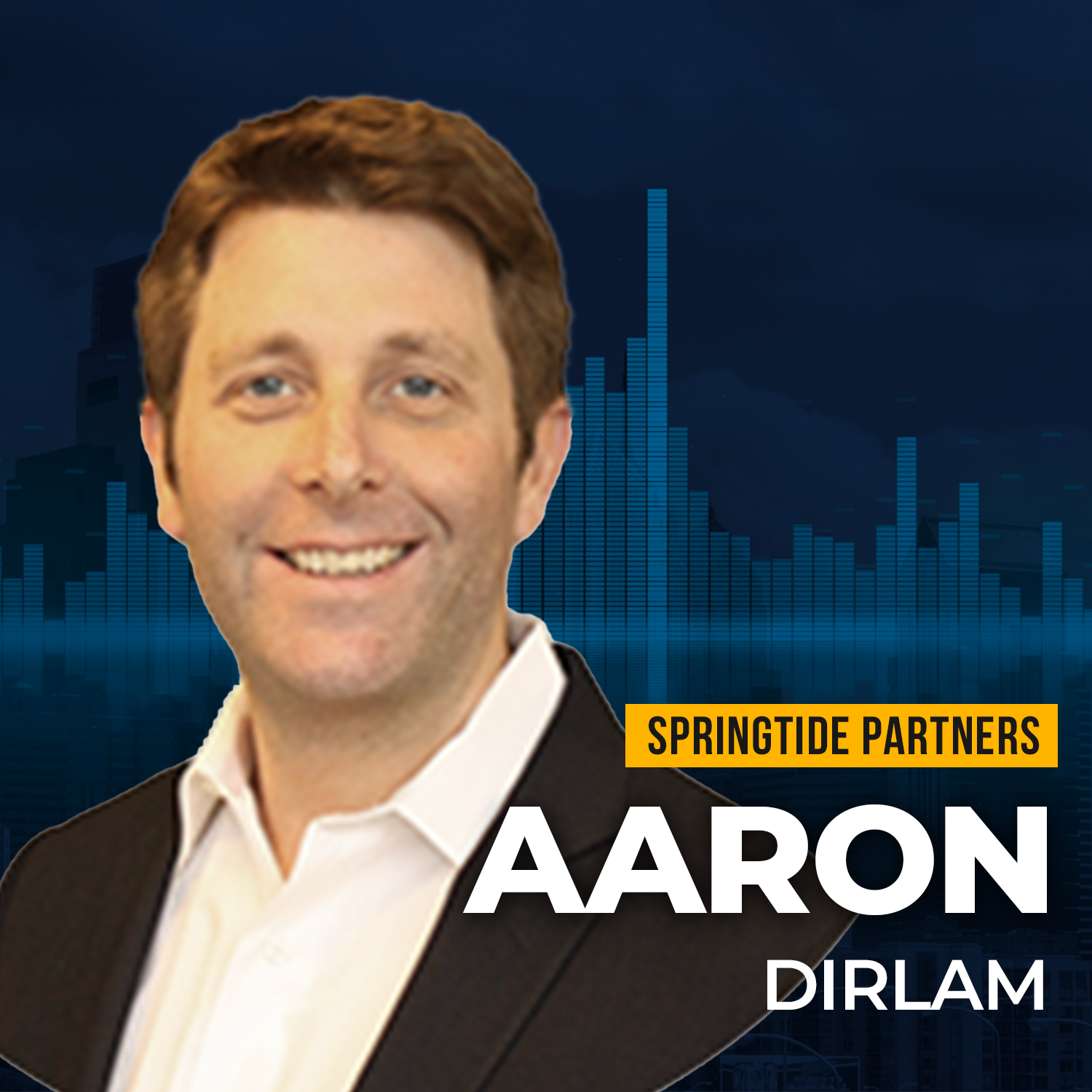
Today's episode is brought to you by Dakota Marketplace. Are you tired of constantly jumping between multiple databases and channels to find the right investment opportunities? Introducing Dakota Marketplace, the comprehensive institutional and intermediary database built by fundraisers for fundraisers. With Dakota Marketplace, you'll have access to all channels and asset classes in 1 place, saving you time and streamlining your fundraising process. Say goodbye to the frustration of searching through multiple databases and say hello to a seamless and efficient fundraising experience. Sign up now and see the difference Dakota Marketplace can make for you. Visit dakotamarketplace.com today. On this week's episode, we are joined by Aaron Dirlam, co-founder and chief investment officer of SpringTide Partners. Aaron, welcome to the show.
Aaron Dirlam: Thank you for having me. Excited to be here.
Robert Morier: I'm excited to see you. It's been a long time. We were just talking about the last time we had a meeting together. It wasn't as informal as this. It was a little bit more formal. I was representing an asset manager. You were in a very different office space. So congratulations on all your success and the growth to date.
Aaron Dirlam: Thank you very much.
Robert Morier: You're very welcome. Well, I'm going to tell the audience a little bit about SpringTide and about your biography, and then we'll get started.
Aaron Dirlam: Great.
Robert Morier: SpringTide is a boutique investment firm dedicated to delivering forward thinking ideas to family offices and advisors. In addition to outsourced CIO discretionary services, the firm provides customized solutions such as approved investments, asset class research, portfolio design, and risk management. As co-founder and chief investment officer, Aaron Dirlam oversees the investment process at SpringTide. Aaron works with the rest of the investment team in determining the appropriate asset allocation for client portfolios, monitoring investment managers currently working with SpringTide clients, and conducting research to identify and select new investment managers. Aaron is also responsible for monitoring markets for emerging trends or developing risks that may impact SpringTide clients' portfolios. Prior to launching SpringTide in 2017, Aaron was director of research at Altair Advisors. Prior to joining Altair in 2005, Aaron was a senior investment analyst at Vogel Consulting, a multi-service family office. He has also worked at Harris Associates, where he was a senior associate. Aaron is a CFA charter holder and has earned the CAIA designation. Aaron graduated from Lake Forest college with degrees in business and psychology, and he is a member of the CFA Society of Chicago. Aaron, congratulations on all your success. Thank you again for being here. It's really a pleasure.
Aaron Dirlam: Thank you. It's been quite a journey.
Robert Morier: I can imagine. Well, take me all the way back. So you're sitting in Lake Forest College. You're thinking about your career. You're studying business and psychology. What was the thought process then? Was there a thought process, or did you just want to get out?
Aaron Dirlam: No, there kind of was. I had always been interested in investments and markets, and in fact, and I don't say this often, but in seventh grade, I did a stock market camp over the summer. And at the end of it, we went to a broker dealer, and we were able to buy $100 worth of stock. And I bought… I think it was a couple shares of Pfizer because 1 of my friend's dads worked there.
Robert Morier: That's amazing. I'm trying to imagine what your letters home looked like to your parents when you were at overnight stock camp. Dear Mom and Dad, Pfizer is doing very well. I bought it at a dip, and it's continued to appreciate since she dropped me off at camp.
Aaron Dirlam: Yeah, yeah. And I would watch it every day in the newspaper. That's how old I am. It started going up it felt like every single day, and that was because the little blue pill was being developed and going to market.
Robert Morier: I love that. Well, thank you for sharing that. That's a great story. You had a very successful career leading into SpringTide, but what was that spark? I'm always curious. I teach within the school of entrepreneurship at Drexel University, and we try to teach that mindset to students. How did you develop that mindset in addition to what you were doing over the years in those various firms and even in your studies?
Aaron Dirlam: So I guess I come by the entrepreneurship because both my dad and grandparents and brother were entrepreneurs before me. So I have a little bit of that gene. But I would say that the experience at my previous firm, Altair, really formed that in a few different ways. 1, in 2005, I hired my co-founder, Paul Courtney. At the time, we didn't realize that we'd be working together so many years later. And then also, the firm encouraged people like me to think and act like an owner. I think when you have that mindset, it also kind of triggers, hey, what I do if this was my firm or if I had my own firm? And as I got to be 40 years old and Paul and I wanted to continue to work together and maybe do things our way, which wasn't a huge departure, but get out there and have some different experiences, meet new people, the challenges, get outside your comfort zone, every day being a research analyst, then have to do business development and other things. So that combination of all of those element’s kind of formed, and that's how we got to springtime.
Robert Morier: That's excellent, and now I'm realizing we could do a whole podcast just on this. I'm curious. 2 follow-up questions… we talk a lot about the characteristics of selecting or finding a co-founder. What were the characteristics that you saw in Paul when you hired him and then decided to launch SpringTide together? What were those… what were those character traits that you saw and wanted to work with?
Aaron Dirlam: Well, I'm a firm believer that you should hire people that are smarter than you. So when I met Paul and over the course of working with him for that decade there, that was clear but also the passion for markets and the willingness to walk in every day, even though we may have experience today, the willingness to walk in and try to learn something every day. And that combination along with Paul's sort of contribution to culture in terms of a research team, all of those factors, I thought, made us a good team and a good partnership. And that was 1 of the early risks for our firm is does the Paul and Aaron story resonate because we had no track record and things like that and then going from there.
Robert Morier: What was the problem that you and Paul were looking to solve when you started the firm? So when you looked at what was happening in the market at that time, what did you see as the opportunity? What did you see as the problem that clients were facing that you could satisfy?
Aaron Dirlam: The research team, research groups, I think are often within firms viewed as a cost center and so therefore may not get all the resources, databases, things of that nature that is ideal to have a robust research team. And then also, going being at a firm for over a decade, you see the evolution, and you see the challenges and opportunities and investment problems that need to be solved over time. And thinking about that in terms of the entire marketplace, we really thought that we could bring solutions to firms that otherwise wouldn't be able to do it if they tried to do it in-house because it was… and the easiest example would be, say, alternative investments. If you're going to do alternative investments and have a program, a structured program, that takes people and networking and experience and other resources. And for a lot of firms out there, they may not be willing to devote all of that to their business. And so from our standpoint, being a virtual team where you can plug into certain solutions that your firm needs, we thought was a compelling opportunity.
Robert Morier: Can you tell us a little bit about the evolution of the business? We were joking around about the offices… that clearly, the office space has gotten bigger since we last saw each other in person. How else has the business evolved over the years?
Aaron Dirlam: I guess the business has evolved in a few different ways pretty materially. 1, I would say, just with clients alone, we do not have a dedicated business development person. As you can probably tell from me talking about the firm and things, we're not polished salespeople, if you will. But we did understand that firms have unique challenges, and when you know 1 RIA or 1 family office, you know 1. And so how we've evolved is being very customized and collaborative. We knew that from the beginning but depending on who became our clients and things of that nature, that's forced us to evolve in certain ways that we maybe didn't previously. From a people standpoint, we never really had envisioned having a Cape Town office with 4 analysts there, but I can tell you that it has been a huge benefit to the firm and our clients in a number of different ways, first being just they're very talented, passionate analysts that are in that office. And secondly, it's allowed us to have turnaround times for projects go much quicker. So if we get a request in the afternoon from a client in the US, our Capetown team can work on it and have it to them in their email box in the morning.
Robert Morier: Oh, that's interesting. In addition to that international footprint, what has shaped the development of the client book? So when you think about RIAs versus family offices, what is that client mix look like?
Aaron Dirlam: I'll maybe put it into 3 buckets if that's ok. We have the traditional RIAs, which I would say is about 2/3 of our business. Single and multifamily offices represent another… now I got to do math in my head… maybe like 17%. And then the remaining piece are banks and financial institutions.
Robert Morier: Can you disclose the assets that you're advising under management?
Aaron Dirlam: We have to preface it by saying a couple things. 1 is that it's an obnoxiously large number. We don't have discretion over those assets. So the amount of assets that our 30 or so research clients have would be in excess of $80 billion.
Robert Morier: Well, congratulations again on all the growth. It's really incredible, and it's a great story to tell. And I'm glad we're having the opportunity to do that here on the podcast. So thank you. Question I was thinking about when I was putting this together, having conversations with you in the past, is has the mean reversion thesis which was core to SpringTide's identity, has that been strengthened since those days when I was first sitting down with you? Has it been refined over the last several market cycles? So when you're starting with 1 of those prospective clients and your kind of talking about the evolution not just of the business, but of the way that you look and view at investment opportunities, what does that evolution look like?
Aaron Dirlam: From a manager perspective, they have shown through and been strengthened. Examples would be doing international value in 2018, in kind of later 2022, large cap growth, aggressive large cap growth managers that had really underperformed, and more recently, small cap managers. And I think when we start a new engagement with clients, there's always some pain points there, whether it's content or whether its certain managers underperforming. And I think the mean reversion framework has really helped because a lot of times, clients are struggling with, do I get rid of this manager or don't I. And we give some fresh perspective certainly from a qualitative standpoint. That's the most important. If the qualitative elements are still intact, we think that the performance will mean revert. And so I think it's helpful for a couple reasons. 1, that mean reversion can be pretty powerful. So that underperformance flipping to you outperformance can really enhance the initial kind of experience clients have with us. And then I would also say when we have managers on our approved list that have looked really good for the last 3, 5 years, and a new client asks about it, we try to temper expectations or maybe point them in a different direction or keep their existing manager until that mean reversion comes into play.
Robert Morier: So do you have to lean back on that psychology degree, then, when you're talking to clients about ignoring the best performing manager and take a look at that median manager? It's better than you think?
Aaron Dirlam: Absolutely. In fact, we do a lot of educational content for our clients, and 1 of them is a behavioral finance packet.
Robert Morier: I'm sure they enjoy that. I know my students do. It's always the most… usually the most highest attended… when we're talking about the thought behind how we make these decisions or choose co-founders or identify problems, whatever it is. Well, thank you for sharing all that. I appreciate it. Another thing that's really interesting to me about this conversation is that you entered the OCIO, the outsourced CIO market, before this explosion of RIA adoption. What were the defining characteristics in the OCIO market then back in 2017 when you launched the business versus where they are today? So if you could compare and contrast for our audience because we have spoken to quite a few outsourced CIOs over the last 12 months. There's no shortage of them. There's no shortage, it seems, of the growth of that segment. So we would love to hear your insights having success in it.
Aaron Dirlam: Yeah, so I firmly believe that the environment that when SpringTide started back then was we were going up against a lot of larger, more institutional consultants’ sultanates that if the prospective client had been using OCIO before, it was really a much larger firm that was more of pension oriented. And I think what we at least… and this has been our experience in gaining traction with those types of clients has been that Paul and Aaron grew up in an RIA. And so we kind of understand the communication that needs to happen, the cadence of materials, the handholding, all of those resources for an RIA. So I think when people looked at SpringTide, in some ways, we were better suited for them given the focus that we had had earlier in our careers. As that's evolved more to today, you're right. The competition has just only increased, which certainly keeps us on our toes. I think 1 thing that's important to our culture and the fabric at SpringTide is that the way we ran through walls for early clients and the scrappiness, that I think still holds true today and is going to be a reason, a key reason, for continued success that we will always grind, grind for our clients, in any way we can from an investment solution standpoint.
Robert Morier: Do you believe that client service expectations have changed?
Aaron Dirlam: Yes, and I think that it's twofold. Really, I would say that in the midst of COVID and coming out of COVID, we think that that was really when our business took off. We had been around for 3 years prior to COVID, and with 2 guys in a windowless office and starting off with the same number of clients that we had windows, zero, we had the staying power during COVID of people who had talked to us in the few years prior and then coming out of that and seeing the content and the high touch elements to our business, which we thought was important in differentiating SpringTide from other more established firms is that from a client service perspective, you have Paul and Aaron's cell phone numbers. And we're structuring the business such that Paul and Aaron's time is spent as much as we can on investment research and client service, which is the majority of our time, that we can satisfy those needs or the environment that kind of COVID brought about. And even since COVID, I would describe the environment as so fluid that client service is a really important part of our business.
Robert Morier: What are clients asking you today that they were not asking you during those COVID years? So during that 2020, 2021 time period, what questions have increased or continued to creep into the conversation?
Aaron Dirlam: 2-fold. 1 would be thematic or tactical or opportunistic investment ideas. We call them tactical, but others would call them thematic or opportunistic and really just kind of where capital has had maybe fled and was creating opportunities. And then the second would be a significant increase in the demand for alternatives and private market recommendations.
Robert Morier: Dakota's Google Chrome extension lets you access all of the high-quality LP, GP account and contact information as well as private company, public company, and more, all of that data that you've grown to and love within Dakota Marketplace right from your Google Chrome browser. This way, as you're browsing, researching, prospecting, or looking for the newest deal target, you'll have all of the high quality and curated data that you need to do your job right there in the same window. You can learn more today on our website at dakota.com. I'm not going to ask you your competitive edge, so I'm going to ask you which question you think yields more results. Is it more beneficial to ask a potential asset manager whether they deserve a seat at the table, or do you think it's more beneficial to ask them what their edge is relative to their competitors?
Aaron Dirlam: The edge question is the more important 1 to ask because how they respond is usually the tell. And it's usually that first impression, just the entire conversation in a lot of ways. The seat at the table in our mind has already been decided based on how they've structured their firm and the alignment of interests there because that's kind of fairly black and white to us.
Robert Morier: Well, I'm going to apologize because you teed me up. What is SpringTide's competitive edge, then?
Aaron Dirlam: It's ingrained in what we want our investment process to be, which is objective, disciplined, and humble. On the objective side, we are indifferent to whether it's passive or active. We just want to make the best decision for that asset class for that time for our clients. The disciplined element to it is having a process and having a structure in place that we can always fall back on that's non-negotiable, so we don't get into sort of thesis creep with any of our managers or any of our decisions. And then the humility part is we have to transact at whatever the market price is today. So the market is always right today. But having that humbleness to not get over our skis on certain investment decisions is really important, and it's probably the most difficult over time to try to maintain. But that's probably why we write and talk about it a lot. So we're always constantly thinking about it.
Robert Morier: Do you think about it during your manager research due diligence as well? Do you… it sounds strange to ask it this way, but do you screen for humility?
Aaron Dirlam: Yes, and that is done in a couple of different ways. 1, it's a very qualitative assessment of how they've structured their business. I think you can also look at it from a historical performance perspective. We would probably say that more often than not, the most humble managers that we are ones that usually generate more consistent performance. That's not to say that they don't underperform, but to borrow a term from the '80s, the 1 hit wonders in our view are managers that typically are on the lower end of the humility scale, if you will. And then it's how they answer questions. It's how they talk about mistakes. It's how they talk about successes. It's how they talk about other people at the firm. And hopefully, after doing this for nearly 25 years, we can pick up on those things in the initial conversations we have with managers.
Robert Morier: That's interesting. Aaron, thank you for sharing that. I appreciate it. Digging into the manager research side of the process, you talked about the qualitative assessments. How has that qualitative and quantitative balance evolved? Are you looking at more data. Are you spending more time on that human nuance that you just described in the context of humility?
Aaron Dirlam: Yeah, I think from a data perspective, that's been fairly consistent over time in terms of the type of data points and the number of data points that we look at. The qualitative assessments part of our process is becoming more and more important for a variety of reasons. But the one that I would mention that I think is the most important is the succession of firms and portfolio managers going to the next generation, that with portfolio managers getting up there in age, especially given our approved list, our turnover is maybe 10%, 15% a year. Making the decision of is that manager still as hungry and as focused as they were maybe 3, 5 years ago, that's really important to us because that will tell a lot about potentially the experience going forward or if we need to find another manager because certain dynamics have changed.
Robert Morier: Could you describe the road to your high conviction list? So talk to us about that journey for an asset manager. So let's say that they've screened through at this point. From that screening process, what does that road to high conviction look like?
Aaron Dirlam: Usually, that road means that they're on our curated peer group list, which may include, say, 15, 20 managers for a given asset class. Candidly, some of the managers included in those curated peer groups are managers that we would never invest in, but we want to see how they perform over time and see if there's something we can learn from what they're doing. Once we've once, we have a need for either a new manager or replacing 1, it's really going back to them from a qualitative perspective and refreshing that element of it. And then from there, they can get on our approved list. But I would say that we're very open-minded to managers that have 15-year track records to managers that have 1 year track records. I think 1 thing that the team has done a very good job of over the years is identifying boutique managers early on in their life cycle that not only have been able to generate pretty attractive relative returns but have grown into their life cycle where they're more established and mature and that more of our clients are open to using them.
Robert Morier: Would you mind telling us a little bit about the team? How is the team constructed? What does coverage look like? Are we generalists? Are we specialists?
Aaron Dirlam: It's a team of 7 analysts, and we put myself and Paul in that category. We are doing a lot of research as well. We're not just rubber-stamping ideas from the analysts. We very much believe in a generalist type of structure for a few different reasons, and that's across asset classes. That's across liquid, illiquid. And we do a fair amount of tactical and macro work, and that is also spread across the analysts for a few reasons. Being a smaller firm and needing to be very dynamic, we need to, as we encounter investment problems or what we see as investment solutions, we need to be able to tackle those as quickly and as efficiently as possible. So whoever has capacity at that time would take on a certain project. We also didn't want to get into situations where say we had someone just focused on real estate and that they're constantly pounding the table for real estate to justify their existence at the firm. And I bring up real estate because real estate's been an area since we launched SpringTide that we haven't had a ton of exposure to. Now that's increased kind of starting in 2022 and forward. But we really believe that having well-rounded analysts across asset classes and disciplines would be more beneficial for our firm than say, very siloed, like maybe some larger firms have.
Robert Morier: Put us in the room with you. It's the first time you're meeting a manager. We're in your offices. It's an asset class that you've been doing work on. So all of that kind of pre-operative time and effort has been put in. What are you hoping to glean from that first meeting? What questions yield the most results for you and where do you find the information is most impactful to take it to a second meeting?
Aaron Dirlam: So I would say our first meetings with managers, we are asking at maybe the first 2/3 of the meeting very open-ended questions to see where they take the conversation. That's important to us because that gives a sense of what they… gives us a sense of what they believe is important. And those obviously need to be aligned, our views on that and their views on it, whether it's how they've structured the business or the strategy or the team. From there, the last maybe 25% of the meeting is asking more targeted questions to their business. So it's important for us to have done a decent amount of work on the manager, probably more than you would think, so that we can dive into some very specific either issues or questions or opportunities and be well versed in what their response should be to gauge, again, just if this is a manager that we would want to work with. And then from there, I think we have a pretty good idea, usually from that meeting, if it's something that we want to pursue immediately, if it's something that we think is interesting enough to do more work on and put it in our curated peer group, or if it's something that we're just not interested at all.
Robert Morier: How about the other side of that barbell? So on 1 side, we're talking about sourcing, screening sourcing, the first meeting, what you're looking for all, which is very insightful. I assume your due diligence process will go through what we hope are the standard… I don't want to call it a checklist because it's more robust than that. But as you get towards the end of that process, is there a final pitch? Does that exist with your clients? Are you introducing the manager to some of your larger relationships? Or is the final destination the high conviction list?
Aaron Dirlam: Yeah, the final destination is the high conviction list. So we're different from, I think, other OCIOs in that we're not going to have 4 or 5 large cap growth managers on our approved list. And we're very upfront with prospects on that element. So there are no surprises. But that's who we are. We'll certainly monitor a client's approved list of managers or things like that. But from our standpoint, we think it's better, more accountability and transparency by having a shorter list. But we are making those decisions. So we're not kind of bringing them to clients for a final’s presentation, things like that. I don't even think… we don't even really have a finals presentation. We have maybe a last meeting to answer kind of any follow-up questions so that we can make a decision we're doing at our level, I guess.
Robert Morier: For your peers that are listening in… CIOs, manager research folks… how do you construct portfolios? So thinking about the portfolio construction process now, how do you construct portfolios that reflect that mean reversion philosophy that we talked about earlier in the conversation?
Aaron Dirlam: In our view, sort of an unconstrained mandate for us would be that we can deviate from the strategic portfolio based on mean reversion happening in certain asset classes… so, overweighting or underweighting, whether it's equities or fixed income, or within those various asset classes or elements like duration and fixed income, credit quality and fixed income, or within equities, small cap, large cap, US… starting with the strategic framework in mind, tweaking off of that. And so I would say that there's some situations where we'll have passive investments for a period of time to wait for mean reversion opportunities within active managers. I would say that's been 1 thing in large cap S&P 500 exposure until around 2021, where we started branching off and doing some more rules-based approaches that avoided the market cap, portfolio construction, as well as certain asset classes going in and out of favor kind of on a rapid basis, just given how fluid markets have been since COVID.
Robert Morier: I'm not going to ask you about the democratization of private markets with RIAs. I think that's been well-covered in the press, and it's been well covered by other podcasts as well. So, more specific to SpringTide, how have you evolved your private market toolkit in the years post-COVID?
Aaron Dirlam: Just a few things. Maybe at a high level, we are very opportunistic in that area. We do not believe in vintage year diversification. We don't believe in owning, say, real estate through every market cycle 100% of the time. And so from a qualitative assessment, these types of investments need to fit into 1 of 3 categories. First, something that we're early on, that we think we're early on, and that's admittedly a SpringTide view. But examples would be crypto and blockchain back in 20 2017, 2018. The second element would be a very contrarian approach, and I think that's where we viewed real estate is that it wasn't attractive for several years. And as there's been issues in commercial real estate in the last few years, we've started allocating more capital. Another example would be doing stressed or distressed credit. Back in 2019, not because we knew that COVID was around the corner but just some of the fundamentals within the business cycle and markets led us to allocations there. And then finally, an inefficiency that we think a manager or strategy can take advantage of, and that's probably admittedly the most fuzzy 1 of our 3. But we communicate to clients if it's or… right now, I would give an example of sports franchises. A lot of opportunity there, we think, with really compelling business models. The interval fund space and the evergreen fund space has been 1 that we've spent a lot of time on. Our view coming out of COVID is that we did not want to own legacy funds. We did not want to own well-established funds, particularly in the areas of real estate and private credit. The view was is that we did not want to take on those issues. The late rapper Biggie Smalls, he had a song, "Mo Money, Mo problems." And so we really focused on funds that were launching, participating in the seed class in some instances. And so we had to get clients comfortable with doing an investment vehicle that the manager had never had before but relying on other strategies and drawdown funds to evaluate their performance. In some ways, that was very environment specific. I don't know that we would always have that view, but that's the view we've had the last several years coming out of COVID.
Robert Morier: That's helpful. Thank you for sharing those 3 criteria for privates in particular. It just begs the question where private credit sits in that. Is it too late? Is it… I wouldn't say it's contrarian. It might be contrarian, actually, to stay in it right now because everyone's talking negatively about it now. That's changed very quickly. So we'd love to hear your views on private credit.
Aaron Dirlam: Yeah, so private credit, we were doing primary and private credit in an evergreen fund and some drawdown funds. On the evergreen side, we decided to redeem from the manager a few years ago. That's because everything had gone really well. They had scaled, which we think is important for Evergreen funds to sort of be constantly growing. And they hadn't stubbed their toe on performance. We view a mistake as being getting gated in 1 of these funds. So we try to set the table with clients that even though you should be getting intermittent liquidity, whether it's quarterly, if you wanted, think about these investments as rolling 3 year type of investments so that if we do get gated, then we don't have issues in the asset allocation as it relates to liquidity or illiquidity. We got out of that fund, and we kind of sat on our hands for a bit. And then we decided about a year and a half ago to do a private credit secondaries fund. And that's our only private credit recommendation right now. We were intrigued by the fact that you could get a first lien senior-secured basket of loans at a, say, 10% discount to net asset value. We had done some secondary funds in '22 as it related to real estate and venture because of the issues going on there. But we felt that the better opportunity set within private credit was in the secondary market also because the manager who does this has some insights into how those loans are performing because they're kind of… they've been going for maybe 2 or 3 years. So you can really underwrite the current state of the business and decide if that's something that you want to own. We probably would go back to primary private credit at some point, but we just think the risk-return is really compelling in secondaries. And maybe if I could go off on a tangent, 1 of the reasons why we think that the Fed was able to raise rates so aggressively when inflation got out of control and not create a recession is that typically, when they do that, bank lending pulls back and it goes negative. Bank lending did indeed pull back during that time. But what continued to grow massively were assets under management by private credit managers. So even though banks were pulling back on lending, you had this sort of massive influx of loans continuing to private, middle market type of companies. And we think that that was a main reason why we were able to sidestep a recession even though interest rates were increasing dramatically.
Robert Morier: For years, legacy data providers have made private fund performance benchmarking complex and expensive. That's why we launched Dakota performance and benchmarks, the first ever benchmarking platform built by people who are using the data themselves every single day. We've made our benchmarking affordable, customizable, and very, very easy to use. You can log in to Dakota Marketplace today to start creating your own benchmarks and viewing our benchmarks, or you can learn more and book a demo at our website at dakota.com. So I am curious. What is early right now for you and what is contrarian?
Aaron Dirlam: Would say what's early, and it's not because these businesses are new or anything, but the ability of private equity to invest in sports franchises across whether it's Major League Baseball, the NHL, more recently the NFL, and even overseas with soccer and, say, Formula One. The reason why I think that's sort of early is that owners are getting older. Their cap tables have a lot of nuances to it. You really don't get a lot of liquidity unless you sell stakes. And so the fact that kind of a partial liquidity window is opening for these businesses and that we can have access to it we think is really compelling because these businesses, by and large, don't have a lot of leverage. So that we don't have to avoid or we don't have to endure a situation where businesses are overlevered. And we do believe that the kind of liquidity providers will expand over time and that that is our liquidity from our investments is down the road in 5, 7, 10 years, selling to whether it's more retail versions of funds. But we do think that is very compelling and what we would describe as being early on. So we've done now this twice with venture capital. If you look at capital raising within VC, maybe outside of AI, fundraising is back to kind of 2014, 2015 levels. That's when we first started doing venture capital investing. The tech bubble had basically wrecked venture capital returns. And so people had kind of avoided them for a while. And underlying our views is being a liquidity provider. So if an asset class is not raising money and we find it compelling, that's an area that we think is contrarian. And I would also say real estate just as a function of us not having really any real estate exposure until 2022. It first started with doing secondaries in the real estate market, then doing a triple net lease evergreen fund, and now looking at student housing. We've done student housing more recently. I think eventually, we'll get to the core sectors within real estate, such as office and even multifamily. But right now, we're seeing a tick up in multifamily delinquencies. And so we're not there yet. Office, we still see some issues and all of that. And so that will evolve over time. But at least from a real estate perspective, sort of non-traditional sectors is the area of focus right now.
Robert Morier: Diving a little bit more specifically into the venture capital, will you approach that allocation through direct managers and then build out a multisector portfolio, or would you consider fund to funds?
Aaron Dirlam: Definitely fund to funds, particularly as it relates to venture. The access is so you critical. On our own, we don't have access to Andreessen Horowitz or Kleiner Perkins or Excel or those. But through a fund of funds manager we've been using for almost a decade now, we do have that access. It's fairly concentrated, and then it's around 10 managers. And we believe that… and we've experienced this, thankfully… that the extra layer of fees is worth it, and we're able to drive returns that are not only compelling relative to other venture funds, but also what we think is important, too, in evaluating illiquid managers and strategies is that they're able to give us a spread above their public market equivalent. If we've invested in a fund that at the end of the day gives us the same return as, say, small cap stocks, IWM, or whatever that's cheap beta in public markets, that's a mistake from our standpoint even if the returns are positive.
Robert Morier: We're talking about private markets, but just really quickly just 1 question on public markets as it relates to hedge funds. Would hedge funds be considered contrarian to you right now, or do you believe that there is a static case for hedge funds, long-short, equity, event-driven, name the subset, within the portfolio?
Aaron Dirlam: So we view hedge funds like private markets where you don't want to own all strategies all the time, that there are certain places in time for them. And so our approved list will ebb and flow in that regard. But I would say in general, I think given the returns that hedge funds sort of generated coming out of the global financial crisis, hedge funds by and large, are more interesting to us today, given everything that's going on in the world than they were, say, pre-COVID.
Robert Morier: And again, directs or fund to funds?
Aaron Dirlam: Now, our approved list is primarily direct, but I would say that we are definitely open to the fund to funds route because of the access that we discussed as it relates to venture.
Robert Morier: All right, Aaron. If mean reversion is inevitable, where does that tide look strongest right now?
Aaron Dirlam: That's a great question. I would say that if you just look at our… I'll maybe go off our positioning. 1 area that we've been investing in from that standpoint is small and mid-cap biotech. If you look at returns, public returns over the last decade, and this is… we started looking at it probably a year and a half ago. They're terrible. And those can stay terrible. And so we have to… what is kind of the catalyst, or what is the element that switches it from not being terrible to a tailwind? And part of it was just valuations in general. But biotech, you need to have success with drugs and things like that. So it's not necessarily all about valuation. But what we believed would be the big tailwind last year was looking at large pharmaceutical companies and the patent cliffs that they faced between now and, say, 2030 of a couple hundred billion dollars and how firms would need to acquire promising drugs and businesses to fill that. And then I think as this year has progressed, what developed in the administration and things like that we also think has provided some tailwinds as well. Conversely, as an aside, we were very concerned at the beginning of the year of insurers. The pharmacy benefit managers, in fact, did something fairly unique from our standpoint in terms of making a manager change as a result of their exposure to health care providers. So, very nuanced in the space from that standpoint. I would say another kind of where the tide has gone out and it is a little bit connected to the private credit discussion, but has to do with BDCs, Business Development Corporations. As a universe, they're trading at a 20% discount to net asset value. Most of these BDCs are first lien senior secured loans. It's highly unusual to have the universe trade at a 20% discount to net asset value and really not see any stresses in the group as a whole, meaning loans going awry. I think certainly the government shutdown and the lack of economic data has created uncertainty around that. And they're very much a beta play on economic activity. Some of the tri-color first brands, like fraud/bankruptcies, have also weighed on it. But from our perspective, if we're not going into recession in the near term, these loans that are trading at $0.80 on the dollar, yeah, they may be some bad loans in there. But $0.80 on the dollar implies kind of a depression in the economy. If you think about if 20% of these businesses are indeed zeros, that means we have serious issues in the economy. So from a risk return perspective, with the yield around 12% to 15%, we think that that's a really compelling opportunity right now.
Robert Morier: We're getting towards the end of our conversation. So this is when I get disappointed that this is not a longer podcast, because we could keep talking, particularly when we're getting into that type of granularity around sector-specific strategies. So thank you for sharing. I'll end it with your relationship with Paul. So after nearly 2 decades of working together, you founded a firm together. You've navigated these interesting market cycles together, including a pandemic. What do you still look for from him when you walk into the office in the morning? What's the first thing… other than the personal stuff aside, what do you look for him to help ground you for that day ahead?
Aaron Dirlam: Well, I would say his enthusiasm for what we do at SpringTide, the willingness or constant search for more knowledge, education. Those would be the 2 main elements that I look forward to in the morning because it is a grind, starting your own business. The business aspects aside, I have 3 kids. I wanted a fourth, but my wife, she's usually right on things. And she said, well, SpringTide is your fourth kid. And she was exactly right on that. And so the reason why I bring that up is that you have to stay grounded through the good times and the bad times. And thankfully, I think we've had more of the former than the latter. But there are days when those morning interactions around enthusiasm and constantly learning and the excitement for our business, that comes from… I take that from Paul, and that's really, really helpful.
Robert Morier: 1 more question because I can't help myself. If Paul were in the room and I asked him what your biases were, what are those biases? We all have them. We come into… you may have developed some of those biases in seventh grade at equity camp. So what are some of those biases that he knows to look out for that help you hedge your decision-making process? And not to outright change it but just to incorporate the devil, the advocacy in the conversation.
Aaron Dirlam: Paul knows everything about me from an investment standpoint. We've been sitting next to each other literally for a couple decades. We've gone through the global financial crisis together and COVID, however you want to define the last few years. So he knows my biases to be contrarian, and sometimes we would say that if you're too contrarian or you're too early, you're wrong. And it gets to a question we didn't touch on. But how do you maintain a long-term focus with investments and clients when in reality, you don't have a 10-year time frame with clients, especially if you do poorly? So what Paul has been great at is understanding, say, the contrarian in me but creating processes around it that not only allow for it because we believe in it but that there are limits to how contrarian we can be. So that's either in risk controls or how we look at managers or even in final decision making, creating those guardrails so that we don't leave our core competency or our core skill set. I think he's done a great job with that.
Robert Morier: Well, if you're looking for a title to your memoir, you can call yourself The Limited Contrarian.
Aaron Dirlam: I like that. I may have to take that.
Robert Morier: Well, I greatly enjoyed this conversation, Aaron. Thank you so much for taking time with us, our audience. Thank you for staying connected to me personally after all of these years. That means a great deal to me as well. And congratulations on all of your success. I wish you nothing but more. So thank you.
Aaron Dirlam: Thank you very much and really appreciate you having me.
Robert Morier: If you'd like to learn more about Aaron and SpringTide Partners, please check out their website at www.SpringTide-partners.com. You can find this episode and past episodes on Spotify, Apple Podcasts, or your favorite podcast platform. We're also on YouTube if you prefer to watch while you listen. And for more content, please visit our website at dakota.com. Aaron, thank you again for being here, and to our audience, thank you for investing your time with Dakota.